
Climb the stone lanes of Arachova on a winter evening and when there is snow while the slopes of Parnassus darken above the town. Not far off, the sanctuary of Delphi lies on its hillside, where Greeks once came to ask Apollo what the future held.
Where is Central Greece and what is it like?
Central Greece, known in Greek as Sterea Ellada, is the southern part of the Greek mainland, leaving out the Peloponnese but taking in the offshore island of Evvia. Its coastline runs along the Aegean Sea, the Evoikos Gulf and the Corinthian Gulf, and its interior is among the most mountainous in the country, with some of the highest ground in Greece. The geographic region is wide: it covers the whole modern administrative region of Central Greece, most of Attica and much of Western Greece.
The administrative region, with Lamia as its capital, is a smaller thing than that older map. Lamia sits on the slopes of Mount Othrys and has been lived in since at least the third millennium BC, which gives you a sense of how long people have been settling this land. The highest summit in the whole region is Mount Parnassus, and it shapes everything around it, from the weather in the villages to the plates on the tables.
The character of the place is split between two moods. On one side are the ancient and the mountain landscapes: stone houses climbing a slope, tavernas serving grilled meat and local cheese, ski lifts above the villages when snow falls.
On the other are the gulf towns, where fishing boats tie up beside waterfront cafés and the pace slows to a long coffee. Galaxidi, a small seaside town, is a popular sea resort for travelers breaking the road between Patras and Delphi.
Central Greece rewards people who like to put a day together around a landscape rather than a single checklist stop. History lovers will find Delphi, Thermopylae and the museums of Athens within reach of the same trip. Anyone who wants a beach resort with a long list of organized activities will find the region more about villages, ruins and mountains than about sunbeds.
What is there to do in Central Greece?
The big reasons to come are the ancient sites, the mountain villages, the winter slopes and the gulf coast. Four themes carry most trips.
Delphi and its oracle
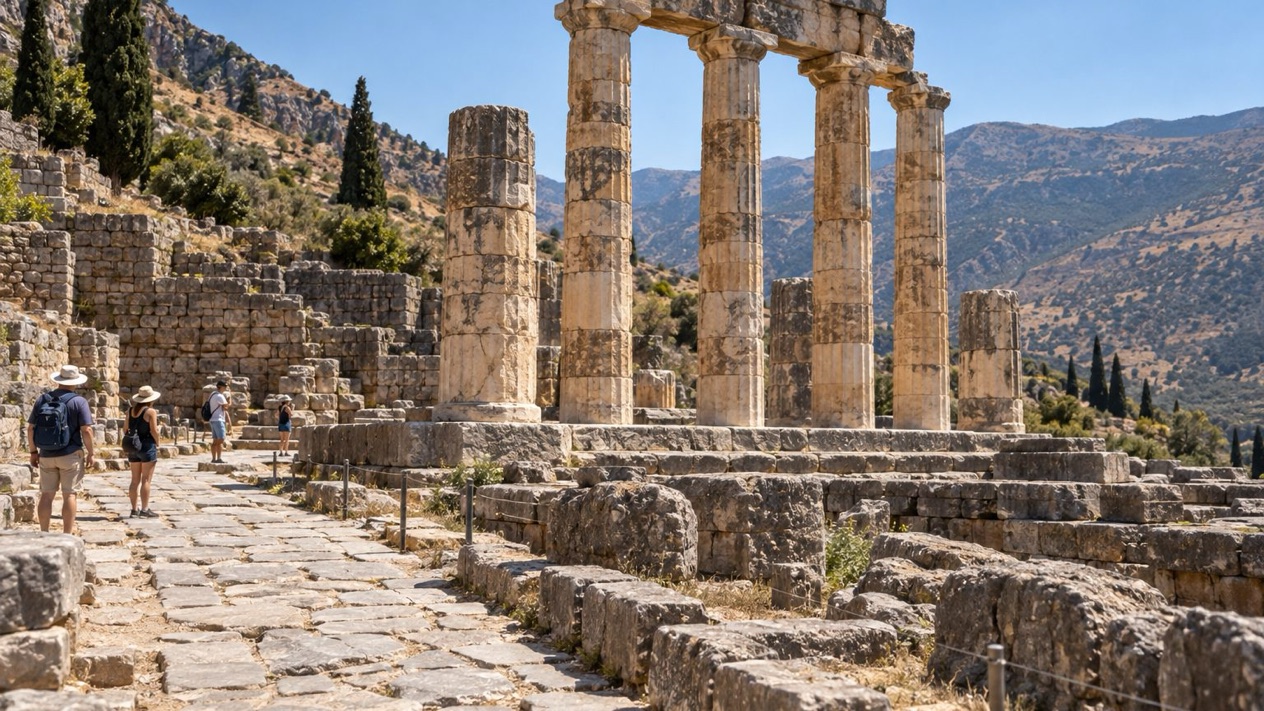
Delphi is an ancient sacred precinct on the southwestern slope of Mount Parnassus in Phocis. In antiquity it was considered the navel of the Earth, a spiritual meeting place for the Greeks and home to the most important oracle of ancient Greece, the oracle of Apollo. Today it is a major archaeological site, and the archaeological district has been a UNESCO World Heritage site since 1987.
You walk the sanctuary on a path that climbs between foundations, terraces and stones that once held offerings from every corner of the Greek world. The Delphi Museum houses the famous Charioteer, the bronze figure that people come specifically to see. The modern town of Delphi lies very close to the site along two streets of traditional small houses, hotels and tavernas, so a meal and a bed are within reach of the ruins.
Arachova and the mountain villages
Arachova is a mountain town on Parnassus, set at a height that gives the air and the views a different character from the coast. Visitors can climb 264 steps to the church of Ai Giorgis for a panoramic view over the roofs and the mountainside. The town is known for its cheese, its wine and its woven textiles, and its streets are lined with shops and tavernas that fill with locals on weekends.
A winter stay here usually centers on the Parnassos Ski Centre, which sits a short distance from the town and suits both beginners and experienced skiers. In the warmer months the same mountain becomes a base for walking, for drives between villages and for long lunches under plane trees. Arachova works as a stop in any season because it combines a place to eat, a place to sleep and a place to look out.
Athens and its monuments
Athens belongs to the Central Greece region on the traditional map, and it is the starting point for exploring ancient Greek history. The National Archaeological Museum holds the objects that bring these sites to life.
The city is also where modern Greek culture, business and social life flourish amid the ancient monuments. Between the ruins you find cafés, tavernas serving souvlaki, gyros and meze (small plates meant for sharing), and neighborhoods with their own character. A visit here pairs well with a trip into the mountains, since the contrast between capital and village is a pleasure in itself.
Gulf towns, Lamia and Thermopylae
The coast brings a softer rhythm. Galaxidi is a seaside town where travelers pause between Patras and Delphi, and Chalcis, the capital of Evvia, is home to the church of Saint Paraskevi, built by the Venetians. Lamia, the regional capital, gives a look at a working Greek provincial city rather than a resort.
Thermopylae, the pass where a famous ancient battle was fought, lies in Central Greece too, and people with an interest in military history make a point of stopping there. Seafood, grilled fish and a glass of ouzo (the anise-flavored spirit) go naturally with an evening at the water.
How many days do you need in Central Greece?
Because the region is large and its attractions are scattered, the question is less how much there is to see than how much driving you want to do. Pick a base and add day trips, or move from place to place.
With a short stay, build everything around Delphi and Arachova. You can see the sanctuary and the museum with the Charioteer, then spend the evening in Arachova climbing to the church of Ai Giorgis and settling into a taverna. If you are starting from Athens, add a visit to the Acropolis and the National Archaeological Museum before you head out of town.
With more time the map opens up. Galaxidi gives you a seaside stop with a harbor and a waterfront, and Lamia and Thermopylae add a different layer of history to the route. If it is winter, a day at the Parnassos Ski Centre can replace a day of sightseeing, and in the warmer months the same mountain invites a walk and a long lunch.
Evvia is worth adding if you want an island without a ferry-heavy itinerary, since it is the offshore island that counts as part of Central Greece. Chalcis, its capital, has the Venetian-built church of Saint Paraskevi. A longer trip might split time between a mountain base such as Arachova and a coastal base such as Galaxidi, so that the trip has both altitude and sea.
Athens deserves its own days if the ancient sites are the priority. The Temple of Olympian Zeus and the Acropolis can each fill a visit, and the National Archaeological Museum rewards unhurried time.
Where to stay in Central Greece
The main places to sleep are the modern town of Delphi, Arachova, Galaxidi, Lamia, Chalcis and Athens, and each suits a different kind of trip. Choose by what you want to wake up next to: ruins, a mountain, a harbor or a capital city.
The modern town of Delphi lies very close to the archaeological site and spreads across two streets lined with traditional small houses, hotels and tavernas. It suits anyone who wants to be near the sanctuary and the museum and to finish the day over dinner a few steps from the hotel. The setting is part of the appeal, because the town looks out over the mountain slope that holds the ancient precinct.
Arachova is the choice for a mountain stay. It stands on Parnassus at a height of about 970 metres, and the Parnassos Ski Centre lies a short distance away, which makes the town the natural base for winter visitors. In other seasons it is a good place for people who like stone architecture, local food and the feel of a village with plenty of tavernas.
Galaxidi is the seaside option. Staying here gives the trip a coastal chapter alongside the mountain and archaeological ones.
Athens is the big-city base, with the Acropolis, the Temple of Olympian Zeus and the National Archaeological Museum on its list. Many trips combine a night or two in the capital with a stay in the mountains.
How do you get to Central Greece and get around?
Travelers arrive through Athens Eleftherios Venizelos International Airport, the biggest airport in Central Greece, located in Athens. A second airport serves the region: Aktion National Airport, also known as Lefkada Airport Aktion, is one of the two airports in Central Greece. From the capital the road leads out to the rest of the region.
Piraeus is the main port for Athens, and ferries from the Greek islands, Cyprus and the Middle East dock there. If your trip includes an island, Piraeus is where the sea part of the journey meets the mainland part. Evvia, the offshore island of the region, belongs on the same map as the mainland towns.
Once you are in the region, the places to see are spread out among mountains and gulfs, so moving between them takes planning. Delphi, Arachova, Galaxidi, Lamia and Chalcis are separate towns, and the traveler who wants to see several of them will move between them by road. Inside the towns themselves, the lanes and steps are for walking, as in Arachova, where the climb to the church of Ai Giorgis is done on foot.
Athens has its own rhythm, with ancient sites, museums and neighborhoods to move among. In Delphi the site and the modern town sit very close together, so a stay in town places the ruins within reach of your hotel. Wherever you base yourself, think of the region as a set of places connected by roads rather than as one compact destination.
When is the best time to visit Central Greece?
Spring and early autumn suit travelers who want to combine ruins, village lanes and coastal stops, since they sit between the cold of the heights and the heat of high summer. Winter belongs to the mountain: the Parnassos Ski Centre makes Arachova a base for snow, and the village lanes smell of wood smoke.
Summer is the season for the gulf towns. Galaxidi and the coast of the Corinthian Gulf and the Evoikos Gulf come into their own when people want to swim and eat by the water. The ancient sites are open… plan around, and, though the heat of the season is something to plan around, and a hat and sun protection are sensible for time spent among the ruins.
Because the region is among the most mountainous in Greece, the weather differs sharply between the heights and the shore. A traveler in Arachova will feel a different climate from one in Athens or on the coast, so match your clothes to the place you are sleeping, not to the capital. Packing layers and a rain jacket makes sense for a trip that crosses from the coast into the mountains.
No single festival defines the calendar for the whole region, so the choice is about landscape. Pick winter for the snow, summer for the sea and spring or autumn for walking among the sites, and you will have chosen well for what each place does best.
Good to know before you go
Greece uses the euro, and the places to eat in the mountain villages and the gulf towns are usually small tavernas, so it helps to carry some cash alongside a card. Take the usual habits of travel with you, such as watching your belongings in busy places. Because the region climbs from the sea to a high mountain, bring layers and sun protection together, and expect the weather in Arachova to differ from the weather in Athens.
Plan the trip around a few bases rather than a long list of stops, since the sights of the region are spread across mountain, gulf and island. Delphi and the Charioteer in its museum, the steps to Ai Giorgis in Arachova, the harbor at Galaxidi and the monuments of Athens each deserve unhurried time.
Sources
- Visit Greece (GNTO), Central Greece (https://www.visitgreece.gr/mainland/central-greece/), checked October 12, 2026
- Wikipedia, Central Greece (https://en.wikipedia.org/wiki/Central_Greece), checked October 12, 2026
- Wikivoyage, Central Greece (https://en.wikivoyage.org/wiki/Central_Greece), checked October 12, 2026
- Wikipedia, Battle of Thermopylae (https://en.wikipedia.org/wiki/Battle_of_Thermopylae), checked October 12, 2026
- Visit Greece (GNTO), Delphi (https://www.visitgreece.gr/mainland/central-greece/delphi/), checked October 12, 2026
- Wikipedia, Delphi (https://en.wikipedia.org/wiki/Delphi), checked October 12, 2026
- Visit Greece (GNTO), Arachova (https://www.visitgreece.gr/mainland/central-greece/arachova/), checked October 12, 2026
- Wikipedia, Arachova (https://en.wikipedia.org/wiki/Arachova), checked October 12, 2026
To plan your stay
- Best Time to Visit Greece: September and Late May to Early June
- Arachova: Parnassus Mountain Town, Formaela Cheese, Ski Season and Saint George's Day
- American Airlines Flights to Greece: U.S. Cities, Athens Arrivals and Onward Island Flights
- Greece on a Budget: Cash Machines, Cards, Beaches and Ferries