
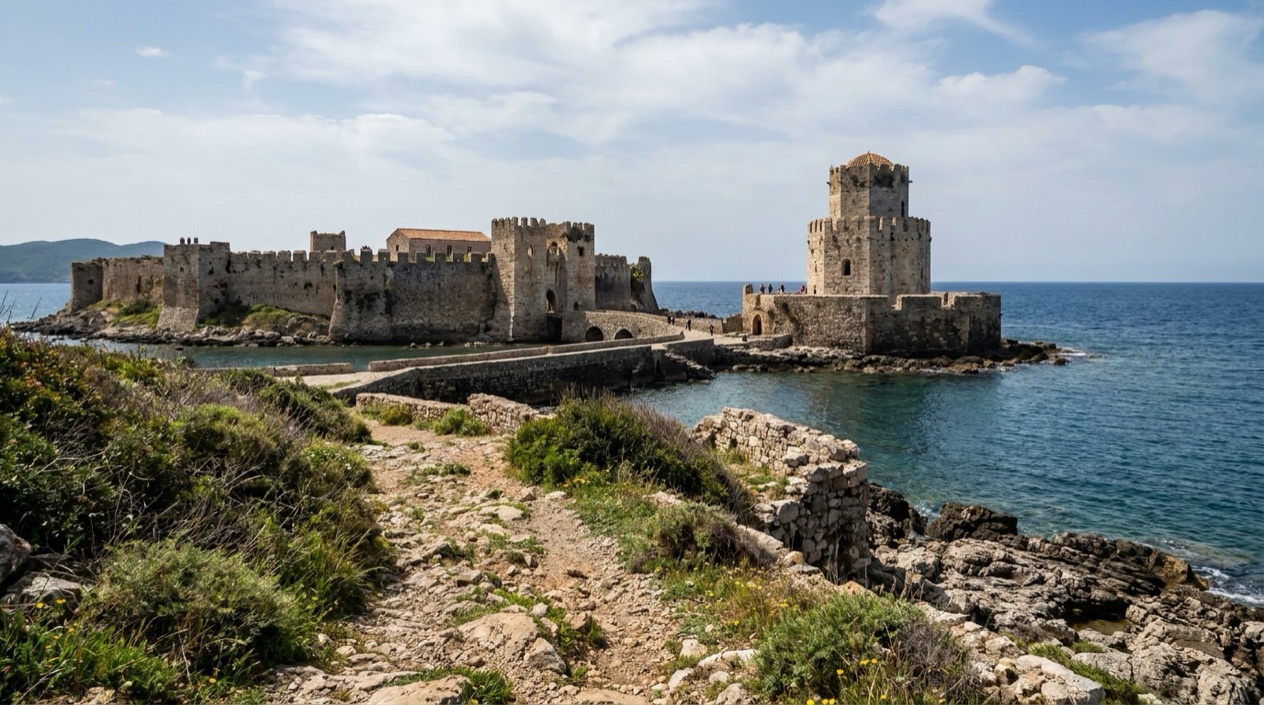
The village of Methoni sits at the end of the road in southwestern Messenia, and the castle announces itself long before you park, a long line of old fortification facing the Ionian Sea. Inside the walls the ground is wide and open, scattered with stone that has stood through Venetians, Ottomans and French soldiers. This is a visit for people who like to wander through layers of history with the sea always in view, and who want a swim on a nearby beach afterward.
Is visiting the Castle of Methoni worth it?
The castle is the main reason travelers come to the village, and the beaches of Tapia, Kokkinia and Kritika sit alongside it, so the visit rarely has to be only about ruins.
What sets Methoni apart from other fortified places in the Peloponnese is the weight of its stories. Under Venetian rule the town became an important center for trade with Egypt and the Levant, and a staging point on the route between Venice and the Holy Lands.
Pilgrims, merchants and sailors passed through here on the way to somewhere else, and that sense of a crossroads still hangs over the site. Then come the darker chapters: a siege, a massacre, a prisoner who would later write one of the great novels, and a French handover that ended centuries of foreign rule.
Nearby, Pylos offers a different kind of past, with its sheltered bay and the memory of the Battle of Navarino, while the Palace of Nestor belongs to the Mycenaean world. Methoni is the one where the story is about ships, trade and fortification. It is also a village rather than a resort, with a population of just over two thousand in the whole municipal unit, so the pace around the castle is that of a small place at the end of a road.
If you have time for only one fortress in this corner of Greece, Methoni is the one that tells the story of the sea routes. If you are building a longer trip around the southwestern Peloponnese, it fits naturally with Pylos and the bay of Voidokilia, which is listed among the top things to see around Pylos.
What to see at the Castle of Methoni
The Venetian trading port
Think of the castle first as a harbor stronghold. When Venice held Methoni, the town was a place where ships stopped to take on supplies and cargo on the way east, and where goods from Egypt and the Levant changed hands. The walls were built to protect that business as much as to defend a population.
As you walk the open ground inside, look at how the fortification follows the edge of the sea and how much of the enclosed space is now empty. Houses, churches and warehouses once filled it, and traces of them show in low walls and stone foundations.
Look out toward the water from the ramparts and imagine the ships that once waited there for a harbor berth. The Venetian chapter is the one that explains why a village this small has such a large castle.
The Turkish tower and Cervantes
After the Battle of Lepanto on 7 October 1571, Miguel de Cervantes was taken to Methoni as a prisoner and spent some time in this tower. The man who would write Don Quixote therefore passed through the same stones you are looking at.
Take a moment at the tower to think about that scene, a wounded soldier from a great sea battle held in a fortress on the edge of the Ionian Sea. The tower is a good place to connect the castle to the wider Mediterranean world of the period, in which fleets from Spain, Venice and the Ottoman Empire fought over exactly these waters.
The siege of 1500 and the French handover
The town of Methoni fell to the Ottoman Turks on 9 August 1500 after a siege of 28 days, and its people were massacred or sold into slavery. Standing inside the walls, it is a sobering fact to carry with you, because the open spaces you cross were once streets full of families.
The ending of foreign control came much later. The fortress surrendered to the French Morea Expedition on 8 October 1828, and in 1833 the departing French turned over its control to the newly established Kingdom of Greece. The castle therefore carries the whole arc, from Venetian prosperity through conquest to the birth of the modern Greek state.
The beaches of Tapia, Kokkinia and Kritika
Methoni attracts visitors for the castle and for the beaches of Tapia, Kokkinia and Kritika. They give the visit its second half, because after the ramparts the obvious next step is water. Each has its own name and its own spot along the coast around the village, and locals treat them as part of the same outing as the castle.
The sea here is the Ionian, and walking from the stones of the fortress to the shoreline makes the link between the two clear: this was always a place built for the water. Look for the beach that suits your mood on the day.
When to visit the Castle of Methoni
Methoni has a hot-summer Mediterranean climate, which tells you most of what you need to know about timing. Summers are hot, and a castle with wide open ground inside its walls offers the sun a lot of room to work, so a visit then is a matter of sun protection and water. Winters are the season when the rain falls, and a site made of open ramparts is not pleasant in a downpour.
| Climate in Methoni | Value |
|---|---|
| Average annual temperature | 66.2 °F |
| Annual precipitation | 26.8 inches |
In practice that means the months between the wet winter and the hot summer are the ones to weigh if you like to walk without extremes, and the shoulder seasons on the Messenian coast reward travelers who plan around the weather rather than the calendar. Bring the rain jacket in the cooler half of the year and the hat in the warm half.
A visit also works well as part of a beach day. Since the beaches of Tapia, Kokkinia and Kritika sit beside the castle, a summer trip can pair the ramparts with a swim, while a visit outside high summer can be a longer walk through the fortress itself. Because Methoni is a village at the end of the road rather than a large town, the surroundings do not change dramatically with the seasons the way a big resort does.
One historic date falls in the early part of the autumn season: the French took the fortress on 8 October 1828. And the story of the siege began in August 1500, in the heat of summer. If you like to tie a visit to the story you are reading, those dates are worth carrying with you, though no event at the castle is tied to them in the information available here.
Tips for your visit
Bring water and sun protection, since the climate is hot-summer Mediterranean and the ground inside the castle is open. In the wet season a rain jacket is the practical addition. Shoes with a decent grip are sensible for walking on old stone, and if you plan to swim afterward, a towel and swimsuit in the bag make the day flow without a detour.
Getting to Methoni
Methoni is the southern end of Greek National Road 9, which runs from Patras through Kyparissia to Methoni, so the village is reached by road from the north along the Ionian side of the Peloponnese. Another road links Methoni with Koroni to its east, which makes it simple to combine the two coastal villages on a drive across the southern tip of Messenia.
Pylos, in its sheltered bay, is the nearest town of any size, with a population of 2,568 in the town itself. It is a natural base for the area, and from there you can reach the rest of the coast.
What to combine it with
The bay of Voidokilia is listed as one of the top things to see in and around Pylos, so it belongs on the same trip. The Palace of Nestor, on the hill of Ano Englianos, is a Mycenaean site where Nestor once ruled as king, and it can be visited every day except on holidays and on Tuesdays, which is worth knowing when you set the order of your days.
If you prefer two wheels, 50cc scooters are for rent from Martin’s shop in Gialova, and to reach the shop you take a bus from Pylos to Gialova. The Battle of Navarino, fought in 1827, adds a naval chapter to the area, since allied British, French and Russian forces defeated the Ottoman-Egyptian fleet in these waters, and the bay of Pylos is where that story is told.
Families and anyone with limited mobility should plan around the fact that the castle is an open historic fortification rather than a managed park. The beaches next door give children an obvious reward at the end of the visit.
Good to know before you go
Methoni is a small village, so carry some euros for a coffee, a meal by the water or an ice cream after the walk. In a place where the sun is strong in the warm months, a hat and a bottle of water are more useful than any guidebook. Keep the usual travel habits you would anywhere in Greece and let the stones, the sea and the long story of the fortress set the pace of the day.
Sources
- Wikipedia, Methoni, Messenia (https://en.wikipedia.org/wiki/Methoni,_Messenia), checked October 12, 2026
- Visit Greece (GNTO), Pylos (https://www.visitgreece.gr/mainland/peloponnese/pylos/), checked October 12, 2026
- Wikipedia, Pylos (https://en.wikipedia.org/wiki/Pylos), checked October 12, 2026
- Wikivoyage, Pylos (https://en.wikivoyage.org/wiki/Pylos), checked October 12, 2026
To plan your stay
- Best Time to Visit Greece: September and Late May to Early June
- Arachova: Parnassus Mountain Town, Formaela Cheese, Ski Season and Saint George's Day
- American Airlines Flights to Greece: U.S. Cities, Athens Arrivals and Onward Island Flights
- Greece on a Budget: Cash Machines, Cards, Beaches and Ferries