
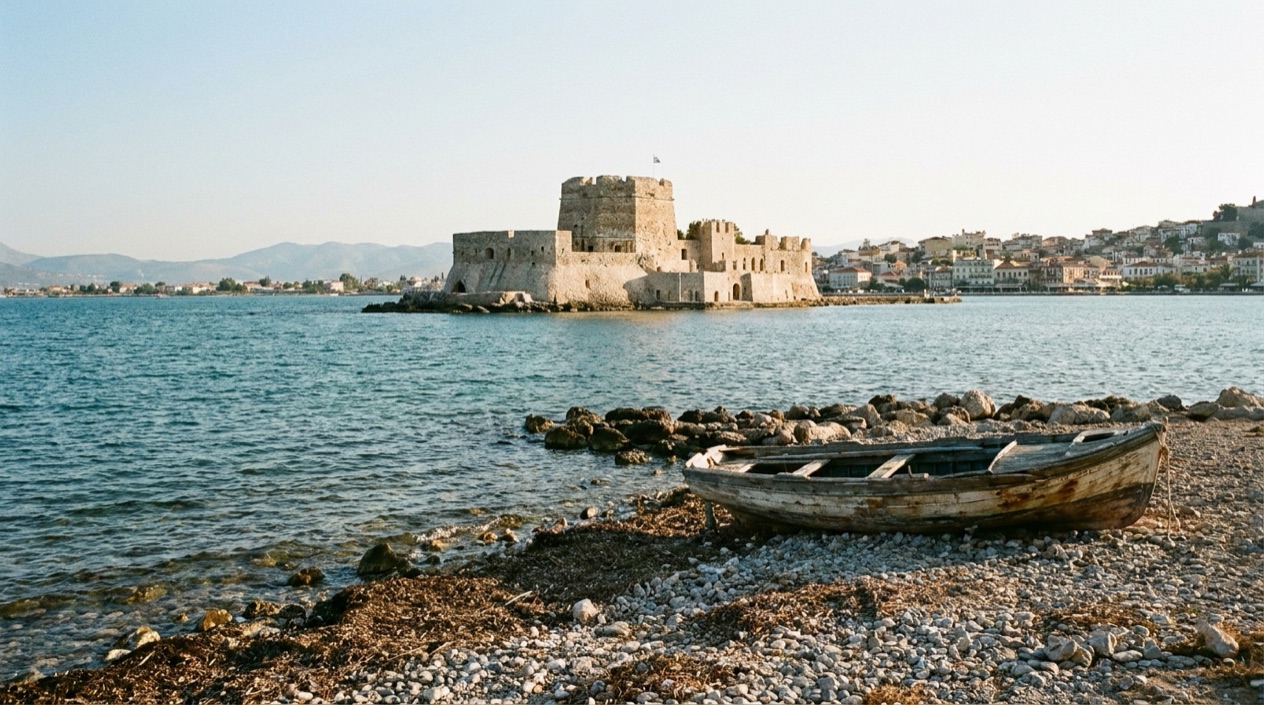
The Bourtzi sits in the port of Nafplio, a squat fortress at the edge of the water that the harbor seems to be built around. Fishing boats, café tables and the long curve of the Argolic Gulf all frame it, and it changes with the weather and the hour.
Is visiting the Bourtzi worth it?
Yes, if you like fortresses that tell you something about a place, and especially if you are already spending time in Nafplio, where the Bourtzi is the image people carry away. It is the most famous of the fortresses that go by this name in Greece, and it stands in the harbor itself, so it belongs to the daily life of the town rather than to a remote hilltop.
What sets it apart from its namesakes is the setting. Greece has several places called Bourtzi: one on an islet off Aegina, one on an island off Poros, a ruined castle near Aulis, a fortress at Methoni in Messenia, another at Karystos, and a Venetian fortress at Chalkis that has since been demolished.
The Nafplio Bourtzi is the one that still guards a working port, with a whole historic town behind it. You do not have to travel to a lonely coast to see it. You can look at it over coffee, walk the waterfront toward it, and place it within the streets where Franks, Venetians and Turks each left their marks.
It also pairs well with the rest of Nafplio. The town is one of the most popular destinations in Greece, and the Bourtzi gives a visit there its anchor: a fixed point to return to between the old neighborhoods and the sea. For those who care little for fortifications, the pleasure is simpler, a harbor view with a stone tower floating in it.
If you want a place with pure ruins and open archaeology, other stops in the Peloponnese will suit you better. If you want a story told by a building that is still recognizable as what it was, with water on every side, the Bourtzi delivers that in a way few sites do.
What to see at the Bourtzi
The fortress in the harbor
The first thing you notice is how the Bourtzi is placed: in the port of Nafplio, surrounded by water, with the town at your back.
Franks, Venetians and Turks all left their marks on Nafplio. Look at how the walls meet the water and how little room there is around them. Everything about the building says that this was a post to be held, not a palace to live in.
The name and its namesakes
Bourtzi comes from Ottoman Turkish and Arabic burc, meaning tower. That is exactly what it is: a tower-fortress, named in the language of the people who later used the harbor. The word became a common name for small sea forts around Greece, which is why you will find it on maps from Aegina to Methoni.
It is a nice detail to carry with you when you look at the building. In Nafplio, the name is attached to the most famous of them, and locals simply say the Bourtzi without needing to add the town’s name. Next to the ruined castle near Aulis or the vanished fortress of Chalkis, the Nafplio one stands as the complete example of the type.
A view of the old capital
Nafplio was the first capital of the newly established Greek state from 1827 to 1834, and the harbor was the front door of that capital. Ships arrived here, and the Bourtzi greeted them. Seen from the waterfront, the fortress and the old town together make a picture of a place that mattered.
Behind the harbor, the neighborhoods still carry the marks of Franks, Venetians and Turks. Walking the quay with the Bourtzi in front of you, it is easy to see why the town sits where it does: at the head of the Argolic Gulf, in a naturally fortified position, with the sea as its main road.
The gulf around it
The water around the Bourtzi is part of the sight. Sit at a waterfront table and the fortress becomes the middle of a slow, changing painting.
Boats move past it, gulls settle on the stone, and the town lights come on behind. It is a view to linger over rather than to tick off, and it rewards a second look at a different time of year.
How to get to the Bourtzi
The Bourtzi is in the port of Nafplio, so the way to it is through the town. Nafplio itself is a small town in the Peloponnese, on the Argolic Gulf in the northeast of the peninsula, and it is the base for seeing the fortress.
From Athens, the trip to Nafplio takes 1.5 to 2 hours by car. That puts the town within reach for travelers starting from the capital, and it makes the harbor fortress a natural part of a Peloponnese itinerary that begins in Athens. The car brings you to Nafplio, and from there the harbor is where the Bourtzi waits.
Once in town, the municipality of Nafplio provides free bicycles for a day first capital of the modern Greek state. That is a pleasant way to move around the waterfront and the old streets, with the fortress as your reference point. The bus station sits right there, so the same spot serves as a meeting point for the town’s transport.
As for reaching the fortress itself from the quay, the details are for the harbor to tell you on the day. What you can count on is that the Bourtzi stands in the port, in plain view from the waterfront of a town built at the head of the gulf.
When to visit the Bourtzi
At Argos, close to Nafplio, highs average about 60°F in January, climbing to the high 80s in July. The rain figures are Nafplio’s own, and they show a town that is much wetter in winter than in summer.
| Month | Average high (°F) | Average low (°F) | Precipitation (inches) | Days with rain (1 mm or more) |
|---|---|---|---|---|
| January | 60.4 | 49.5 | 2.34 | 8.5 |
| April | 68.7 | 54.5 | 1.30 | 6.1 |
| July | 89.8 | 75.2 | 0.27 | 1.6 |
| October | 77.2 | 64.6 | 1.52 | 5.2 |
January brings the most rain of these four months, so a rain jacket belongs in the bag, and the waterfront is a place for a brisk walk rather than a long sit outdoors. April is milder, with fewer wet days, and it suits a walk along the harbor with the fortress in view.
July is the hottest month in the table, with very little rain. Sun protection matters on the exposed waterfront, and the nights stay warm enough for an evening by the harbor.
October sits between the two. If you are choosing a season for a visit built around the town and its harbor, spring and autumn give you the most even mix of warmth and fewer wet days.
Tips for your visit
Treat the Bourtzi as the centerpiece of a Nafplio day rather than a stop on its own. The harbor, the old town and the fortress belong together, and the town is small enough that you can fit them into a single stay without rushing.
For what to bring, let the table guide you. In the wetter months, a rain jacket. In summer, a hat and sun protection, since the waterfront offers a lot of open sky. Comfortable shoes suit the old streets behind the harbor.
To combine it with nearby sights, use the bicycles the municipality provides in front of the Town Hall, by the KTEL bus station. They are free for a day, and they make a loop through the waterfront and the neighborhoods that carry the marks of Franks, Venetians and Turks a pleasant thing to do. Nafplio’s years as the first capital, from 1827 to 1834, give the whole town a thread to follow as you go.
If you are traveling with others, the harbor is a good place to meet and regroup. Everyone can see the fortress from the waterfront, and the town offers places to sit and look at it. For specifics on guides, parking and any visiting rules, rely on what you find posted at the site.
Finally, remember the other Bourtzis. If your route continues to Aegina, Poros, Methoni or Karystos, you will meet fortresses with the same name and very different settings. Seeing the Nafplio one first gives you the model to compare them with.
Good to know before you go
Nafplio is a small town, and the harbor around the Bourtzi is easy to enjoy on foot or by the free day bicycles. Bring a card and some cash for the waterfront cafés, and keep the usual habits of a busy tourist town. In summer, the heat on the open quay is worth planning around, with water and a hat in the bag.
Sources
- Wikipedia, Bourtzi (https://en.wikipedia.org/wiki/Bourtzi), checked October 12, 2026
- Visit Greece (GNTO), Nafplio (https://www.visitgreece.gr/mainland/peloponnese/nafplio/), checked October 12, 2026
- Wikipedia, Nafplio (https://en.wikipedia.org/wiki/Nafplio), checked October 12, 2026
- Wikivoyage, Nafplio (https://en.wikivoyage.org/wiki/Nafplio), checked October 12, 2026
- Hellenic National Meteorological Service (HNMS), climatological normals 1981-2010 for Argos station (https://www.emy.gr/climatic-data), monthly mean daily maximum and minimum; rain from the ECMWF ERA5 reanalysis, 1991-2020, grid cell of Nafplio (Open-Meteo), checked October 12, 2026
- ECMWF ERA5 reanalysis 1991-2020, grid cell of Nafplio (Open-Meteo), checked October 12, 2026
To plan your stay
- Best Time to Visit Greece: September and Late May to Early June
- Arachova: Parnassus Mountain Town, Formaela Cheese, Ski Season and Saint George's Day
- American Airlines Flights to Greece: U.S. Cities, Athens Arrivals and Onward Island Flights
- Greece on a Budget: Cash Machines, Cards, Beaches and Ferries