
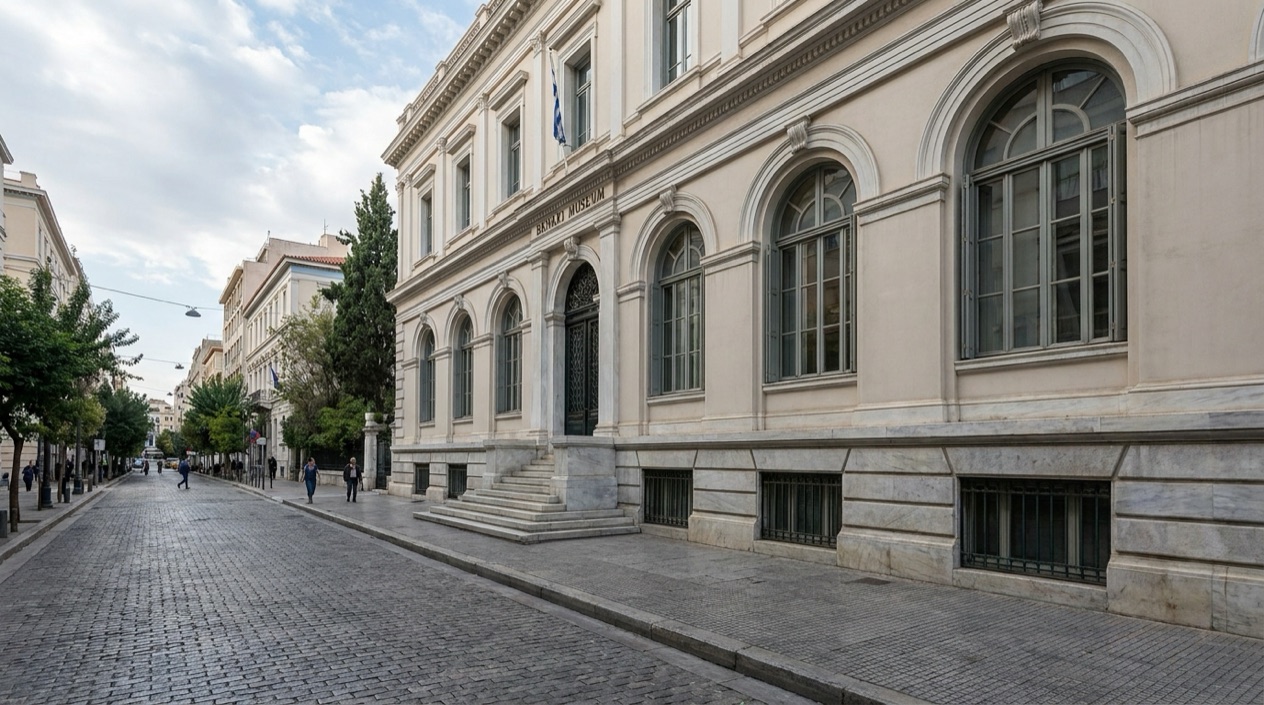
The Benaki Museum stands opposite the National Garden on Queen Sofias Avenue, in the mansion of the family that gave it its name. You step from the avenue into a house first and a museum second, and the rooms lead you through Greek objects of every age. It is a visit for anyone who wants Greek history told through things people made and used.
Is visiting the Benaki Museum worth it?
Yes, especially if you want to see how Greek life looked across many periods in one building, rather than one era at a time. It suits travelers curious about everyday objects, textiles, jewelry, icons and costumes as much as about monuments, and it rewards people who like to wander a collection at their own pace.
The museum was established and endowed in 1930 by Antonis Benakis in memory of his father Emmanuel Benakis. The following year the family donated their house in Athens together with a collection of more than 37,000 Islamic and Byzantine objects. Today the museum houses over 100,000 artifacts from Greek history, a number that explains why the visit feels like a long walk through time rather than a single exhibition.
What sets it apart from other museums in Athens is its scope. The renovation allowed it to become the only museum in Greece that brings visitors through all ages of Greek culture and history, and its Greek works run from the prehistorical to the modern times.
Archaeological museums tend to focus on the ancient world, and the Acropolis Museum in Koukaki stays with the monuments of the rock. Here the thread continues past antiquity into the objects of homes, churches and workshops.
There is a second reason to come, which is the breadth beyond Greece. The museum has an extensive collection of Asian art, and its Islamic holdings have a building of their own in Kerameikos.
Periodic exhibitions add something new to see for people who have been before. Behind the galleries, a state-of-the-art restoration and conservation workshop looks after the collection, which is part of why the objects reach you in such good condition.
What to see at the Benaki Museum
The family mansion on Queen Sofias Avenue
The main building is the Benakis family mansion, and that shapes the experience. You move through rooms that began as a private house, with the National Garden across the avenue, and the collection fills them in the order of time. The setting feels closer to a home that grew into a museum than to a hall built for display.
Look for the way the story is laid out. Greek works of art from the prehistorical to the modern times are gathered here, so you can follow one culture as it changes shape. Pieces that began as ordinary things, such as clothing, tools and household objects, sit beside finer works, and the contrast tells you as much as any label. A museum of this kind is best read slowly, one room at a time.
Greek works from prehistory to modern times
The core of the museum is its Greek collection. It spans the prehistorical to the modern times, and its strength is that no period is treated as an afterthought. Byzantine and later objects, which many visitors skip in Athens because the ancient monuments draw the attention, have a proper place here.
Look for the small pieces. Jewelry, embroidered textiles, icons and objects of daily use show craft and taste in a way large monuments cannot. If you have just come from the Acropolis or its museum, this is the part of the visit that shows what came afterward, and the house itself helps you slow down enough to notice the detail.
Asian art and the Islamic collection
The museum holds an extensive collection of Asian art, which surprises people who expect only Greek material. It is a reminder that the museum began with the wide interests of a collector and not with a narrow national brief.
The Islamic side has its own address. The Benaki Museum of Islamic Art is in the Kerameikos district of Athens. The collection moved to its new home in 2004, in time for the Athens Olympics, and the museum was inaugurated on 27 July 2004.
It occupies more than 1,000 square meters of remodeled space. Its roots go back to the Islamic and Byzantine objects the family donated in 1931, so visiting both buildings lets you follow one collection across two sites.
Periodic exhibitions and the conservation workshop
The museum hosts periodic exhibitions, so what is on display besides the permanent collection changes from one visit to the next. These shows are a good reason to return, since a second trip to a large museum rarely repeats the first.
You will not walk through it, but the conservation work matters to the visit. The museum maintains a state-of-the-art restoration and conservation workshop, and the care it gives to fragile textiles, wood and metal is the reason so many old pieces can be shown at all. Keep that in mind as you look at the oldest and most delicate objects.
When to visit the Benaki Museum
A museum visit depends less on the season than on the weather you want to escape or enjoy, and in Athens that weather changes a great deal. Because the galleries are indoors, the museum works as a refuge in the hottest weeks and as a dry stop on a rainy day, and it pairs naturally with a walk in the National Garden when the air is pleasant.
July is the clearest case for going indoors. The average high is in the low 90s and the average low stays in the mid-70s, with almost no rain. Walking around Athens in the afternoon is tiring then, and a long museum visit fits that kind of day well. Sun protection is worth bringing for the walk to and from the avenue.
Spring and autumn are gentler. April has an average high in the upper 60s with a handful of rainy days, and October has an average high in the mid-70s and a low around 61.
Both months let you combine the museum with time outside, such as the garden across the avenue or an stroll toward Plaka. October brings a few rainy days, so the museum is also a good answer if a shower interrupts your plans.
January is cooler, with an average high in the mid-50s and an average low in the mid-40s, and rain on several days. A rain jacket is sensible, and the museum is a comfortable place to spend a wet day. Plaka is described as a top attraction that gets crowded, and the Acropolis Museum in Koukaki is a stop of its own, so plan the museum as its own part of the day rather than squeezing it between others.
| Month | Average high (°F) | Average low (°F) | Precipitation (in) | Days with rain |
|---|---|---|---|---|
| January | 56.3 | 44.4 | 2.17 | 7.5 |
| April | 68.4 | 53.2 | 1.10 | 5.5 |
| July | 91.8 | 74.1 | 0.28 | 1.6 |
| October | 75.2 | 61.0 | 1.09 | 3.9 |
Tips for your visit
Go with curiosity rather than a checklist. With over 100,000 artifacts in the collection, no one sees everything, so choose the periods or kinds of objects that interest you most and let the rest go. That approach suits this house better than a march through every room.
The main building faces the National Garden on Queen Sofias Avenue, which makes the garden a natural neighbor to the visit. Plaka is also on the list of Athens attractions, with picturesque streets, historic landmarks and lively shops, though it gets crowded. In Koukaki, the Acropolis Museum and a pedestrian walkway link the ancient monuments, so a day of museums can run from the Greek collections here to the finds of the rock.
For the second building, the Islamic Art museum, head to the Kerameikos district. The Athens Metro operates from 5:30 a.m. to 00:30 a.m., and on Friday and Saturday nights lines 2 and 3 stay open later, which helps when you are moving between museums or heading back after dinner. On buses in Athens, passengers cannot use the front door to get on or off, so use the other doors.
Pair the museum with a meal. Athens is a city of tavernas, where meze (small shared plates), grilled souvlaki and a plate of moussaka make a good break after a morning among objects. Coffee at a kafenio (a traditional coffeehouse) is another way to let what you saw sink in. Families with children can use the garden across the avenue for a break between rooms.
Good to know before you go
Greece uses the euro, and the Benaki Museum is one stop among several in a city that rewards slow days. Plan around the weather rather than the clock, and keep the Islamic Art museum in Kerameikos in mind if you want to see the full range of the collection. The tramway returned to Syntagma on 19 November 2020, which adds one more way to move around the center.
Sources
- Wikipedia, Benaki Museum (https://en.wikipedia.org/wiki/Benaki_Museum), checked October 12, 2026
- OASA, Athens urban transport (https://www.oasa.gr/en/), checked October 12, 2026
- Athens Transport, public transport guide (https://www.athenstransport.com/english/), checked October 12, 2026
- This is Athens, the official Athens tourism site (https://www.thisisathens.org/), checked October 12, 2026
- Hellenic National Meteorological Service (HNMS), climatological normals 1991-2020 for Elliniko station (https://www.emy.gr/climatic-data), monthly mean daily maximum and minimum; rain from the ECMWF ERA5 reanalysis, 1991-2020, grid cell of Athens (Open-Meteo), checked October 12, 2026
- ECMWF ERA5 reanalysis 1991-2020, grid cell of Athens (Open-Meteo), checked October 12, 2026
To plan your stay
- Best Time to Visit Greece: September and Late May to Early June
- Arachova: Parnassus Mountain Town, Formaela Cheese, Ski Season and Saint George's Day
- American Airlines Flights to Greece: U.S. Cities, Athens Arrivals and Onward Island Flights
- Greece on a Budget: Cash Machines, Cards, Beaches and Ferries