
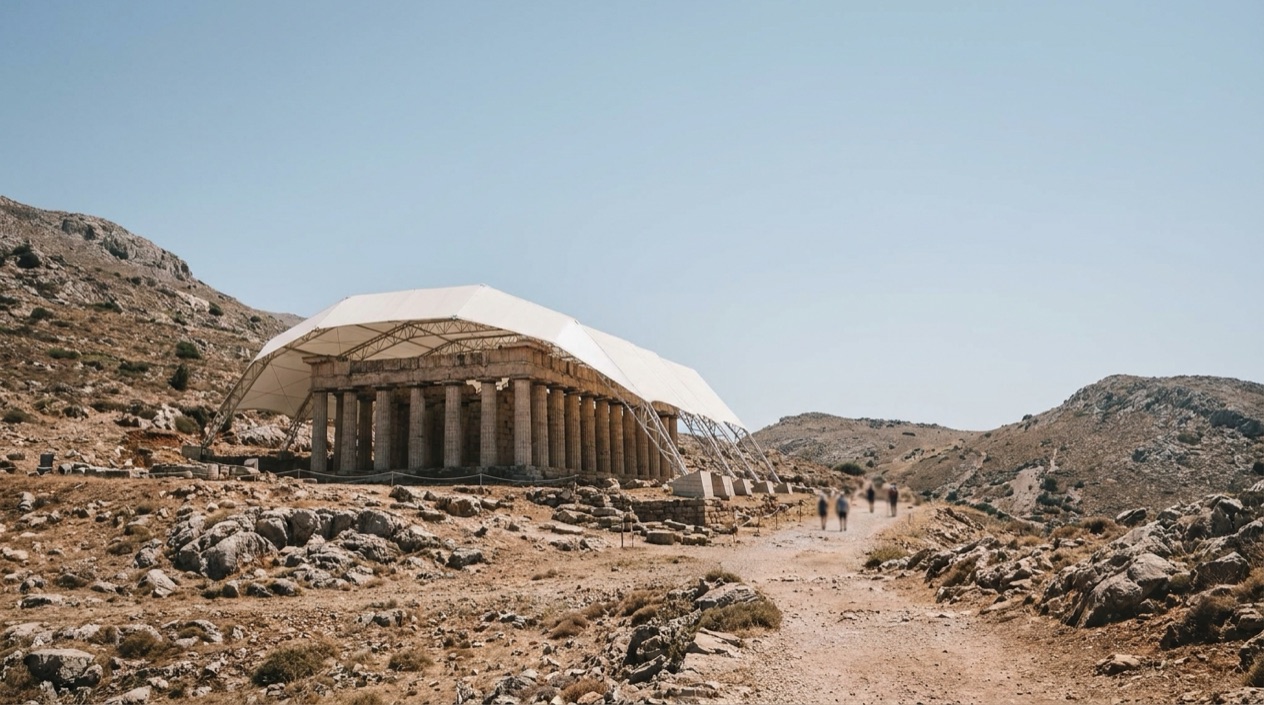
The first thing you see at Bassae is not a column but a great white tent, pale against the dark slopes of Cotylion Mountain. Underneath it stands a temple of Apollo that has spent centuries far from roads, armies and cities.
Is visiting Bassae worth it?
Yes, if what draws you is one remarkable temple in a mountain setting rather than a sprawling city of ruins. Bassae rewards people who enjoy the journey as much as the destination, and who like to read a landscape as well as a monument.
Many ancient sites in Greece sit inside towns or beside busy highways. Bassae lies in Oichalia, a municipality in the northeastern part of Messenia, on the slopes of Cotylion Mountain, near the village of Skliros.
The nearest names on the map are small places: Figaleia lies southwest of the site, Andritsaina to the north and Megalopolis to the east. That isolation is part of the story, because the remoteness of the temple has helped protect it from war damage, from conversion to Christian use and from acid rain.
What also sets it apart is its standing. Bassae was the first Greek site to be inscribed on the World Heritage List, in 1986.
Its plan is unusual too: where most Greek temples are aligned east to west, this one runs north to south, with its principal entrance from the north. A traveler who has already seen the great temples of Athens will find here something that breaks the pattern, and a sense of how varied Greek temple building could be.
It is a smaller visit than Olympia or the Acropolis and does not pretend otherwise. If you want museums, cafés and a long trail of ruins, look elsewhere on the Peloponnese. If you want the feeling of coming upon a temple in the hills, this is the place.
What to see at Bassae
The site is built around one monument, so the visit is a slow look at a single building and the land that holds it. The sections that follow separate what the temple is, how it is protected and the mountain around it.
The Temple of Apollo Epicurius
The temple in its present form was built between 450 and 400 BC, and it is dedicated to Apollo Epicurius, a name often understood as Apollo the Helper. The epithet speaks to what people asked of the god in the hills: help with sickness, with flocks, with the hardships of upland life.
Look at the building as a whole, a long rectangular temple standing alone on its terrace, with nothing else of comparable size around it. The mountain is the only neighbor, and the lack of a town gives the temple a strong presence on its slope.
A temple that faces the wrong way
Most Greek temples are aligned east to west, so that the sunrise falls along the length of the building. At Bassae the temple is aligned north to south, with the main entrance from the north. Anyone with an eye for ancient architecture will want to pause over this, because it shows that builders in the countryside followed local conditions as much as habit.
When you see the building, think of how its orientation relates to the slope it stands on. The mountain shapes the plan of the temple as much as any rule of ritual.
The white tent
At present the temple is covered by a white tent that protects the ruins from the elements. It changes the look of the site: you meet a vast pale canopy first and the stone second, and photographs taken here rarely look like the postcards of other temples.
The tent is a sign that the temple is still being looked after, and that the remoteness that saved it from many dangers does not make it immune to wind, rain and time. Think of it as part of a long process of care rather than a flaw in the view.
The slopes of Cotylion Mountain and Skliros
The setting is as much a part of the visit as the monument. The site lies on the slopes of Cotylion Mountain, and the village of Skliros is the nearest settlement. Take time to look away from the temple and across the folds of the Messenian uplands, which explain why this place felt right for a sanctuary of Apollo.
Because there is no town at the gate, the experience is of a building and a landscape, with few distractions. It is a good place to slow down and let the scale of the surroundings settle in.
How to get to Bassae
Bassae lies in Oichalia, in the northeastern part of Messenia. The map places it near the village of Skliros, northeast of Figaleia, south of Andritsaina and west of Megalopolis, and these are the towns around which you will orient yourself.
The one journey for which we have a clear measure is on foot. The temple is at least a three-hour walk from Phigaleia, along a route of about 8.1 miles. That is a serious outing, and it places the temple in a different category from sites that sit beside a parking lot. A walker who sets out from Phigaleia is traveling through the same hill country that makes the temple so remote.
To reach the area at all, you first arrive on the Peloponnese, a peninsula in southern Greece. It is joined to the mainland by the Corinth Canal, which is 3.9 miles long and was constructed in 1893, and the Rio–Antirrio bridge, completed in 2004, links the western Peloponnese with mainland Greece. Once you are on the peninsula, Messenia and its small towns lie ahead, and Bassae is one of the places that reward the trip inland.
Because the roads, bus links and drive times are not set out here, it is worth building your plan around the towns named above. Pick a base among them and then work out the final approach to Skliros and the temple.
When to visit Bassae
There is no single moment that decides the visit, but the character of the site gives a few clues. The temple stands on a mountain slope in a landscape of hills and small villages, and the setting is part of what you come for.
If you plan to walk from Phigaleia, remember that the route takes at least three hours. That is a reason to pick a day when you are not hurried, and to leave room afterward for the temple itself rather than treating it as a quick stop.
The temple’s north to south alignment is worth keeping in mind whenever you arrive. You enter from the north, and the way the building faces the land is clearer once you have walked around it in your mind. The white tent is there throughout, so the look of the site does not change from visit to visit in that respect.
A trip to Bassae also fits well into a longer journey through the Peloponnese. Ancient Olympia, the birthplace of the Olympic Games, lies on the same peninsula, and the contrast between a great athletic sanctuary and a lonely mountain temple makes for a rich pairing across a few days.
Tips for your visit
Think of Bassae as a single monument that deserves your full attention. Because it is the first Greek site inscribed on the World Heritage List, in 1986, it is worth reading a little about the temple before you arrive, so that you know what you are looking at under the tent.
Start by getting your bearings with the villages. Skliros is the one to keep in mind, with Figaleia, Andritsaina and Megalopolis marking the wider area. If you are walking from Phigaleia, leave plenty of time, since the walk is at least three hours.
Look for the details that make this temple unlike others: its north to south plan, the entrance from the north and the lone position on the mountain slope. These are the features that explain why it has been protected by distance from war damage, conversion to Christian use and acid rain.
Combine the temple with the rest of the Peloponnese by thinking of it as one stop in a larger loop. The peninsula is joined to the mainland by the Corinth Canal and the Rio–Antirrio bridge, and it holds Ancient Olympia as well as the mountains of the south, among them Mount Taygetus, the highest peak in the Peloponnese.
Good to know before you go
Bassae is a rural place, and the villages around it are small, so plan your day around the towns of Messenia rather than around the site itself. The temple is covered by its white tent at present, so you should expect to see the monument under that protection. Carry the habits you would bring to any mountain site in Greece, and let the temple’s long isolation set the pace of the visit.
Sources
- Wikipedia, Temple of Apollo Epicurius (https://en.wikipedia.org/wiki/Temple_of_Apollo_Epicurius), checked October 12, 2026
- Visit Greece (GNTO), the Peloponnese (https://www.visitgreece.gr/mainland/peloponnese/), checked October 12, 2026
- Wikipedia, Peloponnese (https://en.wikipedia.org/wiki/Peloponnese), checked October 12, 2026
- Wikivoyage, Peloponnese (https://en.wikivoyage.org/wiki/Peloponnese), checked October 12, 2026
To plan your stay
- Best Time to Visit Greece: September and Late May to Early June
- Arachova: Parnassus Mountain Town, Formaela Cheese, Ski Season and Saint George's Day
- American Airlines Flights to Greece: U.S. Cities, Athens Arrivals and Onward Island Flights
- Greece on a Budget: Cash Machines, Cards, Beaches and Ferries