
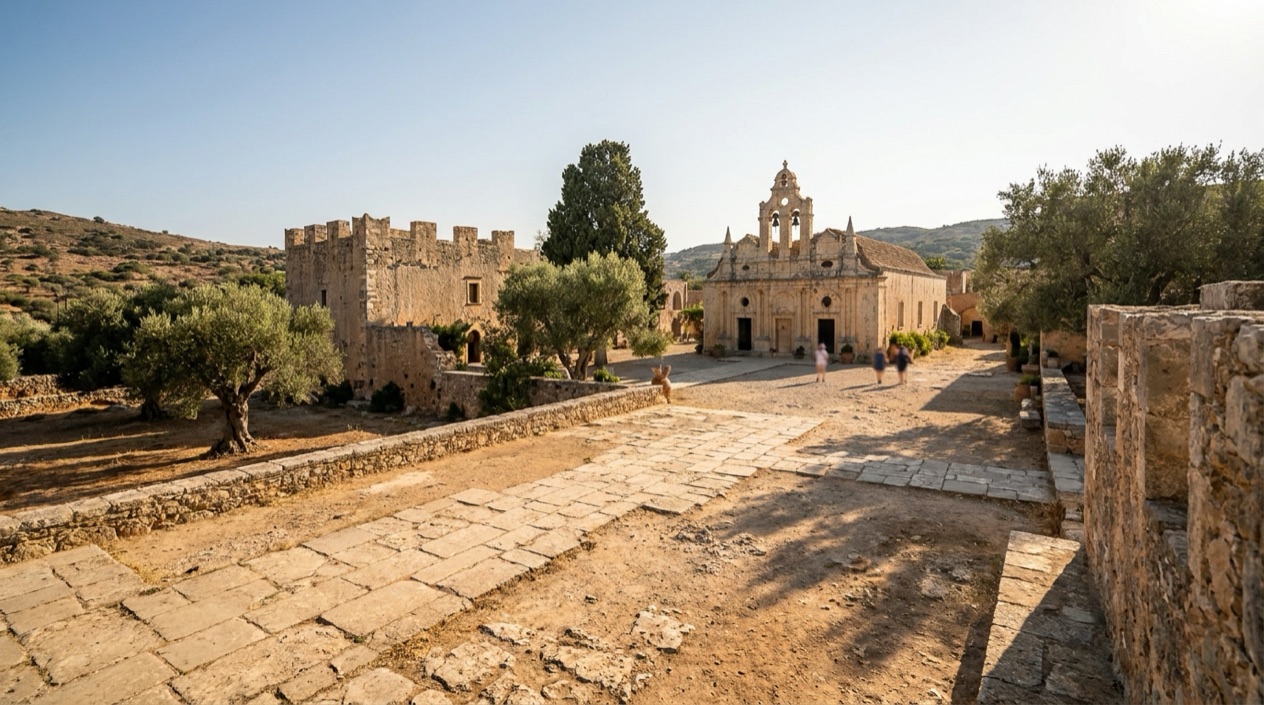
You reach Arkadi along a road that climbs onto a plateau, and the monastery appears behind its stone walls like a small fortress with a calm, carved church front rising above the courtyard. Cypress trees stand in the open space inside, and the pale stone changes color as the light moves across it.
Is visiting Arkadi Monastery worth it?
Arkadi sits on a plateau 14 miles southeast of Rethymno, so it is an outing out of the city and into the island’s interior. The walls, the courtyard and the church tell one story from start to finish.
The story is the heart of it. During the Cretan revolt of 1866, 943 Greeks, mostly women and children, sought refuge inside these walls. After three days of battle, the defenders ignited barrels of gunpowder, choosing to sacrifice themselves rather than surrender. The event became a symbol of Cretan resistance far beyond the island, and the monastery is now a national sanctuary.
What sets it apart from the other monasteries and churches you may pass on Crete is that it is both a beautiful building and a memorial. Many monasteries ask you to admire their icons and quiet corners.
Arkadi asks you to stand in the courtyard and imagine what happened there, and then to look up at a church front whose Renaissance lines feel almost too elegant for the story attached to them. Rethymno, with its Venetian old town and fortress, gives you the sea and the café life, while Arkadi gives you the weight of the island’s modern history.
It also changes the rhythm of a Crete vacation. A day of beach and old-town wandering in Rethymno pairs naturally with an excursion into the hills, where the setting is stone, cypress and open sky instead of promenades and tavernas. Travelers who come only for sand sometimes skip it, and those who go tend to remember it longer than the beach days around it.
What to see at Arkadi Monastery
The church and its façade
The church, the katholikon, is the first thing the eye settles on, and it dates from the 16th century. It was built in a Renaissance Revival style that mixes Roman and Baroque elements, which is why the front looks more like something from an Italian town than a village on Crete. Columns, arches, carved ornament and a pair of levels give it a layered, balanced look against the plain walls around it.
Look at how the stone has been worked, then at the bell tower rising above the front, which catches the eye from across the courtyard. This is the image of Arkadi you will see on postcards and in local publications, and it is worth standing back far enough to take in the whole front before you go in.
The twin-nave basilica
Inside, the church is a basilica with two naves instead of the single hall visitors expect. The northern nave is dedicated to the Transfiguration of Christ, and the southern nave to Saint Constantine and Saint Helen. Two dedications under one roof gives the interior a doubled rhythm, with icons, candle stands and carved woodwork repeated on each side.
Take time to look at the icons and the iconostasis, the screen of painted panels that separates the sanctuary from the rest of the church. If a service is under way, you will hear chant and see the monastery working as it always has. A church like this rewards slow looking, and the contrast between its ornate surfaces and the simple courtyard outside is part of the visit.
The courtyard and the walls
The monastery is laid out in the shape of a nearly rectangular parallelogram, with long walls enclosing a wide open courtyard. Rows of rooms, once cells and storerooms, line the inside of the walls, and their arcades give you shade and a place to pause.
Walk the edges and look at the stonework, the doorways and the old cells. The space feels more like a fortress than a retreat, which makes sense given its role in 1866. A cypress tree stands in the middle of things, and its green against the pale stone makes one of the most photographed corners of the site.
The gunpowder room and the memorial
The powder magazine is the room where the story reached its end, and it is preserved as a place of remembrance. You do not need a guide to understand it, because the space and the memorial around it do the telling. Visitors stop here longer than anywhere else.
A memorial to the victims stands within the monastery grounds, and the whole site is a national sanctuary honoring the Cretan resistance. The mood is one of respect, with visitors speaking softly and moving slowly. It is the part of the visit that stays with people, and it is why Arkadi feels different from a purely architectural stop.
When to visit Arkadi Monastery
The one date that belongs to Arkadi is 8 November, when the Cretan resistance is commemorated. The monastery became a national sanctuary in honor of that resistance, and the day is its moment of public remembrance, with services and ceremonies tied to the story of 1866. If you are on Crete in early November, it is the date that gives the visit its fullest meaning.
The commemoration is a local and national observance, not a festival for tourists. Expect a gathering that centers on the church and the memorial, with Cretans coming to pay respects, and keep in mind that it is a solemn occasion. Travelers who come on other days will find the same stones and the same story without the ceremony.
For the rest of the year, think of Arkadi as an open-air visit. The courtyard, the walls and the approach to the church all happen outdoors, so the weather shapes the experience more than it would at a museum.
Because the monastery sits on a plateau away from the coast, it is a different setting from Rethymno’s beach and old town, and it makes sense to plan it on a day when you want a change of scene. Pair it with Rethymno on either side: a morning or evening in the old town frames the monastery visit with food, sea air and Venetian streets. Opening hours are not something to guess at, so confirm them locally before you set out.
If your trip lands in autumn, the November commemoration is the reason to put Arkadi on the calendar. If it lands at another time, the monastery works as an anchor for a day of exploring the countryside inland from Rethymno, with the history of the island as your theme.
Tips for your visit
Start by treating Arkadi as a visit with two layers: the architecture you see and the history you imagine. Read a little about the revolt of 1866 before you go, so that the courtyard and the powder room carry meaning when you reach them. A notebook or a camera helps, since the church front, the cypress and the arcades all reward a second look.
Bring sun protection and water for the open courtyard, and shoes that suit stone paving. The monastery is a religious site, so move through it as you would any church, with a lowered voice and attention to services that may be under way. If the doors are closed or a service is happening, simply wait or look at the exterior first.
Combining Arkadi with Rethymno
Rethymno is the natural base for the outing, since the monastery lies 14 miles southeast of the city. The city is the third largest on Crete’s northern coast, between Chania and Heraklion, and it has one of the best-preserved medieval old towns in Greece, with Venetian fortifications, Orthodox and Catholic churches, minarets and old hammams.
Its old town was almost entirely built by the Republic of Venice, and the Fortezza, a Venetian-era citadel, is one of the best-preserved castles on Crete. Rethymno also has a vast beach lined with hotels, restaurants and cafés. A day that moves from the old town and fortress to the monastery and back to the waterfront for dinner gives you three different faces of the island.
Getting to the area
Travelers arrive on Crete by sea. Ferries from Piraeus to Chania or Heraklion depart daily at night and arrive early in the morning, which puts you on the island ready to reach Rethymno the same day. In the high season, direct ferries run from Rethymno to Santorini, taking around 2.5 hours on Sea Jets high-speed catamarans, which makes it possible to pair Crete with the island of Santorini.
Once you are in Rethymno, the monastery is the outing that takes you out of town and into the interior.
Families and mobility
Older children who like stories about castles, battles and brave choices tend to engage with Arkadi, especially if you tell the story on the way up. Younger children may find the mood of remembrance harder to grasp, so keep explanations simple and let them look at the cypress, the arcades and the bell tower.
Because the monastery is a courtyard with a church, rooms and a memorial, visitors will be on their feet on stone ground. If mobility is a concern, ask locally about access before you go, as the details of ramps and steps are not something to assume.
Good to know before you go
Arkadi is a sanctuary first and a sight second, and that shapes the habits that fit it: a lowered voice in the church, patience when a service is under way, and photographs taken with respect for anyone praying. Carry some euros for small purchases and any donation you wish to leave, and plan your meals back in Rethymno, where the restaurants and cafés of the old town and the beachfront are waiting.
Sources
- Wikipedia, Arkadi Monastery (https://en.wikipedia.org/wiki/Arkadi_Monastery), checked October 12, 2026
- Visit Greece (GNTO), Rethymno (https://www.visitgreece.gr/islands/crete/rethymno/), checked October 12, 2026
- Wikipedia, Rethymno (https://en.wikipedia.org/wiki/Rethymno), checked October 12, 2026
- Wikivoyage, Rethymno (https://en.wikivoyage.org/wiki/Rethymno), checked October 12, 2026
To plan your stay
- Best Time to Visit Greece: September and Late May to Early June
- Arachova: Parnassus Mountain Town, Formaela Cheese, Ski Season and Saint George's Day
- American Airlines Flights to Greece: U.S. Cities, Athens Arrivals and Onward Island Flights
- Greece on a Budget: Cash Machines, Cards, Beaches and Ferries