
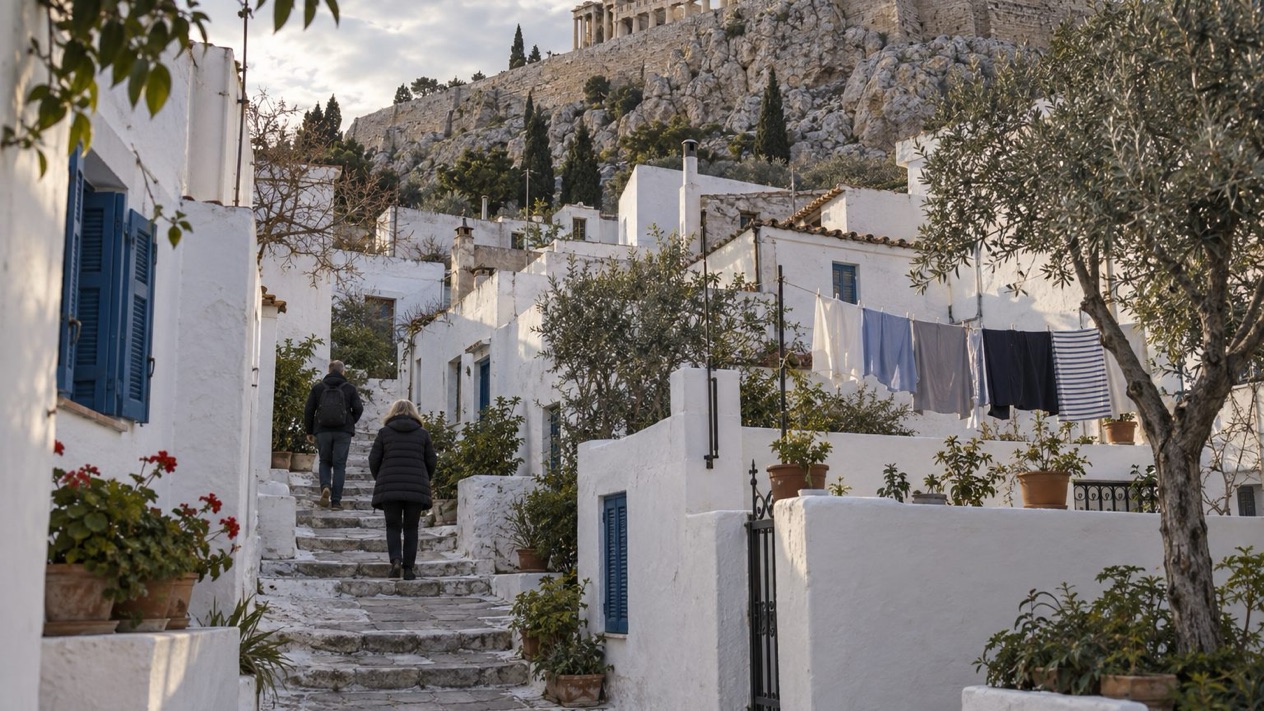
A cat stretches on a step beside a doorway painted blue, a pot of basil sits on a windowsill, and the lane ends at a terrace with the whole city spread out beyond it. Anafiotika feels like an island village that wandered into the middle of Athens and stayed. It is a tiny residential corner under the Acropolis rock, and it rewards anyone who likes to wander slowly and look at details.
What is Anafiotika like?
Anafiotika feels like a Cycladic island village set down in the city: small cubic houses, white walls, tight spaces and lanes that stop at ladders, dead ends or the edge of a terrace. It is built in the style of the Aegean islands, not the grand style of the capital around it, and that contrast is the whole charm. You step off the busy streets and the scale shrinks to doorways, stairs and flowerpots.
The story explains the look. The first houses were put up by workers from the island of Anafi, who came to Athens in the era of Otto of Greece to help refurbish King Otto’s Palace.
They built homes the way they knew how, and the name of the neighborhood is the name of their island. Later the population changed, and in 1922 Greek refugees from Asia Minor settled here too, so the place was no longer only Cycladic in its people.
The neighborhood was also cut back. Part of it was destroyed in 1950 for archaeological research, and in 1970 the Greek state started buying the houses. Today only 45 houses remain, which is why the area feels more like a handful of lanes than a district. The streets from Stratonos to the Acropolis rock are still unnamed, and the houses are known as Anafiotika 1, Anafiotika 2 and so on, a small oddity that tells you how informal this corner was from the start.
People who love Anafiotika tend to love small things: a bougainvillea spilling over a wall, a painted door, a view caught between two roofs, the sense of living rooms a few steps from the path. Photographers and walkers like it, and so do travelers who want a break from the grand monuments. It is a place to look at, not a place with a list of sights, and it is best taken slowly.
Things to do in Anafiotika
Walking the unnamed lanes
The main activity is simply walking. The little streets from Stratonos to the Acropolis rock have no names, and the houses carry numbers in the form Anafiotika 1, Anafiotika 2, so there is no street sign to follow and no fixed route. You let the lanes decide, taking a turn toward a staircase or a doorway, and often find that a lane ends at a ladder or a dead end at a terrace.
Look for the details that make the island comparison real: small cubic houses stacked close together, white walls, stairs that double as front yards, pots of herbs and geraniums on every ledge, and a cat on nearly every step. These are people’s homes, so voices stay low and doors stay unopened. If a lane seems to end in someone’s courtyard, turn around and try the next one.
The terraces and the night view
Several lanes finish at terraces, and these are the reason people come. From the terraces of Anafiotika you can sit and enjoy the night view of the city of Athens, with the lights of the capital laid out in front of you. It is a view that comes without a ticket gate or a rooftop bar, just a ledge, a wall and the city.
Bring a small bottle of something to drink and a light layer if you plan to sit for a while, since you will not be tempted to leave quickly. Come back by daylight too, when the white walls and blue doors show up clearly against the rock above.
Cycladic details and a little history
Because the neighborhood was built by builders from the island of Anafi, the architecture itself is the sight. Notice how the houses are small, cubic and close, how the walls are white, and how the spaces are kept tiny, a style that suits an island more than a capital. Many houses have steps built straight into the lane, and small chapels and shrines appear where you least expect them.
Reading the place gets more interesting when you remember what happened here: workers building a palace and then their own homes, refugees arriving in 1922, part of the area cleared in 1950 and the state buying houses from 1970. You are looking at what survived, and the numbering of the houses, with no street names, makes the survival feel quite personal.
The edge of Plaka
Anafiotika belongs to the wider Plaka district, which the official Athens tourism guide calls a top attraction, with picturesque streets, historic landmarks and lively shops, though it gets crowded. Visitors fold the two together in one wander, dipping into Plaka’s shop-lined streets and then slipping into the stillness of the lanes here. The mood change between the two is part of the pleasure.
Within reach of the neighborhood, the Koukaki area has the Acropolis Museum and a pedestrian walkway that links ancient monuments, a combination that has made Koukaki fashionable. It is a different Athens, more modern and easy to pair with a day of ancient sites, but it belongs to another neighborhood and another outing.
Eating and drinking in Anafiotika
Eating in Anafiotika means eating next door, because the lanes themselves are residential and the table-and-chairs scene belongs to the surrounding streets of Plaka. That is not a drawback. The district around Anafiotika is full of tavernas, the Greek family restaurants where a meal is built from shared plates, and you can finish a walk in the lanes and sit down to one within a few minutes of leaving.
A taverna meal usually starts with meze, a group of small plates meant to be shared: tzatziki, the garlicky yogurt and cucumber dip, fried zucchini, grilled octopus, dolmades, and plenty of bread. Feta appears in the village salad, the horiatiki, which has tomato, cucumber, onion, olives and a thick slab of cheese on top, dressed with olive oil and oregano. It is simple and tastes of ripe vegetables.
For something heartier, look for moussaka, layers of eggplant, spiced meat and creamy béchamel baked until golden. Souvlaki and gyros, meat on skewers or carved from the spit and wrapped in pita with tomato, onion and sauce, make a quick lunch eaten standing up. Grilled fish, lamb and slow-cooked stews fill the longer, slower dinners that Plaka does well.
Drinks follow the food. Ouzo, the anise spirit, turns cloudy when you add water and goes well with meze, and many tables end with a small glass of something stronger on the house.
A kafenio, the traditional Greek coffee house, is the place for a thick small Greek coffee and a sit that has no timetable. Sweet shops and bakeries in the area sell pastries to take away, a good thing to carry up to a terrace in the evening.
One way to plan: have a coffee or a pastry before you go up into the lanes, wander with nothing in your hands, and then choose a taverna on the way back down for the main meal. That way the walk and the meal each get your full attention, and the view over the city from the terraces becomes a prelude to dinner instead of a rush before it.
Staying in Anafiotika
Staying in Anafiotika itself is a question of what the neighborhood is: a tiny cluster of 45 houses, with lanes that end in ladders and dead ends. It is a place that people visit and photograph, not a district built around hotels, so the realistic choice is to stay in a neighboring area and walk in.
Plaka, the district Anafiotika belongs to, is the obvious place to look. It is the top attraction of Athens in the official tourism guide, with picturesque streets, historic landmarks and lively shops. Nights there are shaped by the shops and the visitors.
Koukaki is the other area to know. It has the Acropolis Museum and a pedestrian walkway that links ancient monuments, and the tourism guide calls it fashionable.
Choosing between the two comes down to atmosphere: Plaka for old streets and constant movement, Koukaki for a newer, more local rhythm.
Getting around from either is straightforward. The Athens Metro and the tram, which returned to Syntagma on 19 November 2020, link the center, and buses serve the rest of the city. The terraces of Anafiotika are best enjoyed in the evening, so a base within walking range lets you go up for the night view and return without worrying about the last train.
Good to know before you go
Bring a little cash or a card for the cafés and tavernas in Plaka, and remember that the houses are private homes, so keep your voice low and stay on the lanes. If you are returning at night by public transport, the Athens Metro operates from 5:30 a.m. to 00:30 a.m., and on Friday and Saturday nights lines 2 and 3 stay open later.
On buses in Athens, passengers cannot use the front door to get on or off, so board and leave by another door. The lanes include steps, ladders and dead ends, so wear shoes with a good grip, and bring water if the weather is hot.
Sources
- Wikipedia, Anafiotika (https://en.wikipedia.org/wiki/Anafiotika), checked October 12, 2026
- OASA, Athens urban transport (https://www.oasa.gr/en/), checked October 12, 2026
- Athens Transport, public transport guide (https://www.athenstransport.com/english/), checked October 12, 2026
- This is Athens, the official Athens tourism site (https://www.thisisathens.org/), checked October 12, 2026
To plan your stay
- Best Time to Visit Greece: September and Late May to Early June
- Arachova: Parnassus Mountain Town, Formaela Cheese, Ski Season and Saint George's Day
- American Airlines Flights to Greece: U.S. Cities, Athens Arrivals and Onward Island Flights
- Greece on a Budget: Cash Machines, Cards, Beaches and Ferries