
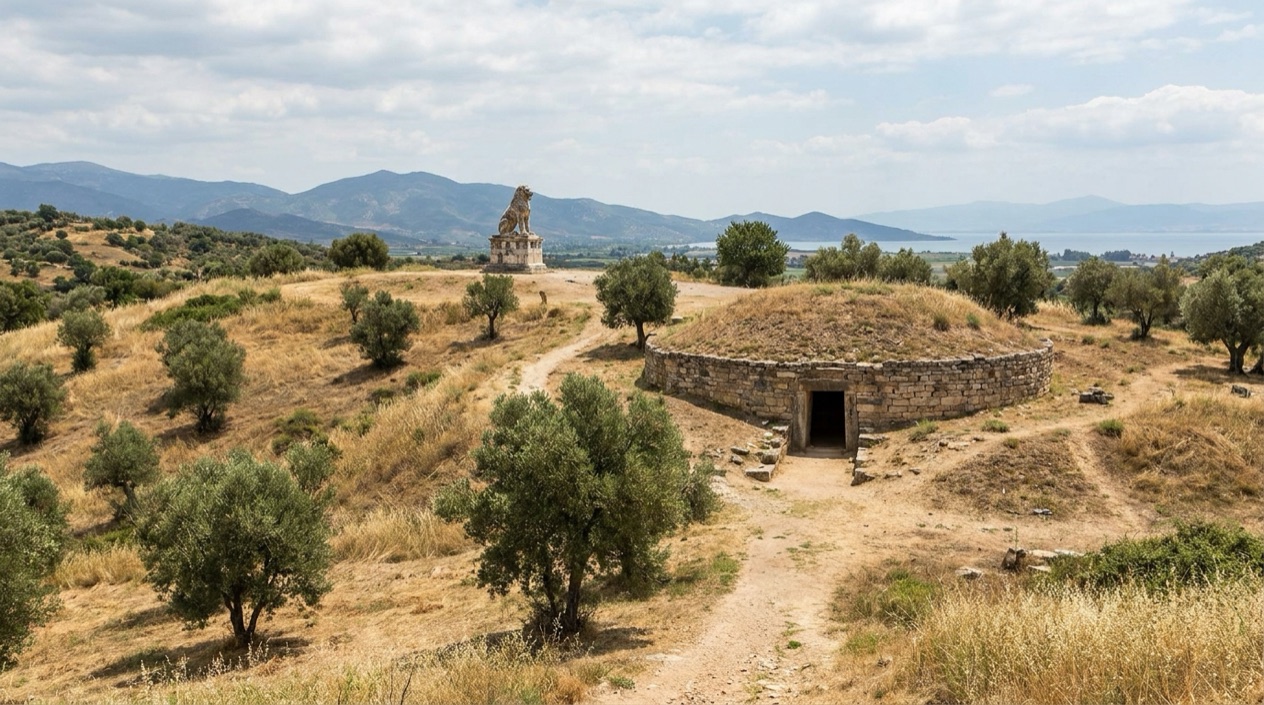
At Amphipolis the landscape does the talking. Stretches of old city wall cross the ground, dark timber piles mark a place where people once crossed the river Strymon, and a vast burial mound stands nearby with a tomb that is still being restored.
It is an open-air visit to a Macedonian city, with a museum for the finds and a lion monument close by.
Is visiting Amphipolis worth it?
Yes, if you enjoy ruins that are spread through the countryside rather than gathered behind one gate, and if the story of a city matters to you as much as its monuments. Amphipolis rewards curiosity. It gives you a defensive wall with gates still standing, a bridge whose timbers have been dated, a training ground for young men and a burial mound that is making news.
What sets it apart from better-known ancient sites in Greece is the variety of things that survive and the way they connect. You see how a city protected itself, how it crossed its river, how it trained its youth and how it honored its dead, all within one area.
There is no single monument to photograph and leave. Instead you piece together a place, then confirm the picture at the archaeological museum, where finds from the excavations are on display.
The visit is quieter on spectacle than a major temple complex, and it asks for a little imagination. A wall is a line in the grass until you know what it enclosed. The pleasure comes from filling that in. Add the Lion of Amphipolis, a monument that visitors seek out, and the Kasta mound, and the day has a clear shape: city, river, museum, tomb.
Travelers who want a polished, fully staged archaeological park with a single grand view may find it understated. Those who like to wander, compare, and read about what they have seen will find plenty to hold their attention. It also pairs well with a stay in Macedonia, where a city break and a day among ruins make a natural contrast.
What to see at Amphipolis
The sights of Amphipolis fall into five groups: the walls and their gates, the ancient bridge, the gymnasium, the Kasta tomb, and the lion monument with the museum. Each tells a different part of the story, so it helps to see them as chapters rather than separate stops.
The city walls and their gates
The original walls of Amphipolis ran for a long circuit around the city, and they are generally still visible today. The northern section is the most impressive, preserved to a remarkable height, so you can see how the builders raised the wall and how it commanded the land around it.
Five of the gates survive, and you can pick them out along the line of the wall. The one in front of the wooden bridge is the best known. Standing at a gate, you grasp what the wall was for: it controlled who came in and out, and it tied the city to the river crossing beside it. Look at the stonework and at how the wall follows the ground.
The ancient wooden bridge
The bridge that crossed the Strymon was discovered in 1977, and what remains are wooden piles, the timbers that once carried the roadway across the water. They are modest to look at, and the story is what makes them remarkable.
Carbon dating has shown that some of the piles go back to 760 BC, while others were still in use until about 1800 AD. A crossing in the same place served people across a vast span of time. Standing by the gate in front of it, you can picture caravans, soldiers and farmers passing through, and the river itself becomes part of the monument.
The gymnasium and its covered running track
The gymnasium was a major public building where young men received military and gymnastic training. It was built in the 4th century BC, and it reminds you that a Greek city was a place of education and physical discipline as well as trade and defense.
The most striking part is the xystos, a long covered portico built so that six runners could race side by side. Walking its length, you can imagine the sprints and the spectators under the roof. Courtyards and rooms around it served the daily life of the training ground. It is a good place to pause and think about how Greeks shaped their youth.
The Kasta tomb
Near the city stands the Kasta burial mound, vast in scale, with a perimeter wall of limestone covered with marble that runs for 544 yards. At the mound an ancient Macedonian tomb has recently been revealed, and the discovery drew wide attention.
Restoration of the tomb is due for completion in 2028, so the site is a work in progress. Even from outside, the long circle of the wall tells you how important the person buried here must have been. It is the part of the visit that feels most alive, because the story is still being written.
The Lion of Amphipolis and the archaeological museum
The Lion of Amphipolis is a monument nearby that draws many visitors. A stone lion is a fitting emblem for a city of walls and soldiers, and seeing it adds a human, memorable image to a day of ruins.
The archaeological museum of Amphipolis displays finds from the excavations. It is where the scattered sites come together: objects from the city give faces and tools to the walls and foundations you have walked. Visiting the museum before or after the open-air sites helps you read what you have seen.
When to visit Amphipolis
The best moment is a season when you are happy to spend a long time outdoors, because most of Amphipolis is under the open sky. Spring and autumn suit that kind of walking, while midsummer asks for more care and winter brings more rain and cool air.
For a sense of the seasons in Macedonia, here are the figures for Thessaloniki. They describe that city, and they give a general picture rather than the exact conditions at the ruins.
| Month | Average high (°F) | Average low (°F) | Rain days |
|---|---|---|---|
| January | 49.3 | 35.6 | 7.4 |
| April | 66.7 | 47.8 | 9.4 |
| July | 90.1 | 69.4 | 6.1 |
| October | 70.7 | 54.7 | 6.8 |
April and October sit in the comfortable middle. Highs in the mid- to upper 60s or around 70 let you walk along walls and across fields without strain. April has the most rain days of the four months shown, so a rain jacket is sensible, and the ground can be damp. October is slightly drier by that count, and its days still reward a long walk among the ruins.
July is hot, with highs around 90 degrees and lows that stay close to 70. A site with open ground and little cover calls for sun protection, a hat and plenty of water. January is cool, with lows just above freezing and rain on about a quarter of the days, so warm layers and waterproofs matter. The museum offers a way to spend part of a wet day.
There is one date to keep in mind: restoration of the Kasta tomb is due for completion in 2028. If the tomb is a priority, that may influence when you plan your trip. Until then, the mound, its long wall and the walls and gates of the city are there to explore in any of the seasons above.
Tips for your visit
Think of Amphipolis as a day of walking among separate sights and bring what suits an outdoor site. Comfortable shoes are a good idea for ground that is uneven in places, and a bottle of water and sun protection matter in warmer months, given the high averages of July. In cooler, wetter months, a rain jacket and warm layers make more sense.
Plan the order of your visit around the story. Begin with the walls and gates to understand the city, continue to the wooden bridge beside the gate in front of it, and then see the gymnasium with its long covered track. The Kasta mound and the lion monument are nearby destinations, and the museum draws the finds together.
A good way to make the day richer is to read a little about the city beforehand. Knowing that the piles of the bridge span from 760 BC to about 1800 AD makes the timbers feel more alive. Knowing that six runners raced side by side in the xystos gives the gymnasium a sense of motion. A notebook or a camera helps you compare the different sites.
A day among ruins followed by an evening of food in the city makes a pleasing contrast.
Pay attention to what is open and what is still being worked on. The Kasta tomb is under restoration, so what you see is part of an ongoing project rather than a finished display. Treat that as part of the interest: you are visiting while archaeologists and restorers are still revealing what the mound holds.
Good to know before you go
Greece uses the euro, and it is useful to carry a little cash for small purchases around a rural site. A visit here is mostly outdoors, so the weather matters more than anything else: sun in summer, rain in the cooler months.
Keep to the usual habits of a careful traveler, such as looking after your belongings in a car park or at a stop along the way. Take time to read the signs at each part of the site, because they explain what you are looking at.
Sources
- Wikipedia, Amphipolis (https://en.wikipedia.org/wiki/Amphipolis), checked October 12, 2026
- Thessaloniki Airport (https://www.thessalonikiairport.gr/en), checked October 12, 2026
- Thessaloniki Tourism Organization (https://www.thessalonikitourism.gr/), checked October 12, 2026
- Visit Greece (GNTO), Thessaloniki (https://www.visitgreece.gr/mainland/macedonia/thessaloniki/), checked October 12, 2026
- Hellenic National Meteorological Service (HNMS), climatological normals 1991-2020 for Thessaloniki station (https://www.emy.gr/climatic-data), monthly mean daily maximum and minimum; rain from the ECMWF ERA5 reanalysis, 1991-2020, grid cell of Thessaloniki (Open-Meteo), checked October 12, 2026
- ECMWF ERA5 reanalysis 1991-2020, grid cell of Thessaloniki (Open-Meteo), checked October 12, 2026
To plan your stay
- Best Time to Visit Greece: September and Late May to Early June
- Arachova: Parnassus Mountain Town, Formaela Cheese, Ski Season and Saint George's Day
- American Airlines Flights to Greece: U.S. Cities, Athens Arrivals and Onward Island Flights
- Greece on a Budget: Cash Machines, Cards, Beaches and Ferries