
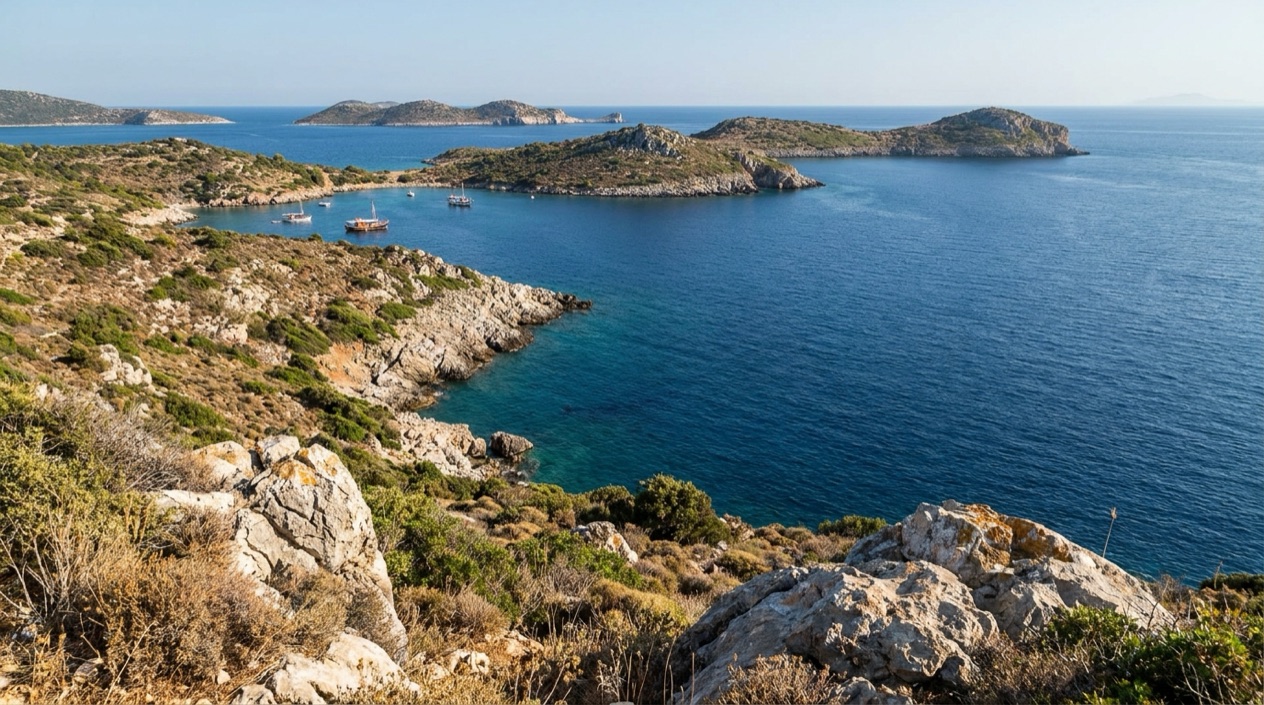
Seen from the harbor at Patitiri, the park begins as a line of low, dark islands on the horizon, with pine and scrub running down to rock and open water. There is no gate and no ticket booth, only the sea, the ferries coming and going, and the villages of Alonissos facing the strait. This is a protected stretch of the northern Aegean, and a visit here means walking, swimming and looking rather than ticking off a monument.
It is a page for travelers drawn to wild coasts and empty islets more than to organized sights.
Is visiting the Alonissos Marine Park worth it?
Yes, if you want an island trip built around the sea and the shoreline rather than around museums, and if you are happy to see some of the park only from a distance. The Alonissos Marine Park is the largest marine protected area in Europe, and it was created in Greece by Presidential Decree on May 16, 1992. That alone sets the tone: this is a place where the point is what is kept intact.
What makes it different from the other Northern Sporades is how the park is organized. Skiathos and Skopelos are the first two members of the group, and Alonissos is the third, about two miles east of Skopelos.
Here the island itself, six smaller islands and a scatter of uninhabited islets all sit inside one protected area. Parts of it are open to ordinary visits, while other parts are closed to boats altogether. The result is a landscape that is partly lived in, partly left alone, and you feel the difference as soon as you leave Patitiri behind.
The park is associated above all with the Mediterranean monk seal, the animal that gave the whole idea its urgency. Seals are shy, and the zones exist so that they can stay that way.
Dolphins and seabirds also use these waters, and you may see some of them from a shore path or a deck, though nothing is promised. Come for the wide horizon, the thin line of the islets and the sense of being on the edge of something carefully protected.
What to see at the Alonissos Marine Park
The park is divided into zones, and the zone decides what you can do. Think of it as three layers: an open area around the inhabited coast, a closed core around Piperi, and a protected island at Psathoura.
Zone B: the island and its villages
Zone B is the part of the park most travelers will actually use. The whole area is open to visits with no specific restrictions, except that free camping and lighting fires are forbidden. It takes in the communities of Patitiri, Palia Alonnisos, Votsi and Steni Vala, so your base, your meals and your walks all fall inside the park.
Swimming and walking are allowed here and are among the simplest ways to meet the natural environment. Patitiri is the main port, in the southeast of the island, and from its quay you can look out over water that belongs to the park. Palia Alonnisos, the old village, gives a different angle on the same sea, while Votsi and Steni Vala are the small harbor settlements you pass between coast and hills.
Amateur fishing is allowed in Zone B according to the rules of the Fisheries Code. For most visitors the better habit is to carry a mask, walk a coastal path and let the pine smell and the sea light do the work.
Piperi and Zone A1
Piperi is the island at the heart of the strictest protection, and the zone reaches out to the surrounding waters up to three nautical miles. Here vessel approach and mooring are forbidden, along with agricultural activity, the use of fire or chemicals, and every kind of fishing, professional or amateur. In plain terms, you do not go there.
A few things are permitted: scientific research under license, park operations under license, maintenance work on the church of Zoothohos Pigis and its adjacent spring, and herding. That small list says a lot about the place.
A chapel, a spring and some grazing animals are the only ordinary human traces allowed in a setting otherwise given over to wildlife and research. For a traveler, Piperi is something to know about and to see as a dark shape across the water, not a stop on the route.
Psathoura and Zone A2
Zone A2 covers the total surface of Psathoura Island. Like Piperi, it belongs to the part of the park where protection comes first, and it is one of the six smaller islands named in the park, alongside Peristera, Kyra Panagia, Gioura, Piperi and Skantzoura.
Psathoura is the island that makes you understand how wide the park is. It lies far out in the water, a place you read about on a map and think about while sitting on a quay at Patitiri. The rest of the park, the six smaller islands and the 22 uninhabited islets and rocky outcrops, forms a chain of shapes that fills the sea around Alonissos.
Hours, tickets and rules
The park works by zones, not by a turnstile. Zone B, the area around the villages and the island coast, is open to visits, and the rules that matter to a visitor are simple and concern behavior in the environment, not entry.
In Zone B, swimming and walking are allowed. Amateur fishing is allowed according to the rules of the Fisheries Code. Free camping and lighting fires are forbidden, which is the one firm line in an otherwise open area.
Zone A1, around Piperi and the waters to three nautical miles, is closed to vessel approach and mooring, and all fishing is forbidden there, professional and amateur alike. Agricultural activities and the use of fire or chemicals are also forbidden in that zone.
Zone A2 covers the whole of Psathoura Island. What you do in each zone depends on its rules, so the practical way to read the park is simple: the inhabited coast of Alonissos is for visiting, and the protected core is for the animals and the researchers.
When to visit the Alonissos Marine Park
Because the park around the villages is open to visits and has no gate, there is no opening time to plan around. The visit is shaped by the weather, the sea and the ferry timetable, which you build around your own days on Alonissos. Ferry and hydrofoil service from Patitiri goes to Volos, Agios Konstantinos, Skiathos, Skopelos and Skyros, so the island is joined to its neighbors and to the mainland through the port at the heart of the park.
A day here follows the sea. Walks along the coast, a swim from the shore and a long meal near the harbor are the natural rhythm, and none of it needs a ticket. If the wind is up or the sky is gray, the villages themselves, Palia Alonnisos above all, are the place for a slow stroll between houses and views over the water.
The sea temperature, the daylight and the rain are not given here, so choose your month by what you want from the island: a bright swim, a quiet walk or a base from which to look out at the islets. The park does not change its shape through the year. The zones stay where they are, Zone B stays open, and the closed core stays closed.
If your trip includes the Northern Sporades more widely, Alonissos fits between Skopelos and Skyros, with the ferries from Patitiri tying the group together. The park is the reason to stay on Alonissos rather than pass through it.
Tips for your visit
Pack for the coast: a swim mask, walking shoes and a bottle of water are the sensible kit for a park that is mostly shoreline and sea. Because free camping and lighting fires are forbidden in Zone B, plan to sleep in a village, and plan to carry any picnic without a flame.
Base yourself in one of the four communities of Zone B, depending on what you want. Patitiri is the main port, in the southeast of the island, and it is where the ferries and hydrofoils arrive. Palia Alonnisos is the old village, Votsi and Steni Vala are the smaller harbor settlements. Each is inside the park, so a walk from your door can already be a walk through protected land.
If you fish, remember that amateur fishing is allowed in Zone B only according to the rules of the Fisheries Code, and that it is forbidden around Piperi. If you are on a boat, the approach and mooring ban around that island is the one thing to keep in mind. Swimming and walking, by contrast, are open to you throughout Zone B.
Combine the park with the neighboring islands. Skopelos is two miles to the west, Skiathos is the first of the three Northern Sporades, and Skyros is also served from Patitiri. For a longer trip, the ferry connections to Volos and Agios Konstantinos link the park to the mainland.
Good to know before you go
Shops on Alonissos sell the usual holiday goods, and jewelry stores are common. The colorful sea shells sold as souvenirs are very often imported and have no authentic connection to the island, and many brand name products in the tourist shops, such as T-shirts, towels and hand bags, may be fakes or unlicensed. A better keepsake from a park like this is what you carry home in your head: the view across the strait and the shape of the islets against the sky.
Sources
- Wikipedia, Alonnisos Marine Park (https://en.wikipedia.org/wiki/Alonnisos_Marine_Park), checked October 12, 2026
- Wikipedia, Alonissos (https://en.wikipedia.org/wiki/Alonissos), checked October 12, 2026
- Wikivoyage, Alonissos (https://en.wikivoyage.org/wiki/Alonissos), checked October 12, 2026
To plan your stay
- Best Time to Visit Greece: September and Late May to Early June
- Arachova: Parnassus Mountain Town, Formaela Cheese, Ski Season and Saint George's Day
- American Airlines Flights to Greece: U.S. Cities, Athens Arrivals and Onward Island Flights
- Greece on a Budget: Cash Machines, Cards, Beaches and Ferries