
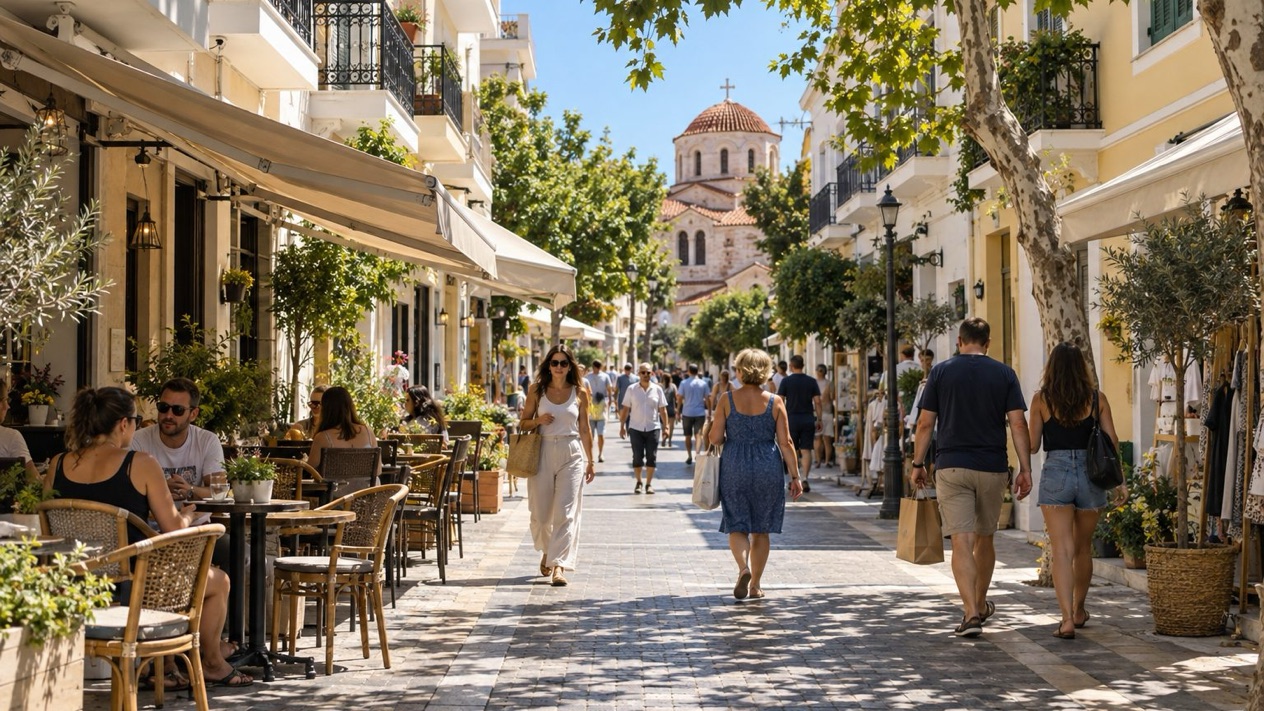
On a summer evening in Alexandroupoli, the coastal road turns into the town’s living room. Couples and families stroll beside the water, and tables fill at the tsipouro tavernas facing the sea.
This is a harbor town in Western Thrace, far in the northeast of Greece, with ferries to island neighbors and a river delta full of birds nearby.
Where is Alexandroupoli and what is it like?
Alexandroupoli sits in Western Thrace, in the northeast of Greece, on the shore of the Thracian Sea and close to the border with Turkey, a position that links Europe and Asia. It is a small town with a harbor and an airport, and that combination explains much of its character: people arrive here to cross to an island, to take a train, to head for a nature reserve or to continue toward the frontier.
The town has a short history by Greek standards. In the mid-19th century, fishermen from Maroneia and Makri founded a small settlement called Dede-Agats, which means the monk’s tree.
That fishing-village root still shows in the way the town faces the water. The beach is rocky, and the nightlife is the typical Greek kind, built around the seafront, with long evenings over small plates and glasses of tsipouro, the clear grape spirit poured with food.
The heart of the town beats along the coastal road. In summer evenings it is filled with people walking, stopping for a drink or settling into one of the traditional tsipouro tavernas by the sea. Around the town the landscape opens up. The Evros River Delta, with its wetlands and rare bird species, lies close, and the road to Didymoteicho passes Dadia Forest National Park.
Who will love it? Who may not? Anyone looking for a polished island resort with a sandy cove at the hotel door. Here the pleasures are the promenade, the table and the surroundings.
What is there to do in Alexandroupoli?
The big reasons to come are the seafront evenings, the town’s churches and museum, the birds and wetlands of the Evros Delta, and the medieval and Byzantine sites around town. What sets Alexandroupoli apart from island ports is that it is a mainland harbor on the Thracian coast, where a day can mix a lighthouse, a cathedral and a castle.
The coastal road and the tsipouro tavernas
The seafront is the main event. In summer evenings the coastal road fills with people on a stroll, and the traditional tsipouro tavernas by the sea put out their tables. Tsipouro is usually served with a spread of small dishes, so an evening here is about grazing and talking rather than ordering one big plate.
The Lighthouse of Alexandroupoli is part of the scene. Its beam reaches 24 nautical miles, and it gives three white blinks every 15 seconds, a steady signal you can watch from the waterfront as the town lights come on. Come hungry, and plan to stay past dessert.
The cathedral and its museum
Alexandroupoli Cathedral, also known as the Church of Saint Nicholas, was inaugurated in 1901 and is dedicated to the patron of sailors, a fitting choice for a town born from fishermen. It gives the harbor town a spiritual landmark and a sense of its past.
Beside the cathedral, a museum displays sacred artifacts dating back to the 16th century. Icons and church objects are the kind of things you look at slowly, and they add depth to a visit that would otherwise be all sea and seafront.
The Evros Delta and the castle and cave church
The Evros River Delta surrounds the town with wetlands and rare bird species, so nature is part of the stay and not a separate trip. Birdwatchers will want to give it time, and anyone who simply likes open water and big skies will enjoy it too.
For history, the Castle of Avanta (Potamos), also known as Boz-Tepe, has three impressive medieval towers, square and surrounded by a double wall. The Agii Theodori Cave Church near town holds frescoes from the 10th century AD. Together they show that the area around the harbor is far older than the 19th-century settlement.
How many days do you need in Alexandroupoli?
The town is small, so its own sights do not demand much time: the cathedral and its museum, the lighthouse, the harbor and the seafront strolls.
In a short stay, spend your days on the cathedral and its sacred-artifact museum, then walk the coastal road toward the evening. Plan at least one dinner at a tsipouro taverna by the sea, since that is where the town gathers. If you have a rental car or a local ride, the Castle of Avanta and the Agii Theodori Cave Church bring the medieval and Byzantine past into the trip.
With more time, the harbor becomes a launch point. The port has daily ferry services to the islands of Samothrace and Lemnos, and Samothrace is reached by a twice-daily ferry that takes 2 hours. Inland, Didymoteicho has several old churches and museums, and Dadia Forest National Park lies along the road to Didymoteicho, so the two fit naturally into a single outing.
Komotini, a small town with a Muslim character, adds a different Thracian flavor. The highway border post to Turkey is at Ipsala, on the road to Istanbul, which shows how close the frontier is. A week would let you mix an island crossing, a day of birds and forest, and a day of old churches without hurrying any of them.
Where to stay in Alexandroupoli
The seaside is where most stays center. Alexandroupoli has no cheap youth hostels, but it has many 1-star hotels and a few upscale hotels by the seaside. That means a simple room is easy to picture here, and so is a more polished stay facing the water.
Backpackers often stay at the beach near the train station, which suits travelers arriving or leaving by rail and wanting the sea close by. Staying near the water also puts you within reach of the coastal road, where the town’s evening life unfolds.
Along the seafront, small hotels combine a harbor-town setting with breakfast and wifi, and some of the 1-star hotels give each room a balcony, a pleasant thing to have in a town where the evenings are spent outside.
Choose the seafront if you want to walk out to the tavernas after dinner. Choose the area near the train station if your trip depends on a morning departure by rail. Either way, the harbor, the cathedral and the coastal road stay close at hand.
How do you get to Alexandroupoli and get around?
Travelers arrive by air from Athens, by train or by bus, and the town also has a port with island ferries. Dimokritos International Airport serves the city, with four flights every day to Athens operated by Olympic Airlines and Aegean Air. Sky Express flies three times every week to Heraklion or Sitia on Crete.
By rail, Alexandroupoli is served by trains to Thessaloniki and to Ormenio. Slow trains from Thessaloniki take 6 hours and cost €9, while fast IC trains take 4 1/2 hours and cost €16. Trains from Alexandroupoli run only to Dikea, which is 9.3 miles short of the Bulgarian border.
Shuttle buses to Athens depart twice daily and take approximately 8 to 9 hours. That is a long ride, and it puts the flight in perspective for anyone weighing the two.
Once in town, the harbor, cathedral and coastal road sit in the same town, so you can take them in on foot. For the Castle of Avanta, the Agii Theodori Cave Church, Dadia Forest National Park and Didymoteicho, you need to reach the countryside around town. By sea, the port sends daily ferries to Samothrace and Lemnos, and the Samothrace ferry runs twice a day.
When is the best time to visit Alexandroupoli?
In the summer evenings, the heart of the town beats along the coastal road, filled with people enjoying a stroll or the traditional tsipouro tavernas by the sea. If a lively seafront is why you are coming, those are the months to aim for.
Summer is also when the ferry connections to Samothrace and Lemnos matter most for a traveler who wants to add an island to the trip, since the port has daily service to both. The town’s other attractions are not tied to a season. The cathedral and its museum, the lighthouse, the castle and the cave church are there whenever you arrive, and the Evros Delta and its birds are a reason to visit beyond the beach months.
Since the beach here is rocky and the town’s charm lies in its seafront, its tavernas and its surroundings, the right month depends on what you want. For evenings outside by the sea, choose summer. For churches, castles and nature, any month you can travel to Thrace will give you something to see.
Good to know before you go
Alexandroupoli is a small town, and its rhythm is easy to fall into: mornings for the cathedral and the museum, evenings for the coastal road. Much of what draws visitors lies beyond the town, so think of it as a base for the Evros Delta, Dadia Forest and the old towns of Thrace, and for ferries to Samothrace and Lemnos.
Travelers planning to continue by road toward Istanbul will find the highway border post at Ipsala on that route. Rail travelers should know that trains from Alexandroupoli run only to Dikea, which is 9.3 miles short of the Bulgarian border.
Sources
- Visit Greece (GNTO), Alexandroupoli (https://www.visitgreece.gr/mainland/thrace/alexandroupoli/), checked October 12, 2026
- Wikipedia, Alexandroupolis (https://en.wikipedia.org/wiki/Alexandroupolis), checked October 12, 2026
- Wikivoyage, Alexandroupolis (https://en.wikivoyage.org/wiki/Alexandroupolis), checked October 12, 2026
To plan your stay
- Best Time to Visit Greece: September and Late May to Early June
- Arachova: Parnassus Mountain Town, Formaela Cheese, Ski Season and Saint George's Day
- American Airlines Flights to Greece: U.S. Cities, Athens Arrivals and Onward Island Flights
- Greece on a Budget: Cash Machines, Cards, Beaches and Ferries