
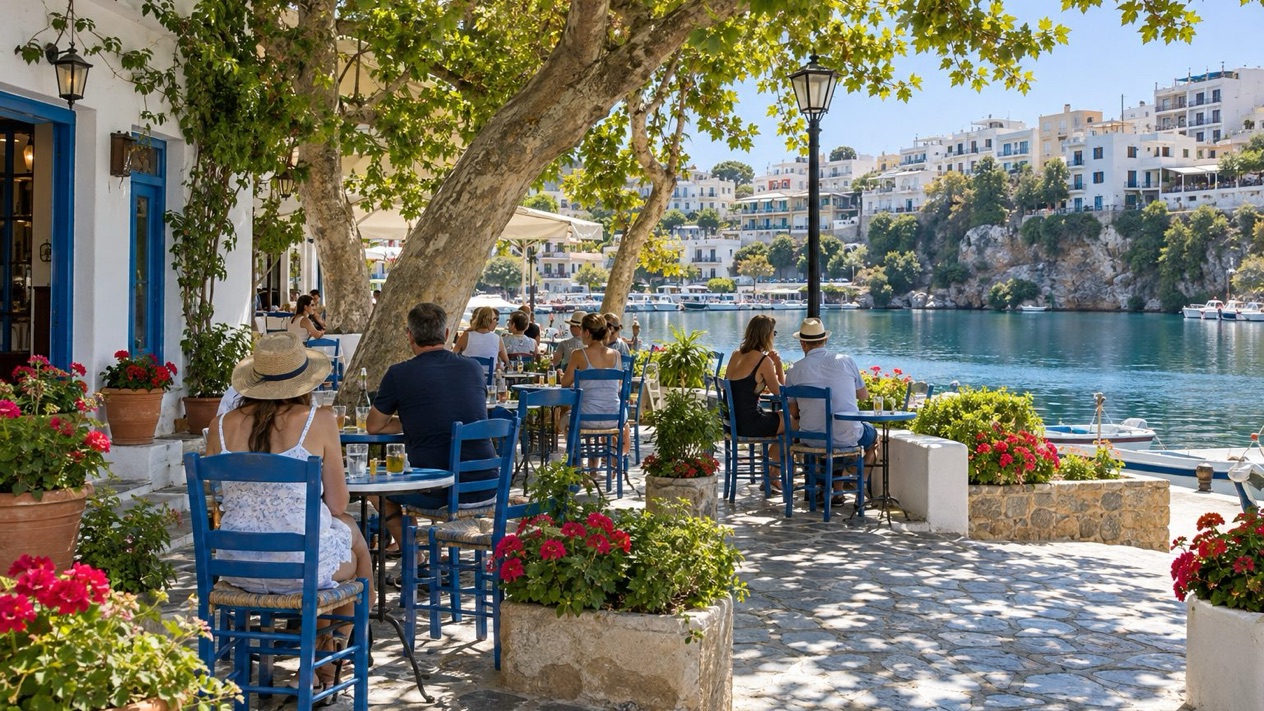
Early evening in Agios Nikolaos, and the tables around Lake Voulismeni fill with people ordering coffee, a plate of fried zucchini or a glass of something cold. Fishing boats rock on the water, pigeons walk between the chairs, and the lights of the cafés shake in the lagoon.
Where is Agios Nikolaos and what is it like?
Agios Nikolaos sits on the coast of eastern Crete, in Mirabello Bay, east of Heraklion, north of Ierapetra and west of Sitia. It belongs to the prefecture of Lasithi, the easternmost of the four into which the island is divided. It is a town rather than a resort strip, with a harbor, a lagoon and streets that climb away from the water, and it keeps a lively atmosphere all year round.
The landmark is Lake Voulismeni, a small lagoon at the very center of town, around which Agios Nikolaos grew. A narrow canal joined the lake to the sea in 1870, and the water is so deep for its size that local legend calls it bottomless. Today a small park with a trail runs along its edge, with traditional fishing boats tied up, ducks and pigeons underfoot, an amphitheatre and a ring of cafés.
The town also sits partly on the ruins of the ancient city of Lato pros Kamara, so the modern streets rest on a much older place. You will not find a single grand monument to match that, but you feel the layering as you walk between the lake, the harbor and the small beaches inside town.
The visitors are mostly from Western Europe, and Greek vacationers arrive in force in mid-August. That mix gives the cafés and promenades a cosmopolitan feel, with many languages at neighboring tables.
Travelers who like an evening stroll that ends at a waterside table will feel at home. Those looking for a village with no visitors at all, or for a place built around one long beach, may find the town more social than they want.
Crete itself is the largest Greek island, stretched between the Sea of Crete and the Libyan Sea, south of the Peloponnese. From Agios Nikolaos you reach the eastern part of that long island: Elounda and Plaka on the bay, Ierapetra on the southern shore, and Sitia farther along the coast.
What is there to do in Agios Nikolaos?
The things to do here fall into a few clear groups: the lake and the town, the small beaches, the museums and exhibitions, and the boat trip to Spinalonga. What sets Agios Nikolaos apart is that most of it sits within the town itself, so you can fill hours without a vehicle and still have outings in reserve.
Lake Voulismeni and the waterfront
Start at the lake, where the trail loops through a small park. You will see traditional fishing boats, ducks and pigeons, the amphitheatre, and cafés on nearly every side. Sit with a Greek coffee or a frappé and watch the canal where the lagoon meets the open sea.
Travelers come back several evenings in a row. It is the natural place to meet for dinner, since the town’s tables are within a few steps of the water.
Beaches and the island of Agioi Pantes
Small beaches lie within the town, which means a swim can sit between a museum visit and lunch. The tiny island of Agioi Pantes is among the attractions of the town, a small point of land that gives the bay a focal point to look at from the shore.
Mirabello Bay gives the whole area its character, with water and hills in the same view. For longer stretches of sand and swimming, travelers often drive or ride out to other points along the bay and the coast, though the town beaches are enough for a dip and a rest.
Museums, flora and fairs
The archaeological museum is the main cultural stop in town, and it fits well with the fact that the modern streets sit above the ancient city of Lato pros Kamara. Beyond it is the local flora exhibition called Iris, a smaller attraction that shows the plants of the island.
The town is also known for numerous fairs, which add stalls, crafts and local food to the streets at certain times. They give the center a seasonal rhythm, and they are one more reason a stay here feels more like living in a town than passing through a resort.
Spinalonga Island
Spinalonga Island is one of the two sites called must-sees of Crete, the other being the Minoan Palace of Knossos outside Heraklion. It can be reached from Agios Nikolaos, and also from Elounda and Plaka, so you can begin the trip from the town itself or from one of those villages on the bay.
Plan it as the main outing of your stay. Because the departure points are spread around the bay, you can pick the one that fits your base, and pair the crossing with a meal in a waterside taverna afterward.
How many days do you need in Agios Nikolaos?
The core of Agios Nikolaos is compact in what it offers: the lake, the harbor, the town beaches, the archaeological museum and the Iris exhibition fit comfortably into a few unhurried days with time left over for long meals.
With a short stay, give the lake a morning coffee and an evening drink, spend a stretch of the day on one of the small beaches, visit the archaeological museum, and set aside the outing to Spinalonga.
With more time, the surroundings open up. Elounda and Plaka on the bay are natural additions, and they are the other places where the boat to Spinalonga starts. Ierapetra lies to the south and Sitia to the east, each with its own harbor and a different pace from Agios Nikolaos, and each one can be a change of scene for a day.
Heraklion adds the Minoan Palace of Knossos and an important archaeological museum, along with the island’s largest city and its main international airport. Travelers who want to see Knossos can pair it with the town’s own museum for a sense of how many layers of history Crete holds.
If you like food and wine, a week also lets you follow the Cretan table. Grapes are harvested from the beginning of August to October depending on variety and altitude, so a stay in late summer or early autumn can bring you closer to the vineyards of the island. Traditional tavernas and kafeneions (coffee shops) are the places to taste what is fresh that day.
The rural side of Crete is shown in museums such as Lychnostatis in Hersonnisos and in restored houses like the one in the small village of Vrahasi. These showcase the traditional agricultural lifestyle of the island and make a contrast to the harbor life of Agios Nikolaos.
Where to stay in Agios Nikolaos
The center of town, around Lake Voulismeni, is the base for travelers who want cafés, the harbor and the small town beaches within reach of the door.
Staying near the lake also puts the museum, the Iris exhibition and the waterfront within the same stretch of town. Travelers who want to see the town on foot and return to their room between a swim and a meal will find this part of Agios Nikolaos the natural fit.
Elounda and Plaka, the other two places from which boats go to Spinalonga, offer a different base on the same bay. They suit travelers who want to be nearer the departure point for the island and who are happy to be a little away from the town’s busiest evening streets.
Because tourism is mainly West European and Greek visitors concentrate in mid-August, the town’s rhythm shifts with the calendar. In the tourist season the dining scene is at its fullest, since some Cretan towns that cater mainly to visitors have international restaurants that open only during the season. Staying in the center during those months puts you beside most of what is open.
For a stay built around other parts of eastern Crete, Ierapetra and Sitia are towns with their own harbors and are options for an overnight on a longer route. Sitia also has an airport, which matters if you arrive by air at the eastern end of the island.
If you plan to drive around the island, a base in or near the center still works, since the town is a hub for the bay and its neighbors. If you do not, a room near the lake keeps nearly everything you want on foot.
How do you get to Agios Nikolaos and get around?
Travelers arrive by air on Crete, and Heraklion has the island’s main international airport, which is also the closest large gateway to Agios Nikolaos in the sense of being the capital city of the island and its principal hub. Heraklion International Airport is planned to be replaced by a new inland airport at Kasteli, southeast of Heraklion.
Other airports on the island give further choices. Chania International Airport is much larger but far less busy than Heraklion. Sitia Airport serves a small number of domestic flights, mainly to and from Athens, and it receives charter flights from Europe, mainly France, during the summer.
Heraklion also has a cruise and ferry port, which is the sea gateway for travelers who arrive on the island by boat. From these arrival points you continue to Agios Nikolaos in eastern Crete, which lies east of Heraklion.
Once in town, the center is the place to explore on foot, since the lake, the harbor, the small beaches and the museum all lie within the town itself. For Spinalonga, boats leave from Agios Nikolaos, Elounda and Plaka, so you can travel on the water for that outing.
To see more of the island, travelers hire a car. A valid driving licence written in the Roman alphabet is required, and one in another alphabet needs an International Driving Licence. The driving age is 18 for passenger cars and 16 for mopeds, and you can and should pay for rental vehicles with a credit card.
Crete has helmet, seat belt and child seat laws. Rental companies are required to have helmets available for all vehicles that require one, which matters if you plan to rent a moped for a run along the bay.
When is the best time to visit Agios Nikolaos?
September and early October are the months to aim for if you want the town at a lively but less hurried pace, and they come with the grape harvest, which runs from the beginning of August to October depending on the variety and the altitude. The town keeps a lively atmosphere all year round, so the choice of month is about what you want around you rather than whether anything is open.
The crowded stretch is mid-August, when Greek tourism concentrates in Agios Nikolaos. Visitors from Western Europe fill the town through the summer, and the Greek holiday weeks add a different crowd to the lakeside cafés and the harbor. If you prefer more room at the water, avoid that week.
The tourist season is also when the full range of restaurants is open. Some towns in Crete that cater mainly to visitors have international restaurants that open only during the season, so a trip outside it means a smaller choice of dining, with the traditional tavernas and kafeneions as the steady core.
Spinalonga and the other outings on the bay are part of the summer routine, and the town’s numerous fairs add seasonal color. In the months around the grape harvest you can pair a stay with the wine side of Crete, and in any month the lake remains the place where the town gathers in the evening.
Good to know before you go
Greece uses the euro, and in Crete’s tavernas the printed menu is mostly for tourists. Cretans ask the waiter for the specialties and look in the kitchen or in a glass display case called a vitrine, and in traditional tavernas and kafeneions most dishes are fresh from that day. Follow that habit and you will eat what the locals eat.
If you rent a car or moped, remember that Crete has helmet, seat belt and child seat laws, and that a credit card is the way to pay for the rental. Plan your meals with the season in mind, since some restaurants that cater mainly to visitors open only during the tourist season.
Sources
- Visit Greece (GNTO), Agios Nikolaos (https://www.visitgreece.gr/islands/crete/agios-nikolaos/), checked October 12, 2026
- Wikipedia, Agios Nikolaos, Crete (https://en.wikipedia.org/wiki/Agios_Nikolaos,_Crete), checked October 12, 2026
- Wikivoyage, Crete (https://en.wikivoyage.org/wiki/Crete), checked October 12, 2026
- Wikipedia, Lake Voulismeni (https://en.wikipedia.org/wiki/Lake_Voulismeni), checked October 12, 2026