
The first morning in Athens begins with the clatter of café chairs and the smell of coffee and warm sesame bread rings from the street kiosks. Above the rooftops the Parthenon sits on its rock, and you keep finding it again at the end of side streets. Three days in Greece work best as a close look at one city and a taste of the Aegean, with Athens as the base and one island crossing in the middle of the plan.
Is three days enough in Greece?
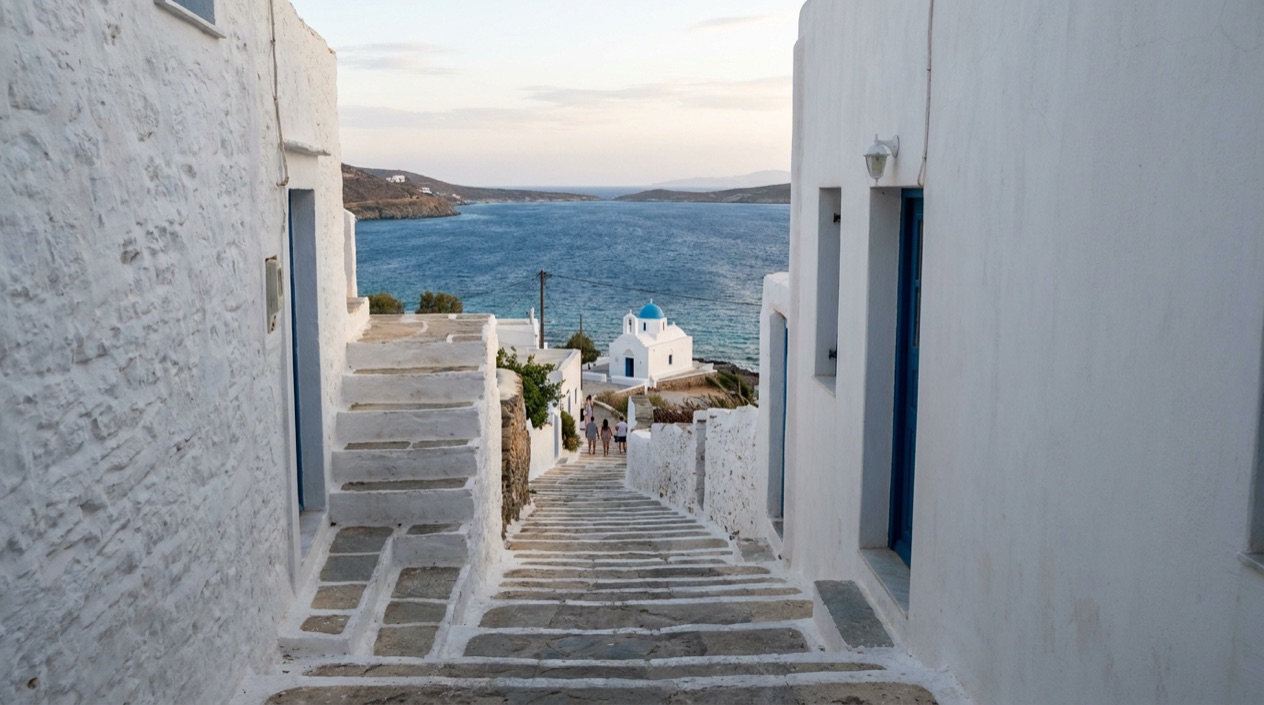
Three days are enough for a first taste of Greece, if you accept that you will see Athens properly and one island briefly rather than the whole country. The plan here gives two days to the city, with the Acropolis and its museum, and one day to Syros, the Cycladic island linked to Piraeus by a ferry that takes only 2.5 hours.
What it leaves out is most of what makes Greece a country of islands, mountains and villages. Santorini, Mykonos, Naxos and Crete each deserve their own stay, and the mainland holds monasteries and ancient sites that do not fit into a short trip.
With more time, add one of those islands and give it nights, not an afternoon. The weather in Athens changes the feel of the plan, so here are three months side by side.
| Month | Average high (°F) | Average low (°F) | Rain (inches) | Rain days (0.04 inch or more) |
|---|---|---|---|---|
| April | 68.4 | 53.2 | 1.10 | 5.5 |
| July | 91.8 | 74.1 | 0.28 | 1.6 |
| October | 75.2 | 61.0 | 1.09 | 3.9 |
July brings real heat and almost no rain, so sun protection matters on the exposed ancient sites. April and October are milder, with a few rainy days, and a light rain jacket is the sensible thing to carry.
Day 1 in Greece
Start on the Acropolis. The Parthenon stands here in Athens, and the whole site covers 7.5 acres, which means you spend your time walking among the stones, gateways and terraces rather than rushing between buildings. Take in the city spread out below you, with the roofs and the hills around it, then come down slowly.
For the afternoon, drop into the old quarters at the foot of the rock. Plaka has narrow lanes and shops selling sandals, olive oil and sponges. Monastiraki next to it has the flea market and the cafés where people sit over a frappé. Lunch can be a taverna with a shaded table, ordering souvlaki, a spread of meze to share, or a plate of grilled vegetables with feta.
In the evening, let the day slow down. Greek dinner begins late and runs long, so order dishes in rounds: tzatziki, fried zucchini, then moussaka or grilled fish. Afterwards, a glass of ouzo or a small pour of wine at a rooftop bar lets you look at the lit Parthenon above the city.
One tip for moving around: the Athens Metro is the way to cross the city without worrying about traffic, and Day 1 needs little of it, since the old quarters sit close under the Acropolis. Save your energy for Day 2.
Day 2 in Greece
Spend the morning at the Acropolis Museum, where the finds from the rock are laid out so that the sculpture you saw from a distance yesterday can be seen up close. It is a good place to understand what the Parthenon once held. Take the time to read the labels, and look through the glass floors at the excavations beneath the building.
After lunch, head to the working side of the city. The central market streets are lined with butchers, fishmongers and stalls of olives, spices and dried herbs, and the shops around them sell the cheeses and honey that make good gifts. A coffee at a kafenio, the traditional coffeehouse, is a pleasant pause. You can follow it with a loukoumades stop, the hot honey doughnuts sold across the center.
In the evening, ride toward Piraeus, the port of Athens, to feel the other side of Greece, the one that lives on the sea. Ferries and boats come and go there, and the seafront has fish tavernas serving grilled octopus, small fried fish and salads of tomato, cucumber and capers. It also puts you at the port ahead of tomorrow’s crossing.
A practical note: Athens buses do not let passengers use the front door to get on or off, so use the other doors.
Day 3 in Greece
Spend your last evening in Athens, which gives you a real Cycladic island within reach of Athens. It gives a different mood from the capital without asking you to cross the whole Aegean.
On the island, sweet things are the local pleasure, in particular the loukoumi, the soft, powdered sweets sold in shops near the harbor, and the local cheeses that appear on taverna tables. Sit on the waterfront with a coffee and let the harbor set the pace, then wander uphill through the lanes of the old town as far as you feel like.
Back in Athens, spend the evening without a plan. Walk the lanes of Plaka again, now that you know them, or sit at a taverna in a quieter neighborhood and order what the waiter recommends. A late dinner of lamb, a salad of greens with olive oil and lemon, and a plate of fruit sent over at the end makes a good last night.
If the sea does not appeal, keep the third day in the city. Return to the places you liked best, walk the hills above the old quarters or simply sit in the cafés. Athens rewards a slower day as much as a full one.
Where to stay for three days in Greece
Stay in central Athens, close to the old quarters under the Acropolis. For this plan, the center works because two of your three days are spent in the city and a Metro station nearby helps with the trip toward Piraeus. Plaka and the streets near it put you among tavernas and cafés, so you can walk out of your door to dinner and see the Parthenon lit up above the rooftops.
A base near the Metro is the useful detail, since the line runs from early morning to past midnight and later on weekend nights.
With only three days, keep Athens as your base.
What to skip if you only have three days in Greece
Skip a second island. Santorini, with its active volcano and the Bronze Age settlement of Akrotiri, and Mykonos, known for its nightlife and its winds, both tempt first-time visitors.
Naxos, the largest island of the Cyclades, has the great marble gateway of the Portara. Each of them has an airport, but every one deserves a stay of its own, and squeezing a second island in would leave you with transfers instead of time to look.
Skip Crete as an add-on. It is big enough to be a trip of its own, with mountains, the dishes of dakos and gamopilafo, and the old town of Chania with its ancient Kydonia. Its main airport at Heraklion is the second busiest in Greece. Use the time to do justice to Athens, and plan Crete for a longer visit.
Skip the urge to tick off every ancient site. Choose the Acropolis and its museum, enjoy them, and leave the others for later. Delphi, Olympia and the monasteries of the mainland are better done on a trip that gives them time.
Skip a long, heavy schedule of museums as well. One good museum in the morning leaves room for the market, the neighborhoods and the long meals that are part of the pleasure of Greece. A glass of something cold at a corner café is a better use of an hour than a third gallery.
Getting around Greece in three days
In Athens you get around on foot and by Metro. The old quarters under the Acropolis, Plaka and Monastiraki, are close together, so you walk between them, and the Metro covers the longer links to the museum area, the market and Piraeus. Buses also serve the city, and passengers there cannot use the front door to get on or off.
| Service | Runs |
|---|---|
| Athens Metro, daily | 5:30 a.m. to 00:30 a.m. |
| Lines 2 and 3, Friday and Saturday nights | Later than usual |
If you arrive by Metro from the airport, note that on line 3 the section between the Airport and Douk. Plakentias has trains every 30 minutes, so build that wait into your plans. For Day 3, the crossing from Piraeus to Syros is by ferry and takes 2.5 hours, which shapes how much you can do on the island.
Later trips will bring other legs. Several islands have international airports, including Santorini and Mykonos, while Syros has an airport with domestic flights only. For those islands, think of the journey by sea or by air, depending on where you are going, and plan it as part of a longer visit.
Good to know before you go
Bring a hat, sunscreen and a water bottle if you travel in summer, since July is hot in Athens, and carry a rain jacket in April or October. Comfortable shoes matter on the Acropolis and in the old lanes, where the stone underfoot is uneven.
Sources
- Wikipedia, Tourism in Greece (https://en.wikipedia.org/wiki/Tourism_in_Greece), checked October 12, 2026
- Wikivoyage, Greece (https://en.wikivoyage.org/wiki/Greece), checked October 12, 2026
- Wikivoyage, Greek islands (https://en.wikivoyage.org/wiki/Greek_islands), checked October 12, 2026
- OASA, Athens urban transport (https://www.oasa.gr/en/), checked October 12, 2026
- Athens Transport, public transport guide (https://www.athenstransport.com/english/), checked October 12, 2026
- Wikipedia, Acropolis of Athens (https://en.wikipedia.org/wiki/Acropolis_of_Athens), checked October 12, 2026
- Wikipedia, Parthenon (https://en.wikipedia.org/wiki/Parthenon), checked October 12, 2026
- Santorini official guide (https://www.santorini.gr/), checked October 12, 2026
- Visit Greece (GNTO), Santorini (https://www.visitgreece.gr/islands/cyclades/santorini/), checked October 12, 2026
- Wikipedia, Akrotiri (prehistoric city) (https://en.wikipedia.org/wiki/Akrotiri_(prehistoric_city)), checked October 12, 2026
- Wikipedia, Ancient Thera (https://en.wikipedia.org/wiki/Ancient_Thera), checked October 12, 2026
- Visit Greece (GNTO), Mykonos (https://www.visitgreece.gr/islands/cyclades/mykonos/), checked October 12, 2026
- Wikipedia, Mykonos (https://en.wikipedia.org/wiki/Mykonos), checked October 12, 2026
- Visit Greece (GNTO), Naxos (https://www.visitgreece.gr/islands/cyclades/naxos/), checked October 12, 2026
- Wikipedia, Naxos (https://en.wikipedia.org/wiki/Naxos), checked October 12, 2026
- Wikipedia, Portara (https://en.wikipedia.org/wiki/Portara), checked October 12, 2026
- Heraklion airport information (https://www.heraklion-airport.info/), checked October 12, 2026
- Visit Greece (GNTO), Crete (https://www.visitgreece.gr/islands/crete/), checked October 12, 2026
- Wikipedia, ANEK Lines (https://en.wikipedia.org/wiki/ANEK_Lines), checked October 12, 2026
- Wikipedia, Blue Star Ferries (https://en.wikipedia.org/wiki/Blue_Star_Ferries), checked October 12, 2026
- Hellenic National Meteorological Service (HNMS), climatological normals 1991-2020 for Elliniko station (https://www.emy.gr/climatic-data), monthly mean daily maximum and minimum; rain from the ECMWF ERA5 reanalysis, 1991-2020, grid cell of Athens (Open-Meteo), checked October 12, 2026
- ECMWF ERA5 reanalysis 1991-2020, grid cell of Athens (Open-Meteo), checked October 12, 2026
- Plan de the (duree choisie by the redaction)
To plan your stay
- Best Time to Visit Greece: September and Late May to Early June
- Arachova: Parnassus Mountain Town, Formaela Cheese, Ski Season and Saint George's Day
- American Airlines Flights to Greece: U.S. Cities, Athens Arrivals and Onward Island Flights
- Greece on a Budget: Cash Machines, Cards, Beaches and Ferries