
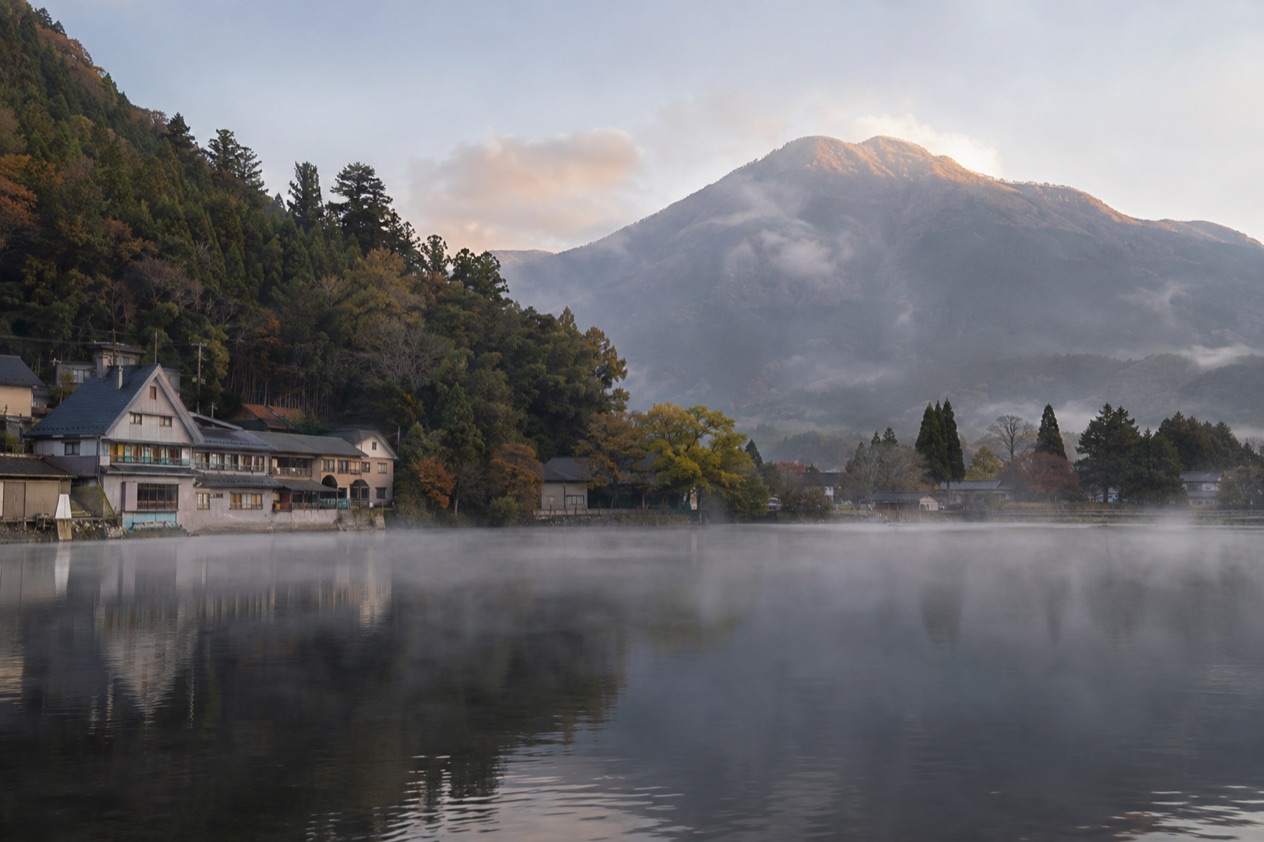
Steam drifts off a hot spring bath into cool air, and beyond the rooftops a two-peaked mountain stands over the town. Footsteps and the clink of teacups carry along the lanes where small shops and cafés sit close together. Yufuin is a hot spring town in Oita Prefecture, a place for slow days of bathing, walking to a lake and wandering lanes, suited to travelers who like to let a day unfold without a checklist.
Where is Yufuin and what is it like?
Yufuin is the northwest section of the city of Yufu, in Oita Prefecture on the island of Kyushu, and it is described as one of the best hot spring resorts in Japan. Its hot spring system, Yufuin Onsen, is extensive, and the town is set among mountains rather than on the coast. The name on the map is Yufu, but travelers say Yufuin, and that is the district with the station, the lanes and the baths.
The character of the place comes from scale and rhythm. Yufuin welcomes more than three million visitors a year, yet it is a town of lanes, small galleries, bakeries, sweet shops and cafés, where people drift from one doorway to the next with a warm snack in hand. Mornings tend to start with a bath, afternoons with a walk, and evenings with a meal at an inn or a small restaurant.
Over everything stands Mount Yufu, also called Yufu-dake, with two peaks that you spot from many corners of town. It gives Yufuin its postcard silhouette and its sense of being a valley resort. Beppu, a far larger hot spring resort in the same prefecture, makes a very different companion: steam vents, hot spring zones and a more urban feel, while Yufuin keeps things small and closer to the hills.
Who loves it? Couples, friends and families who like onsen, strolling, browsing and eating small things along the way. Who may not? Travelers hungry for nightlife, big sights or a packed schedule may find the days here move slowly, and those who prefer to avoid shared lanes in the busy hours should keep that in mind.
What is there to do in Yufuin?
Bathing comes first, then a lake, then a mountain, and in between the lanes of the town itself. What sets Yufuin apart from its neighbor Beppu is the mood: Beppu is about steaming ground and spectacle, while Yufuin is about soaking, strolling and sitting down with something good to drink.
Onsen and sentō
A hot spring bath is the reason people come. Some onsen in Yufuin are open to day visitors, while many are strictly for overnight guests, so the way you plan your stay shapes which baths you can enter. The town also has sentō, traditional public baths, and some can be used by tourists while others are for local residents only.
A bath here usually means washing first, then lowering yourself into water that can be hot and mineral-rich, with a view of trees or hills if the pool is outdoors. Staying at an inn with its own baths lets you soak in the evening and again in the morning, which is how people like to experience an onsen town. Whichever bath you choose, take the time: the soak is the point, not a stop between other stops.
Lake Kinrinko
Lake Kinrinko is the town’s best-loved stroll, and it costs nothing to visit. It is a leisurely 1.5-km walk from Yufuin train station along Yufumi-dori and Yunotsubo Kaido, a route that passes the shops and cafés of the town on the way. At the water, visitors commonly photograph the lake with the two-peaked Mount Yufu rising behind it.
Walk out, stop for a coffee or a sweet along the lanes, and walk back at a pace that suits you. The lake is a spot to sit, look and take photographs rather than a destination with a program, which is exactly what makes it a fit for an unhurried afternoon.
| Site | Admission |
|---|---|
| Lake Kinrinko | Free |
Mount Yufu
Mount Yufu can be hiked in about 90 minutes, which makes it the active choice in a town otherwise built around soaking and strolling. It is the same mountain you see from the lanes and from the lakeshore, so climbing it gives you a new view of the town you have been exploring.
A hike like this pairs naturally with a bath afterward. Sore legs and a hot spring is a very old combination in Japan, and Yufuin offers it close to home. If the weather turns, the mountain is just as rewarding as a backdrop from the café table.
The lanes and cafés
The street between the station and the lake is a destination in itself. Small shops sell ceramics, sweets and local goods, and cafés and bakeries invite you to sit down. Nothing here needs a plan: you wander, you stop when something smells good, and you keep going.
It suits travelers who enjoy browsing and snacking, and it works for families and groups who want something to do between baths. Those who come for the onsen alone can treat the lanes as the walk between one soak and the next.
How many days do you need in Yufuin?
One night is enough for a taste, and two nights suit the town better. A short stay fits a bath, the walk to Lake Kinrinko, an hour or two in the lanes and a dinner at an inn, with room left for a slow morning.
Spending a night rather than passing through changes the experience. Staying at an inn with onsen baths means you can soak in the evening and wake up to another bath, and that rhythm is what Yufuin does best. A day visit works if you only want the lake and the lanes, but many onsen are strictly for overnight guests, so a day trip leaves some baths out of reach.
With a second day, add the Mount Yufu hike, which takes about 90 minutes, and follow it with a bath. A third day gives you room to repeat your favorite café or simply do nothing, which in an onsen town is a perfectly good plan.
For a longer trip, pair Yufuin with Beppu, the largest hot spring resort in western Japan. It has eight major hot spring zones and about 3,000 steam vents, and its Beppu Hells are thermal waters near boiling that cannot be bathed in.
Tatsumaki-Jigoku, the tornado hell, is one of the most active geysers in the world, and Kamado-Jigoku, the furnace, was once used to cook rice over the geyser. Seeing them makes a vivid contrast with the soaking you do in Yufuin.
Where to stay in Yufuin
Staying overnight gives access to those baths, and it is the clearest way to feel what makes Yufuin different from a day stop.
Two areas make sense. Near the train station, you are close to the Yufu City Tourist Information Center and the start of the lane that leads toward Lake Kinrinko. That suits travelers arriving by train who want to walk to their lodging, step out into the shops and cafés, and come back for a bath.
Closer to the lake and the lower slopes of the mountain, the town opens out. Staying here puts the water and the view of Mount Yufu near your door, and it suits travelers who want a lodging with a view more than quick access to the lanes. Either way, the walk between the two is the 1.5-km stroll the lake path follows.
A traditional ryokan, a Japanese inn, is a good fit here. Expect tatami floors, a yukata (a light cotton robe) to wear around the inn, baths on the premises and, often, a multi-course dinner built around local ingredients. Shoes come off at the entrance, and the evening revolves around the bath and the meal. If you prefer a simpler base, a small lodging in town still keeps the lanes and the lake within reach.
How do you get to Yufuin and get around?
From there, the town is laid out around a walk: the 1.5-km stroll to Lake Kinrinko along Yufumi-dori and Yunotsubo Kaido.
Beside the station is the Yufu City Tourist Information Center, which has some information in English. It is the first place to stop for a map or a question about the town, and it sits right where you step off the train.
| Site | Open |
|---|---|
| Yufu City Tourist Information Center | 09:00 to 17:30 |
Getting around is mostly a matter of walking. The route from the station to the lake runs through the heart of the town, so a single stroll covers the lanes, the shops and the water. A walk like that lets you stop whenever something catches your eye, and in Yufuin that happens often.
Beyond the center, the Mount Yufu hike and the baths farther from the station lie outside this walk. Plan the day around where you will sleep and bathe, and let the station, the lake and the lanes be the part you cover on foot.
When is the best time to visit Yufuin?
Yufuin draws visitors across the calendar, with more than three million a year, because a hot spring is a pleasure in every season. The choice of month is about mood. A soak feels different when the air is cool and the water is hot, and a walk to the lake feels different under a clear sky than in mist.
Cooler months suit the bathing side of the town. Stepping from a warm bath into fresh air, with the mountain nearby, is much of what people come for, and a morning mist over a valley town is a scene travelers hope to see. Warmer months suit the hike up Mount Yufu and long afternoons on the lanes between the station and Lake Kinrinko.
Weekends and Japanese holiday periods are when a town this size tends to feel busiest, since it welcomes so visitors. A weekday stay leaves more room in the lanes and at the lake. Whatever the month, a bath and a walk are always on the table, and rain simply moves the plan toward the baths and the cafés.
Good to know before you go
Yufuin rewards a slow pace, so plan around baths and walks rather than a long list of stops. Some onsen and sentō welcome tourists and others do not, so check which bath you are heading to before you set out with a towel. Rain and the typhoon season are worth keeping in mind when you plan outdoor time such as the mountain hike, and the lanes and cafés give you somewhere to go if the weather turns.
Sources
- Japan National Tourism Organization, Beppu (https://www.japan.travel/en/destinations/kyushu/oita/beppu-and-yufuin-around/), checked October 11, 2026
- Wikipedia, Yufuin (https://en.wikipedia.org/wiki/Yufuin), checked October 11, 2026
- Wikivoyage, Yufuin (https://en.wikivoyage.org/wiki/Yufuin), checked October 11, 2026
To plan your stay
- Best Time to Visit Japan: Cherry Blossoms, Autumn Colors, Weather and Festivals
- Where to Stay in Japan: Ryokan, Temple Stays, Capsule Hotels and the Best Cities to Base In
- Sending Luggage from the Airport in Japan: Hands-Free Travel, Hotel Delivery and Coin Lockers
- Know Before You Go to Japan: Entry, Money, Etiquette and Getting Around