
Takamatsu is a port city on the Seto Inland Sea, where the daily rhythm is set by boats, gardens and noodle shops. It suits travelers who like a base with a great garden, a castle by the water and islands of contemporary art within reach.
Where is Takamatsu and what is it like?
Takamatsu is the capital of Kagawa Prefecture, on the northern coast of Shikoku, facing the Seto Inland Sea. Across the water lies Honshu, and the Seto-Ohashi Bridge carries trains from the Shikoku side to Okayama. For a visitor, that means the city sits at a hinge: the rest of Shikoku opens out behind it, and a scatter of islands sits in front of it, reached by boat from a harbor beside the station.
The city has the feel of a working regional capital rather than a sightseeing showpiece. Office workers stream out at lunchtime to the noodle shops, covered shopping arcades hold fishmongers, bakeries, clothing stores and small cafés, and the castle grounds sit right in the middle of town, with the sea lapping at the moat.
Nothing here demands a rushed schedule. The pace suits someone who likes to wander, stop for a bowl of noodles, and let one good sight fill a morning.
Takamatsu is also a city of water. Its harbor connects it to nearby islands, its castle draws seawater into its moat, and its biggest garden is built around ponds, pines and little bridges. Walk around any of these and you feel the Inland Sea close by, even when you cannot see it.
Who will love it? Garden lovers, travelers drawn to modern art, and anyone who plans a trip around meals. It makes a very good first stop on Shikoku, and it is a comfortable place to rest between bigger itineraries. Who may not?
Anyone who wants the lantern-lit lanes of Kyoto or the neon of Tokyo. Takamatsu offers a few outstanding places spread across a regional city, and it rewards the traveler who is content with that.
What is there to do in Takamatsu?
The reasons to come are a historic garden, a castle with a sea moat, a ferry harbor that opens onto art islands, and a hillside temple. Takamatsu differs from its neighbors because these four things sit close together in a single city, and a bowl of Sanuki udon fits between any of them.
Ritsurin Garden
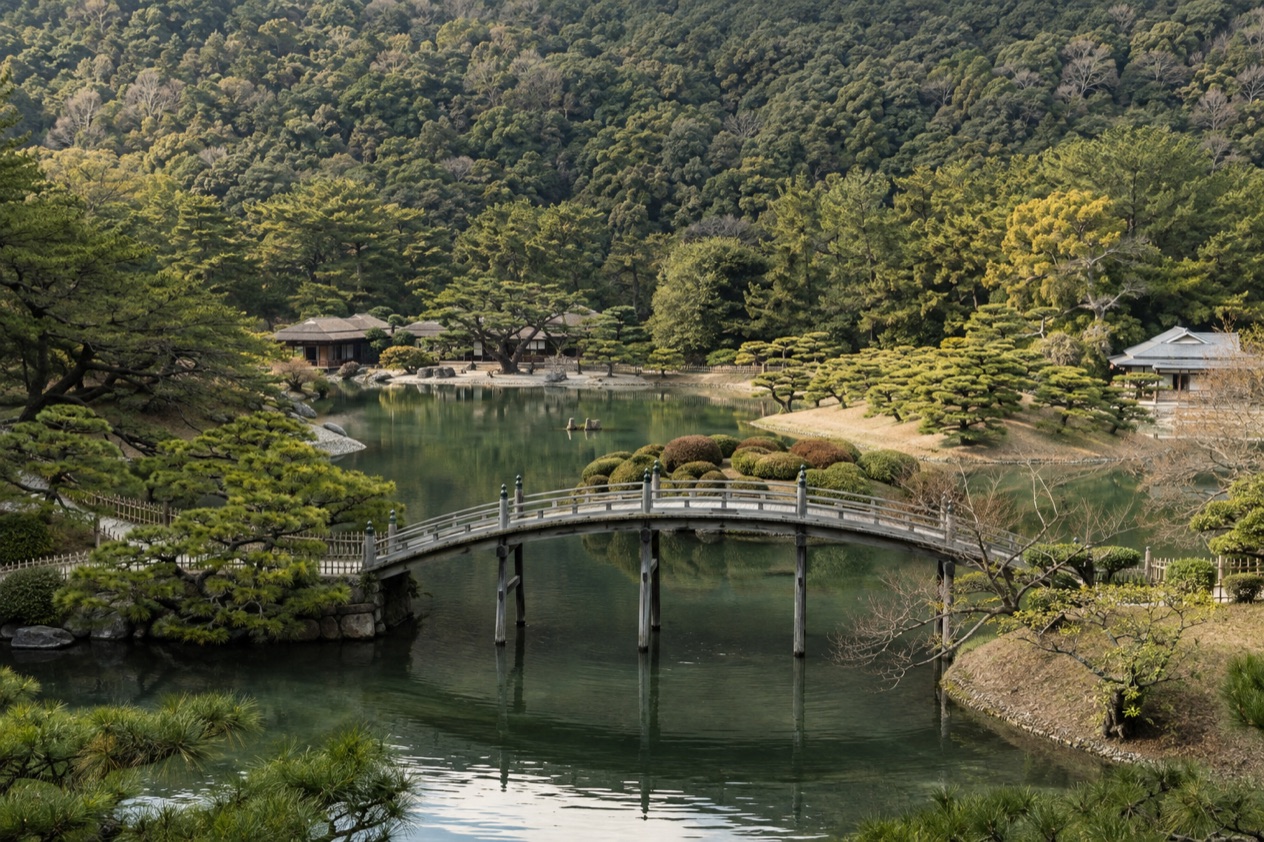
Ritsurin Garden is a large strolling garden, completed in 1745 as a private villa and garden for local feudal lords and opened to the public in 1875. The Japanese government designates it a Special Place of Scenic Beauty. You walk paths that circle ponds, cross wooden bridges and pass carefully shaped pines, and each bend frames a different view of the hills behind.
Two experiences stand out. You can ride a traditional boat on the pond with a guide’s commentary, and you can sit in the tea house with a bowl of matcha and a sweet. The garden is spectacular in spring during cherry blossom season and in autumn, when the maples turn vivid colors. Any season rewards a slow loop, though, and a rainy day gives the moss and stone a deeper tone.
Takamatsu Castle and the harbor
Takamatsu Castle is known for using seawater in its moat, an unusual sight in a country where most castle moats are fed by rivers. Its restored keep is open for public viewing, and the grounds make a pleasant circuit of stone walls, pines and water. Locals know the castle by the name Tamamo, and the moat holds sea bream, a detail that children and curious adults like to look for from the bridges.
The harbor is a few minutes’ walk from Takamatsu Station, so a stroll along the waterfront fits easily before or after a ferry. Boats leave here regularly for nearby islands, and watching them come and go is part of the city’s character. The castle and the port together give you a feel for Takamatsu as a city built around the sea.
Naoshima and the art islands
Naoshima Island, reached by ferry from Takamatsu, houses several museums and modern art installations. Much of the art is set into the landscape, so a visit mixes gallery rooms with walks past sculptures, quiet village lanes and views over the water.
Since 2010, Takamatsu and nearby Seto Inland Sea islands have hosted the Setouchi Triennale, a contemporary art festival. During the festival, the islands fill with temporary works alongside the permanent ones. Even outside a festival period, the combination of ferry crossing, art and island scenery gives Takamatsu something no inland city can match.
Yashima and the udon tables
Yashima Temple, in the Yashima district of Takamatsu, is free to enter. It gives you a temple visit without a ticket line, a chance to walk among its halls and look out over the sea. It pairs naturally with a day built around the city’s history, away from the garden and the castle.
Then there is the food. Kagawa is the home of Sanuki udon, wheat noodles with a firm bite, served hot in broth or cold with a dipping sauce, often with a raw egg, tempura or a sprinkle of scallions. Travelers plan a meal or two around a bowl, and Takamatsu is the obvious base for it. Pair it with a pastry from an arcade bakery or a coffee in a small café.
How many days do you need in Takamatsu?
A long weekend covers Takamatsu well, and a few more days let you add the islands and the rest of Shikoku. The city’s main sights are compact in spirit even if they are spread across town, and the ferry harbor is close to the station, so there is little wasted motion.
Fit in at least one udon lunch, and let dinner be an izakaya, the Japanese pub where small dishes arrive one after another. A second day can go to Naoshima by ferry, where the museums and outdoor installations fill the hours.
With more time, add Yashima Temple, which is free to enter, and a slower evening along the harbor. If a Setouchi Triennale is on, give the islands extra days, since the festival spreads across several of them and rewards unhurried crossings. Another option is a day trip by rail to Okayama across the Seto-Ohashi Bridge, which lets you cross from Shikoku to Honshu by train.
For a longer trip around Shikoku, Takamatsu Station is the starting point. JR Shikoku runs trains from there to destinations around the island, so the city works well as the first or last night of a loop. Even travelers who only pass through can fit in a garden walk and a bowl of noodles.
Where to stay in Takamatsu
The most practical area is around Takamatsu Station, because the ferry port is a few minutes’ walk from it. Staying here puts the trains to Okayama and around Shikoku, and the boats to the islands, right at your door. It suits travelers who plan an island day, an early departure or a rail trip, and who like to keep their luggage handling simple.
The city center, around the covered shopping arcades, suits travelers who care about evenings. Here you find the noodle shops, izakaya and cafés, and you can walk to dinner and back without planning a ride. It is a good fit for food lovers and for anyone who likes to wander at night, with the castle grounds nearby.
A third choice is to base yourself near Ritsurin Garden. It suits garden lovers who want to be among the first through the gate and who like a calmer neighborhood after the day. Takamatsu has a range of places to sleep, from business hotels to traditional inns, and the right area depends less on prestige than on what your days look like.
Think about your plans first. If the islands are the priority, stay by the harbor. If dinners and strolling matter most, stay in the center. If the garden is the reason you came, stay close to it. Any of the three works for a trip built on Takamatsu itself.
How do you get to Takamatsu and get around?
Travelers arrive at Takamatsu Station, the main train station of the city, operated by JR Shikoku. From here trains run to destinations around Shikoku and to Okayama Station on Honshu, crossing the Seto-Ohashi Bridge. That rail link is what ties Takamatsu to the main island, and the bridge crossing is part of the journey.
The ferry port sits a few minutes’ walk from the station, which makes arrival and onward travel straightforward for island trips. Regular boats serve nearby islands, including Naoshima, so you can step off a train and onto a boat in one outing. Arriving by sea or by rail, you end up in the same part of town.
Within the city, the main sights are Ritsurin Garden, Takamatsu Castle, the arcades and Yashima Temple. Beyond those, you will move between neighborhoods by whatever local transport suits your plan, and a day on the islands depends on the ferry timetable.
A trip built around Shikoku can use Takamatsu as the rail hub, since the station connects the city to the rest of the island. For a trip built around art, the harbor is the key. Either way, plan your days around the station and the port, and the rest follows.
When is the best time to visit Takamatsu?
Spring and autumn are the best seasons. In spring, Ritsurin Garden is spectacular during cherry blossom season, with petals over the ponds and pines. In autumn, the same garden is spectacular again, this time with vivid colors, and the stone paths and bridges show off the maples.
Summer is the hot side of the year. July and August can be quite warm, so garden walks and castle visits feel better with a hat and a long break for shaved ice or a cold noodle dish. Cold udon with a dipping sauce suits the season, and the harbor and ferries give you a breeze on the water.
Winter is cooler, and January and February are the coldest months, with occasional nighttime freezing temperatures. A hot bowl of udon fits that weather well, and the garden has a stark look in the cold. The Setouchi Triennale, held on Takamatsu and the nearby islands since 2010, is a reason to plan around the festival, since the islands carry extra works while it runs.
Good to know before you go
Takamatsu is a city where a day moves between garden, castle, harbor and noodle shop, so comfortable shoes matter more than any special gear. Carry some cash for small shops and noodle counters, and keep a bit of time free for ferry crossings, since the islands are part of the appeal. A few things, such as Yashima Temple, cost nothing to enter, while others like the garden and the museums have their own admission.
Rain can come in any season, and a wet day gives gardens and temple grounds a different mood. Check the weather before an island day, since the boats are central to the plan.
Sources
- Japan National Tourism Organization, Takamatsu (https://www.japan.travel/en/destinations/shikoku/kagawa/takamatsu-area/), checked October 11, 2026
- Wikipedia, Takamatsu, Kagawa (https://en.wikipedia.org/wiki/Takamatsu,_Kagawa), checked October 11, 2026
- Wikivoyage, Takamatsu (https://en.wikivoyage.org/wiki/Takamatsu), checked October 11, 2026
- Japan National Tourism Organization, Japanese gardens (https://www.japan.travel/en/see-and-do/japanese-garden/), checked October 11, 2026
- Wikipedia, Ritsurin Garden (https://en.wikipedia.org/wiki/Ritsurin_Garden), checked October 11, 2026
To plan your stay
- Best Time to Visit Japan: Cherry Blossoms, Autumn Colors, Weather and Festivals
- Where to Stay in Japan: Ryokan, Temple Stays, Capsule Hotels and the Best Cities to Base In
- Sending Luggage from the Airport in Japan: Hands-Free Travel, Hotel Delivery and Coin Lockers
- Know Before You Go to Japan: Entry, Money, Etiquette and Getting Around