
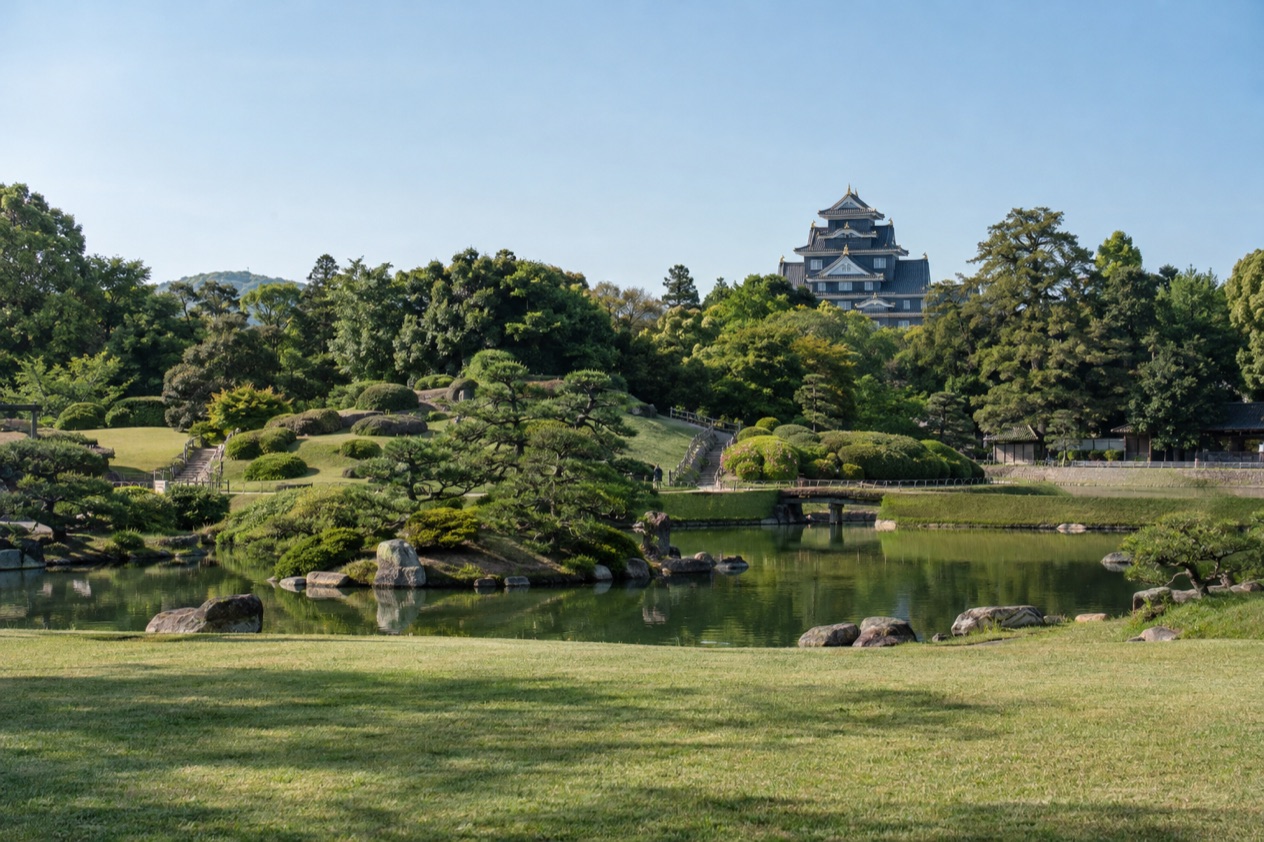
A black castle stands over the river in Okayama, its dark walls giving it the name Crow Castle, and across the water a lawn of raked green stretches through one of the great gardens of Japan. Peaches and muscat grapes fill the fruit stalls, and the folk tale of the boy born from a peach still lends its characters to station signs and souvenir shops. Okayama is a city for travelers who like a garden, a castle and a good lunch without the weight of a major tourist center.
Where is Okayama and what is it like?
Okayama is the capital and largest city of Okayama Prefecture, set on the coast of the Seto Inland Sea in the Chugoku region of Honshu, facing the island of Shikoku to the south. It is a major transit hub for western Japan, which explains why so travelers pass through its station on the way to somewhere else, and why a growing number now stop on purpose.
The city has the feel of a working regional capital rather than a monument. Department stores, shopping arcades and office towers surround the station, while the river, the castle and the garden give the center its green and black outline.
The prefecture has long carried a nickname, the Land of Sunshine, and the region claims to be the sunniest in Japan. That reputation colors how people talk about the place: fruit orchards, open skies over the inland sea, and a relaxed attitude that travelers coming from Kyoto or Osaka often notice at once.
Okayama suits travelers who like their sightseeing in a few well-chosen stops, who enjoy gardens and castles, and who want a base with good rail links. It suits families and couples equally, and it works well as the middle chapter of a longer trip through western Japan.
It may disappoint anyone looking for a dense maze of neon nightlife or a long list of temples. This is a city of a few strong sights, a pleasant pace and a table worth sitting at.
Beyond the center, the prefecture opens into a country of old merchant towns, art islands in the Seto Inland Sea and farmland that supplies the city’s markets. Visitors use Okayama as a hinge, with the city by day and a day trip in the other direction the next morning.
What is there to do in Okayama?
Okayama’s pleasures come in three clear groups: a black castle, a celebrated garden and a table of local food, with the wider prefecture as a fourth reason for a day away. Together they give the city a character of its own, distinct from the temple-heavy streets of Kyoto or the commercial energy of Osaka.
Okayama Castle, the Crow Castle
Okayama Castle is known as the Crow Castle because of its black walls, and the effect is striking against the sky. The castle was built in 1597 and is ranked among the best 100 Japanese castles, which gives the visit some weight for anyone who has started to collect castles on a Japan trip.
Bombing in 1945 during World War II destroyed the original. The castle was rebuilt in 1966, so what you walk through is a reconstruction, a faithful reminder of the old keep rather than the original timber.
Inside, displays tell the story of the lords who ruled the area and the samurai-era life around them. Outside, the walls and the surrounding grounds make a good place to walk and take photographs, and the black keep gives the city its signature view.
Castle lovers will want to compare this dark keep with the white castles elsewhere in Japan, and the contrast is part of the fun.
Korakuen Garden
Korakuen is considered one of the three most beautiful traditional gardens in Japan, and walking through it explains why. It is a stroll garden, laid out as a sequence of lawns, ponds, little hills, tea houses and carefully placed trees that unfold as you move along the paths. The Japanese garden tradition has been appreciated for over 1,000 years, and Korakuen belongs to that long line of designs meant to be seen slowly.
The garden changes with the season. Spring brings fresh green and blossoms, summer deepens the shade, autumn turns the maples, and winter reduces the view to bare branches and clean lines. Visitors who come with a camera tend to linger at the ponds, where the sky and the trees repeat themselves in the water.
Travelers who enjoy gardens will find this the heart of a visit to the city. Anyone short on time can pair it with the castle on the same outing, since the two sights stand close together in the city, and give the garden the longer share of the day.
Momotaro, peaches and the local table
Okayama is tied to the legend of Momotaro, the boy born from a giant peach who set out with a dog, a monkey and a pheasant to fight demons. The story turns up on the station concourse, on sweets and on signs around the city, and it is a pleasant way to see how a local tale becomes part of everyday life.
The peach is more than a character. Okayama is known for its white peaches and its muscat grapes, which show up in desserts, drinks and the fruit parlors of the city when they are in season. Barazushi, a local style of sushi in which the toppings are scattered over seasoned rice, is the dish visitors look for at lunch, and station shops sell boxed versions to carry on the train.
Seafood from the Seto Inland Sea also appears on local menus, and an evening at an izakaya, the casual Japanese pub, is a good way to taste it. Come hungry, and let the season decide what is on your plate.
Day trips around the Seto Inland Sea
Okayama is a base for outings into the surrounding prefecture and beyond. The old canal town of Kurashiki, with its white-walled warehouses and willow-lined water, is a favorite of travelers who like preserved streets and small museums. Art lovers also look to the islands of the Seto Inland Sea, where galleries and outdoor installations sit among fishing villages.
Because Okayama is a major transit hub, its station also connects to other cities of western Japan. Hiroshima, Kobe, Himeji and Osaka are all places travelers combine with a stay here. What makes Okayama different from its neighbors is that it asks little of you: a base with rail connections, a garden and a castle, and room to choose between an art island, a canal town or another city on the following day.
How many days do you need in Okayama?
The city’s big sights are the castle and the garden, and both fit comfortably into a single outing with a long lunch in between.
With a day, start at the castle, take in the black walls and the exhibits, then cross to Korakuen and walk its paths at an unhurried pace. Leave room for a bowl or a box of barazushi, and finish with a fruit dessert if peaches or grapes are in season. That is a satisfying, complete day for travelers, particularly those on a longer route who are passing through.
A second day opens the prefecture. Kurashiki and its canal quarter make a natural day out for anyone who enjoys old streets, crafts and small museums. Travelers more interested in contemporary art can spend the day on one of the islands of the Seto Inland Sea instead. Either outing returns you to Okayama for the evening and a second round of local food.
A third day suits those who want to treat Okayama as a hub. Hiroshima, Himeji and Kobe are all reachable from the station for travelers who prefer a day of city sightseeing, and Okayama’s position on the main rail corridor makes switching between them easy to imagine. Longer stays also make room for a slower look at the gardens, a second visit to a favorite cafe or a lazy afternoon among the fruit stalls.
Those who like to settle in will find three days a comfortable fit, with room to wander the center and take an outing in each direction.
Where to stay in Okayama
The most practical area to stay is around Okayama Station, because the city is a major transit hub for western Japan and almost everything starts there. Hotels near the station put you beside the Shinkansen platforms and the local lines, which suits travelers planning day trips or catching an early train the next morning. Restaurants, shops and department stores cluster around the station as well, so dinner and breakfast are easy to find on foot.
A stay near the station suits first-time visitors, travelers on a rail itinerary and anyone arriving late or leaving early. It also gives you a base for the outings to Kurashiki, the islands or other cities, since the trains are right there.
The second option is to stay in the city center near the castle and Korakuen, where the river, the lawns and the old keep set the tone. This area suits travelers who care more about the atmosphere of the place than about the shortest route to a platform, and who like to begin the day with a walk past the black walls.
Evenings in the central districts revolve around izakaya, small restaurants and the covered shopping arcades, and these are the places to taste the local seafood and sushi. Travelers who enjoy browsing for food in the evening tend to prefer this side of town.
A third approach is to use Okayama as an overnight stop between larger cities, staying one night and seeing the garden and castle before moving on. Others stay in Kurashiki or on one of the islands and visit Okayama as a day trip, which suits travelers who care most about the old canal town or the art. Whichever you choose, the rail network makes it straightforward to swap bases if your plans change.
How do you get to Okayama and get around?
Travelers reach Okayama by Shinkansen, since Okayama Station is on the JR Tokaido-Sanyo Shinkansen Line, with trains from Tokyo Station and Shin-Osaka Station. The Nozomi from Tokyo reaches Okayama in as little as 3 hr 13 min, and Nozomi trains leave Tokyo at 20-minute intervals. The first departs at 6:00 and the last at 20:30.
The Hikari is another choice, with one train per hour from Tokyo making the trip in 4 hr 15 min. It is free with the Japan Rail Pass, which matters for travelers who hold one. Those who prefer to sleep on the way can take the Sunrise Seto and Sunrise Izumo overnight train from JR Tokyo Station. It leaves Tokyo at 22:00 and arrives in Okayama at 06:27 the next morning.
Okayama Momotaro Airport offers domestic flights to and from Tokyo (Haneda), Sapporo and Okinawa. It also has direct international flights to Hong Kong, Seoul, Shanghai, Kaohsiung and Taipei, which makes it a way into western Japan for travelers coming from elsewhere in Asia.
Once in the city, the station is the center of everything, and the castle and Korakuen are in the city itself, so the main sights are reached without leaving the urban area. For day trips to Kurashiki, the islands or other cities, you return to the station, which is why staying near it makes sense for many itineraries.
Local transport such as buses, streetcars and taxis fills in the gaps within the city, and a ferry is part of the journey to the islands of the Seto Inland Sea. Where a route, fare or timetable matters, check it on the day, because these details change by operator.
When is the best time to visit Okayama?
Okayama rewards a visit in the seasons when the garden is most photogenic, which for Japanese gardens means spring and autumn. In spring the lawns turn bright green and the trees flower, and in autumn the maples and other leaves change color. These are the months when Korakuen, one of Japan’s three most beautiful traditional gardens, is most often the reason for a trip.
The Okayama region claims to be the sunniest in Japan and is nicknamed the Land of Sunshine, which makes it a pleasant place for an outdoor visit across much of the year. Summer brings long days and the fruit season, with peaches and muscat grapes appearing in the shops, though the heat can make a long garden walk slower. Winter strips the garden to its structure and suits travelers who prefer an uncrowded, minimalist look.
Because the city sits on the main rail corridor, it can feel busy during Japan’s major holiday periods, when travel across the country picks up. If your dates are flexible, aim for the shoulder weeks around spring and autumn rather than the peak holiday weeks, and let the season in the garden guide the timing of your stay.
Good to know before you go
Okayama is a city where a day on foot, a few train rides and a good lunch are the whole plan, so there is little to prepare beyond a comfortable pair of shoes for the garden paths. Keep some yen on hand for small shops and market stalls, and expect to find the usual safe habits of any big city: watch your bag in crowds and keep your phone charged for maps and train times.
Carry a light layer, since the weather shifts with the seasons and the rainy season and typhoon months can bring wet spells to western Japan. Rain does not spoil the garden, which visitors find lovely under gray skies, and the castle interior offers shelter. Check forecasts before day trips to the islands, as ferry plans depend on the weather.
Sources
- Japan National Tourism Organization, Okayama (https://www.japan.travel/en/destinations/chugoku/okayama/okayama-and-around/), checked October 11, 2026
- Wikipedia, Okayama (https://en.wikipedia.org/wiki/Okayama), checked October 11, 2026
- Wikivoyage, Okayama (https://en.wikivoyage.org/wiki/Okayama), checked October 11, 2026
- Japan National Tourism Organization, Japanese gardens (https://www.japan.travel/en/see-and-do/japanese-garden/), checked October 11, 2026
- Wikipedia, Kōraku-en (https://en.wikipedia.org/wiki/K%C5%8Draku-en), checked October 11, 2026
To plan your stay
- Best Time to Visit Japan: Cherry Blossoms, Autumn Colors, Weather and Festivals
- Where to Stay in Japan: Ryokan, Temple Stays, Capsule Hotels and the Best Cities to Base In
- Sending Luggage from the Airport in Japan: Hands-Free Travel, Hotel Delivery and Coin Lockers
- Know Before You Go to Japan: Entry, Money, Etiquette and Getting Around