
Steam rises from the middle of town and drifts between the inns, and the smell of sulfur reaches you before you have found your bearings. Wooden channels carry pale, hot water through the center, and people in yukata (light cotton robes) shuffle past in sandals on their way to a bath. Kusatsu Onsen is a mountain hot spring town in Gunma Prefecture, built around its water rather than around any single sight, and it suits travelers who want to soak, stroll and slow down.
Where is Kusatsu Onsen and what is it like?
Kusatsu Onsen is a town in Gunma Prefecture, in the Kanto region of Japan, set high in the mountains at about 1,200 meters above sea level. It is a hot spring resort first and everything else second, and it counts among the most famous in the country. The water that feeds the town comes from Mt. Shirane, and the whole place is arranged around where that water comes out of the ground.
The character of the town follows from that. Instead of a skyline or a grid of shopping streets, you find a compact huddle of inns, bathhouses, sweet shops and small restaurants gathered around a steaming center. The air smells of minerals, the streets are full of people in robes and wooden sandals, and the days are organized around baths: one before breakfast, another after the afternoon walk, a last one before bed.
The water itself is sulfurous and acidic, which gives Kusatsu its distinctive smell and its reputation for healing. There are about 100 hot springs in the area, and the town has long been a place people come to take the waters rather than simply to look at them. That reputation shapes who loves it here: travelers who see a bath as the main event of the day, couples and friends on a quiet getaway, and anyone who wants a break from the pace of Tokyo or Osaka.
It may suit others less. If you want nightlife, a long list of museums or a beach, this is not that kind of place. The rhythm is built around soaking, strolling, eating simple local food and going to bed early, and the pleasure is in giving in to it. A trip here works best when the bath is not an extra but the plan itself.
What is there to do in Kusatsu Onsen?
The big reason to come is the water, and nearly everything else in town grows out of it. You watch the springs, you bathe in them, you eat the sweets and eggs cooked in their heat, and you walk the lanes between them.
Kusatsu stands apart from other hot spring towns because its source is not hidden away in a back room of an inn. It sits in the open, in the middle of the streets, where anyone can stand and watch it.
The Yubatake in the center of town
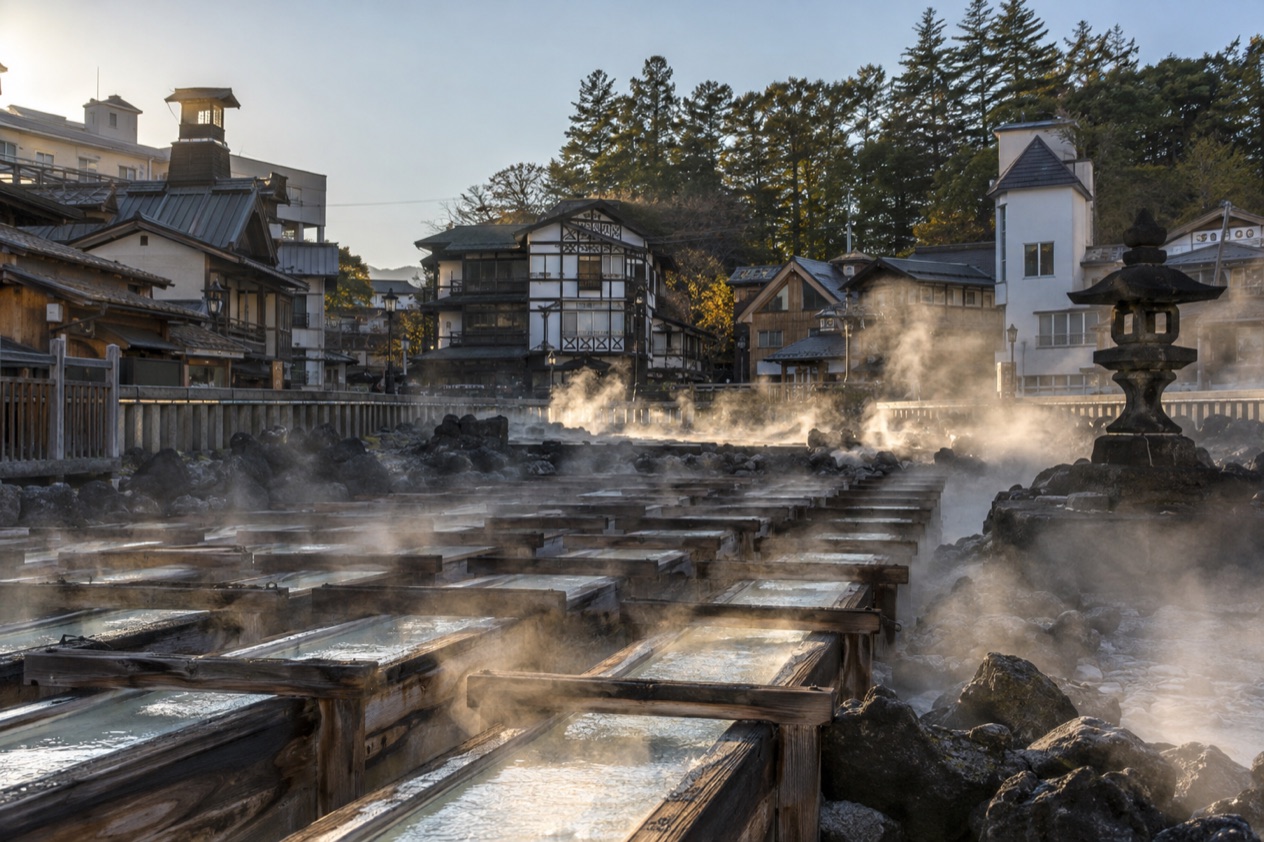
The Yubatake is the heart of Kusatsu, a hot spring right in the center of town that gushes out 5,000 liters of water per minute at 70°C. It is Japan’s largest, and it is free to visit. Long wooden troughs carry the steaming water across a stone-edged basin, and mineral deposits build up in pale colors along the channels.
Visitors come back to it more than once, because it looks different in the daylight than it does after dark, when the steam catches the lamplight. Stand by the railing for a while and the water, the steam and the smell of sulfur tell you what the town is about. The lanes around it are lined with shops and inns, so it also works as your landmark when you are finding your way around.
Bathing in the town’s waters
With about 100 springs in the area, Kusatsu offers bathing in many forms: the baths of the inns, public bathhouses that serve the town, and larger halls built for visitors. Because the water is sulfurous and acidic, the experience is distinctive, with a strong smell and a cloudy look quite unlike the clear, mild baths of many other resorts. It is a bath for people who want the water to be the point.
A good rhythm is to bathe more than once a day, with a walk or a meal in between. Take the usual habits of Japanese bathing with you: wash first, keep the small towel out of the water, and move slowly. Staying at an inn with its own baths means you can soak at your own pace in the evening and again in the morning.
Walking, snacking and the town’s traditions
Between baths, Kusatsu is a town to wander. Small shops sell onsen manju, steamed buns filled with sweet bean paste that are a classic hot spring town treat, and onsen tamago, eggs gently cooked in hot spring water until the yolk is creamy. Cafés and noodle shops offer warm meals, and souvenir counters are stacked with bath salts and local sweets.
The town is also known for yumomi, a tradition in which hot water is stirred and cooled with long wooden boards, accompanied by singing, as a way to bring the spring down to bathing temperature without diluting it. Demonstrations are put on for visitors, and they are a good way to understand how seriously the town treats its water. Beyond the center, a park of steaming pools and rocky ground, usually called Sai-no-Kawara, gives you a longer walk through the sulfur landscape.
How many days do you need in Kusatsu Onsen?
One night is enough to feel the town, and two nights let you enjoy it properly. Kusatsu does not ask you to tick off a long list of sights, so a short stay works well if you arrive with the bath as your goal. With more time, the town becomes a place to settle into rather than to see.
A short stay might run like this: arrive, drop your bags at your inn, and walk to the Yubatake while the light is still good. Browse the lanes, try a sweet or a cooked egg, and then soak before dinner. The next morning, take another bath before breakfast, wander the park of steaming ground, and leave without hurrying.
A second night changes the feel of the visit. Travelers who treat the town as a retreat often find that this second day is the one they remember.
If you have longer, Kusatsu works as a base for quiet days in the mountains of Gunma, with the hot spring baths as the anchor of each day. Some people combine it with other hot spring towns in the region, and others pair it with a stay in a bigger city before or after. Because the town gives you little reason to rush, a longer stay is about rhythm: morning bath, a walk, lunch, a nap, another bath.
The Yubatake takes little time to see, but the town only makes sense when you soak, and that takes an evening and a morning at least. Plan the stay around bathing, not around checking sights off.
Where to stay in Kusatsu Onsen
Stay in the town center if you want the Yubatake outside your door. The lanes around it hold the inns, bathhouses and shops, and you can step out for a bath, a snack or a look at the steaming water without planning anything. For a first visit, this is the area where the town’s character is easiest to feel.
The kind of lodging matters as much as the area. A ryokan, a traditional Japanese inn, usually means tatami floors, futon bedding laid out in the evening, a yukata to wear around the building, and often a meal served in the room or a dining hall. Travelers choose a ryokan precisely because it brings baths and meals under one roof, so the whole stay becomes part of the soak.
Inns with their own baths suit travelers who want to bathe first thing in the morning and last thing at night without leaving the building. Simpler guesthouses and small hotels suit those who plan to use the town’s public baths and eat out. Both styles work in a town this small, because the center holds everything within the same area.
Staying slightly outside the center suits those who want more room between their bed and the crowds of the main lanes. You trade a shorter step to the Yubatake for a calmer evening, and the center is still near enough to visit. Whichever you choose, pick a place whose baths appeal to you, since you will spend more time in them than in the room.
How do you get to Kusatsu Onsen and get around?
Kusatsu Onsen lies in the mountains of Gunma Prefecture, in the Kanto region, so you reach it by heading up from the lowlands into high country. It is a mountain town, which is part of its appeal, and the setting is one reason it feels apart from the big cities of Kanto. Your inn can tell you how to make the final leg of the trip when you book.
Once you are there, the town is organized around its center, where the Yubatake sits in the middle of the streets. Shops, bathhouses and inns gather around that point, so it is the natural place to orient yourself on arrival. Most of what you come for, the steaming water, the sweets, the baths and the lanes, is concentrated in this one part of town.
Moving between your inn and the center is part of the experience. Many guests step out in a yukata and sandals for a bath or a snack, and the evening stroll is part of the routine. Pack shoes that suit sloping streets, since a mountain town at this altitude is built on a slope.
Allow for the weather, since mountain conditions can change the feel of a day. For anything beyond the town itself, your inn is the best source of local advice on how to go.
When is the best time to visit Kusatsu Onsen?
At about 1,200 meters above sea level, Kusatsu sits in cooler air than the lowlands, and that altitude is part of its appeal. Hot water feels different against the cold, and against the mild air of a mountain summer.
Autumn and winter suit travelers who like the contrast of steam and cool air. Warm baths are most enjoyable when the air around them is crisp, and the clouds of vapor over the Yubatake become more striking in cold weather. Spring and summer suit those who want to walk more in the mountains between baths, and who prefer the mountain air to the heat of the lowlands.
There is no fixed festival season that shapes the town, since the water itself is the draw and it keeps flowing in every month. Holiday weekends in Japan bring more visitors to hot spring towns in general, so a midweek stay gives a calmer feel when your schedule allows. Whenever you choose, pack layers for a mountain town, since mornings and evenings are cooler than the middle of the day.
Good to know before you go
The Yubatake is free to visit, so the center of town costs nothing to see. The sulfur in the water has a strong smell and can tarnish metal, so many bathers leave silver jewelry in the room. Mountain weather can change quickly, so a light jacket for the evening walk is useful, and the rainy and typhoon seasons that affect Japan are worth keeping in mind when you plan the trip.
Sources
- Wikipedia, Kusatsu, Gunma (https://en.wikipedia.org/wiki/Kusatsu,_Gunma), checked October 11, 2026
- Wikivoyage, Kusatsu (https://en.wikivoyage.org/wiki/Kusatsu), checked October 11, 2026
To plan your stay
- Best Time to Visit Japan: Cherry Blossoms, Autumn Colors, Weather and Festivals
- Where to Stay in Japan: Ryokan, Temple Stays, Capsule Hotels and the Best Cities to Base In
- Sending Luggage from the Airport in Japan: Hands-Free Travel, Hotel Delivery and Coin Lockers
- Know Before You Go to Japan: Entry, Money, Etiquette and Getting Around