
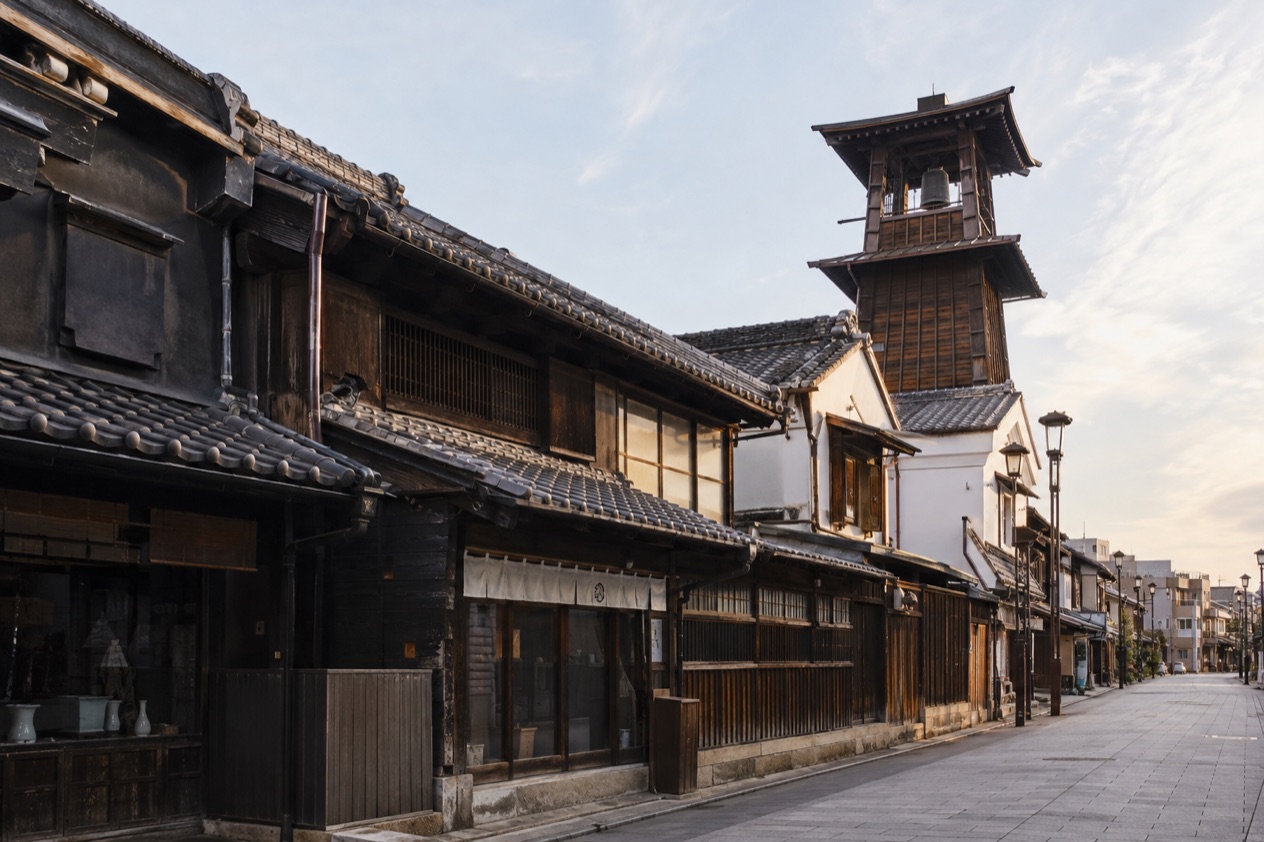
On the third weekend of October, the narrow streets of Kawagoe fill with the thump of taiko drums and the shrill of flutes as two towering floats meet face to face and their musicians try to out-play each other. The rest of the year the town keeps a gentler beat, with black-tiled warehouses, sweet potato treats and a bell tower, the Toki no Kane, that gives the old quarter its landmark. Kawagoe, in Saitama Prefecture and nicknamed Little Edo, suits travelers who want a slice of old Japan with plenty to eat along the way.
Where is Kawagoe and what is it like?
Kawagoe is a city in Saitama Prefecture, on the rail network that reaches Ikebukuro in Tokyo on one side and Omiya on the other. It is a town of streets, temples and food rather than of mountains or coastline, and its nickname, Little Edo, comes from a preserved district of warehouses. Edo was the old name of Tokyo, and Kawagoe still carries a good deal of that earlier look.
What gives the town its character is how many eras sit side by side. You can walk past buildings and shop fronts that recall the Edo period, then the Meiji, Taisho, Showa and Heisei years, all within the same few streets. Historical buildings, cultural properties, seasonal nature, cute cafes and good gourmet food are the ingredients, and they are meant to be taken slowly, with a sweet in one hand and a camera in the other.
The warehouse district lies about 0.9 miles north of Kawagoe Station, so the day has a natural shape: you leave the station area, make your way toward the old quarter, and stop often. The pace is that of a stroll with many pauses, in shops selling sweets and crafts, in tea rooms and at the temple gates. Around 4 million visitors a year come for it, which is part of the reason the old streets have such a lively, shop-lined feel on a weekend.
The town suits couples, families with older children, photographers and anyone who likes history served with snacks. Travelers hunting for dramatic scenery, beaches or a late night out will find that Kawagoe is quieter in ambition: it is about walking, looking, eating and learning a little about how Edo-era Japan lived and traded.
What is there to do in Kawagoe?
What sets it apart from its neighbors is the way these sit in one town, all tied to the story of Edo and its successors.
The warehouse district and the Toki no Kane
This is the picture people have of Kawagoe: rows of kurazukuri, the heavy, dark-tiled merchant warehouses built to guard goods against fire, now housing shops, cafes and small museums. Walking the main street, you pass sweet shops, craft stalls and places selling sweet potato in every form, from soft-serve and sweets to tempura. Sweet potato treats are a local specialty, served here as sweets, soft-serve and tempura.
The Toki no Kane, the Bell of Time, rises near Kashiya Yokocho, the lane of old-fashioned candy shops. Traditional penny sweets, rice crackers and toys are sold here, and children and adults alike tend to wander slowly.
The district covers only a few hundred square meters, so it is a place to pause rather than to cover distance. For those who like to compare, the buildings are best taken one facade at a time, noticing the thick plastered walls, the heavy doors and the tile ridges.
Kita-in temple and its Edo Castle rooms
Kita-in is a Buddhist temple believed to have been founded in 830 by the monk Ennin, under orders from Emperor Junna. Its real surprise is its link with the Tokugawa shoguns: when the temple burned in 1638, the shogun Tokugawa Iemitsu had part of Edo Castle moved here, which makes Kita-in the only place with extant structures from the original Edo Castle.
The Reception Hall, built in 1638 as part of Edo Castle, contains the room where Iemitsu is believed to have been born. Beside the entrance stand statues of 540 disciples of Buddha, known as the 500 Rakan, carved between 1782 and 1825.
Each figure has its own pose and expression, some laughing, some brooding, and visitors enjoy hunting for the ones that seem to resemble a friend.
Kawagoe Castle’s remains
Kawagoe Castle is a flatland Japanese castle, built in 1457 by Ōta Dōshin and Ōta Dōkan. It is the closest castle to Tokyo that visitors can actually enter, since Edo Castle is now the Imperial Palace and largely inaccessible. The castle was dismantled beginning in 1870 and some buildings were relocated within Kawagoe and to nearby cities.
Today only a mound where a yagura, or tower, once stood and the Honmaru Goten, the primary hall, remain on the original site. Those expecting a tall keep will not find one, but history lovers appreciate seeing how a castle can fade from a town while its name and layers stay behind. It makes a quiet counterpart to the busier streets of the old quarter.
The Kawagoe Festival
Held every year on the third weekend of October, the festival lasts two days and draws around one million visitors. Its biggest highlight is Hikkawase, the musical battles among floats, in which performers play music and dance as the floats face one another. There are 29 floats kept by neighborhoods, and about 20 of them take part.
The floats are Edo-type double-decked structures topped with a doll. The lower level is a decorated stage, the upper a platform for the doll. Seeing them parade between the dark warehouses, with lanterns and drumming, is the best argument for why the town is called Little Edo. Those planning a visit for that weekend should expect the old quarter to be full of people.
How many days do you need in Kawagoe?
A single day is enough to see the heart of Kawagoe, and an overnight stay lets you slow down and see the town in a second light. Because the main stations tie Kawagoe to Tokyo and Omiya, it also slots easily into a longer trip based elsewhere.
With a day, begin at the station and head to the warehouse district, taking in the bell tower, the candy lane and the lines of old merchant houses. Add Kita-in and its Rakan statues, and, if time allows, the remains of the castle. Lunch is a natural place to try sweet potato dishes, followed by a cafe stop in one of the renovated old buildings.
A second day, or a long weekend, gives time to go further. Kawagoe’s cherry blossom viewing course takes about five hours. In autumn the festival weekend can fill one of those days on its own, and it is worth planning around the crowds.
If you have more time, the town works well as one stop among several. Ikebukuro, on the Tobu Tojo Line, and Omiya, on the JR Saikyo line, are both linked by train, so a day in Kawagoe fits between city days in Tokyo or alongside other places in Saitama. Travelers use it as a counterweight to the bigger, faster cities, a place to wind down and eat well.
Where to stay in Kawagoe
The area around Kawagoe Station is the practical base. It is an interchange station operated by both Tobu Railway and JR East, and the JR side has a staffed ticket office called Midori no Madoguchi. Staying here puts you at the point where the lines meet, and the old quarter lies about 0.9 miles to the north.
Another option is to stay in Tokyo and come out for the day. The Tobu Tojo Line links Ikebukuro to Kawagoe, and the town is also reached from Omiya on the JR Saikyo line, so a base on either side works. This suits travelers who want a longer Tokyo itinerary with Kawagoe as one outing in it.
Choosing the station area suits people who want to arrive without hurry, eat dinner nearby and wake up close to the lines. Choosing Tokyo suits those who want more nightlife and a wider range of places. In either case, the day in Kawagoe itself is built around the old quarter, the temple and the food.
How do you get to Kawagoe and get around?
Visitors arrive by train. From Ikebukuro in Tokyo, the express on the Tobu Tojo Line runs to Kawagoe, and from Omiya the JR Saikyo line does the same. The Tobu station sits 19 miles from the Ikebukuro terminus, and first opened in 1915 as Kawagoe-nishimachi Station.
| Route | Time | Fare |
|---|---|---|
| Tobu Tojo Line express, Ikebukuro to Kawagoe | 30 minutes | ¥450 |
| JR Saikyo line, Omiya to Kawagoe | 17 minutes | ¥320 |
| Co-edo Loop Bus day pass | About 1 hour per loop | ¥500 |
At Kawagoe Station, the JR East side has two island platforms serving three tracks, and the Tobu side is a separate station of the same interchange. The two operators share the town, so choose the line that best fits where you are coming from.
Once in town, the vintage Co-edo Loop Bus loops around the main attractions and carries a day pass. The bus gives a way to link the old quarter, the temple and other sights without retracing steps.
When is the best time to visit Kawagoe?
October is the month for the big event: the Kawagoe Festival, on the third weekend, when floats roll through the old streets and Hikkawase musical battles fill the corners.
Kawagoe’s Cherry Blossom Viewing Guide lays out a five-hour route through the city. Blossoms move from one spring to the next, so the exact days shift, but the course gives a ready-made plan for a whole afternoon among the trees.
Outside those peaks, the old quarter is a place to visit in any month, since its sweet shops, cafes, temples and warehouse streets do not depend on a season. A festival weekend and a blossom weekend are the times when crowds are thickest, and the rest of the year gives a more relaxed pace in the same streets.
Good to know before you go
Kawagoe in Saitama is not the only place of the name, since there is also a town called Kawagoe in Mie Prefecture, so check which one your map or booking shows. Bring an appetite for sweets, since much of the pleasure lies in tasting your way along the old streets, and plan for a crowded old quarter on the festival weekend in October.
Sources
- Wikipedia, Kawagoe (https://en.wikipedia.org/wiki/Kawagoe), checked October 11, 2026
- Wikivoyage, Kawagoe (https://en.wikivoyage.org/wiki/Kawagoe), checked October 11, 2026
- Kawagoe City Tourism Association, Koedo Kawagoe (https://koedo.or.jp/en/), checked October 11, 2026
- Wikipedia, Kita-in (https://en.wikipedia.org/wiki/Kita-in), checked October 11, 2026
To plan your stay
- Best Time to Visit Japan: Cherry Blossoms, Autumn Colors, Weather and Festivals
- Where to Stay in Japan: Ryokan, Temple Stays, Capsule Hotels and the Best Cities to Base In
- Sending Luggage from the Airport in Japan: Hands-Free Travel, Hotel Delivery and Coin Lockers
- Know Before You Go to Japan: Entry, Money, Etiquette and Getting Around