
Steep thatched roofs in Shirakawa-go carry their own weather with them, built so snow slides off instead of settling. In Takayama, old merchant streets hold sake breweries and wooden storefronts, while the ridgelines behind the towns stay white long after the valleys have turned green. The Japanese Alps run down the spine of Honshu, and they suit travelers who want mountain scenery, old townscapes and a hot bath at the end of the day.
Where is the Japanese Alps and what is it like?
The Japanese Alps are a series of mountain ranges that bisect Honshu, the main island of Japan, and they reach across Niigata, Toyama, Yamanashi, Nagano, Gifu and Shizuoka prefectures. They include nearly all of Japan’s tallest mountains, with the notable exception of Mount Fuji. Three ranges make up the whole, and the towns people actually visit sit in the valleys and foothills between them.
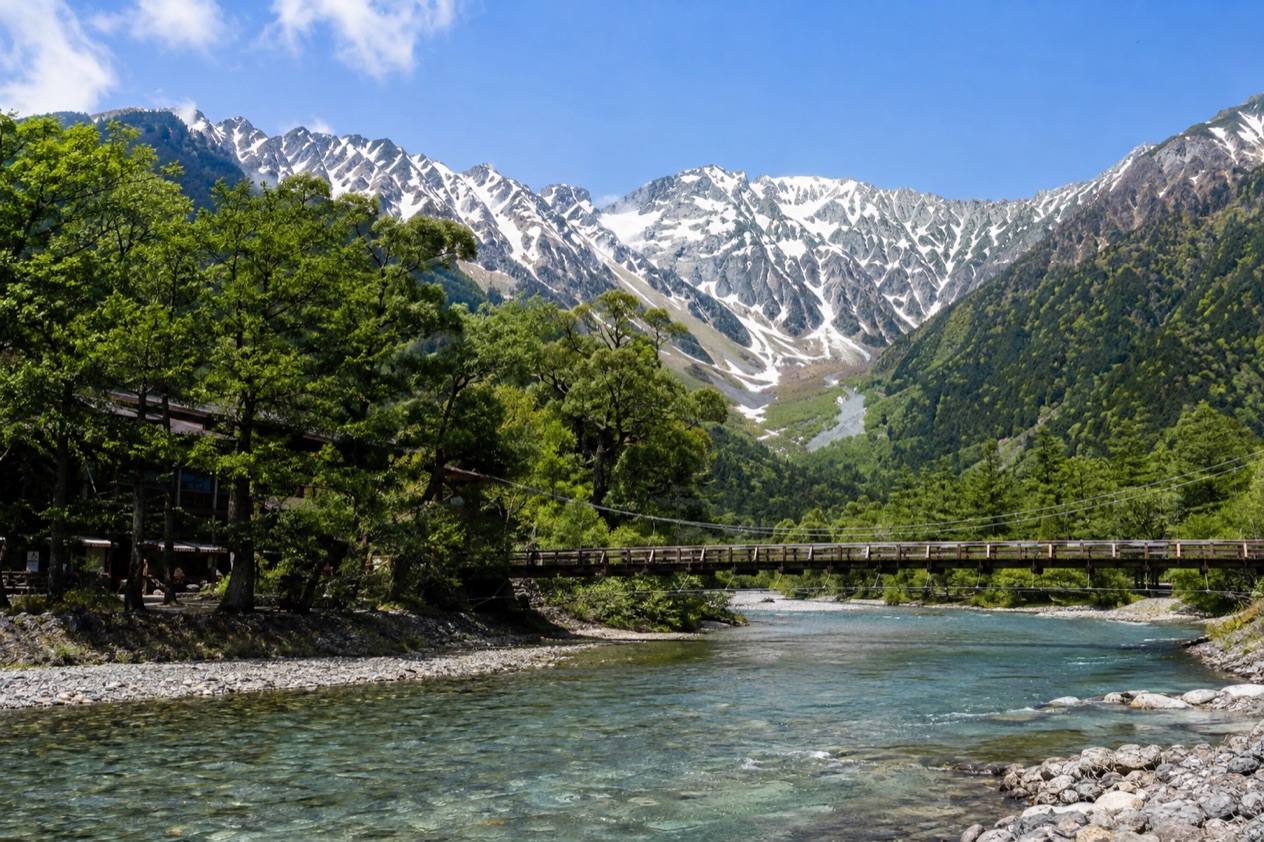
The Northern Alps, also called the Hida Mountains, run through Nagano, Toyama and Gifu, with a small portion reaching into Niigata. Their Gifu side is the Oku-Hida region. The Central Alps, known as the Kiso Mountains, lie mostly in Nagano Prefecture. Many peaks keep a cap of snow well into the summer, which gives the valley towns a backdrop that changes with the seasons rather than staying the same.
The character of the region is that of a string of separate places rather than a single resort. Takayama, in Gifu, sits in the heart of the range and is sometimes called the Little Kyoto of Hida because of its well-preserved quarter of Edo-style streets. Matsumoto is a city in Nagano Prefecture.
Hakuba is a village in the eastern foothills of the Hida Mountains and a ski resort. Nagano city is the capital of its prefecture and a transportation hub for the north. Shirakawa-go, a UNESCO World Heritage Site together with Gokayama in Toyama, adds a village of farmhouses to the list.
The pace is that of a mountain region: days built around a walk through an old quarter, a market, a long lunch of local noodles or beef, and an evening soak in an onsen, the volcanic hot springs that Japan treats as part of any stay in the hills. It rewards people who like moving from town to town and looking up at ridges. It is less suited to anyone who wants a single beach-style base with everything in one place, since each town has its own character and the distances between them take planning.
| Fact | Detail |
|---|---|
| Length of the range | 200 kilometers |
| Width of the range | 40 kilometers |
| Highest peak, Mount Kita | 3,193 meters |
| Second highest, Mount Hotaka | 3,190 meters |
| Nagano city altitude | 371.4 meters (1,219 ft) |
What is there to do in the Japanese Alps?
The reasons to come fall into four groups: old towns, farmhouse villages, castle and city life, and skiing. What sets the Japanese Alps apart from the big cities of Honshu is that the mountains are always in view, and that each of these four things happens in a different valley.
Takayama and its old streets
Takayama is the place to walk. Its well-preserved quarter keeps Edo-style streets lined with dark wooden buildings, the kind of lanes where you drift from a craft shop to a sake tasting to a bowl of noodles without a plan. The city is known as Hida-Takayama, and local cooking leans on mountain ingredients, with Hida beef a name you will see on menus.
The city is also the largest in Japan by area, which explains why it reaches far into the mountains around it.
It suits couples, food lovers and anyone who likes towns made of wood and lattice windows. Pair it with a trip to Shirakawa-go, which can be reached from Takayama in the time given in the getting-there section.
Shirakawa-go and the gassho farmhouses
Shirakawa-go is a village of farmhouses built in the gassho style. The name means hands together, as in prayer, and it describes the steep roofs that keep snow off in winter. Together with Gokayama in Toyama, the village was registered as a UNESCO World Heritage Site on December 9, 1995.
Visiting means looking at roofs, doorways and the way the houses stand against the hillsides, and seeing how a building shape answers the weather. It is a place to photograph and to stroll, and it fits well into a day that starts or ends in Takayama. Since the Hida Tunnel opened, the trip is far shorter than it used to be.
Matsumoto and Nagano city
Matsumoto is a city in Nagano Prefecture and a core city since April 1, 2021. It is a base for people who want a real town with cafés, shops and restaurants close to the ranges, rather than a village. Nagano city, the prefectural capital, serves as the northernmost transportation hub, and it is where many northern routes start.
Both cities suit travelers who want an urban evening after a mountain day. Nagano is also known for soba, the buckwheat noodles served cold with a dipping sauce or hot in broth, and a bowl of them is an easy way to taste the region. Nagano is the highest prefectural capital in Japan.
Skiing in Hakuba Valley
Hakuba Valley lies in northwestern Nagano Prefecture at the base of the Northern Japan Alps, and it hosted the 1998 Nagano Winter Olympics. Hakuba is the central hub for 10 ski resorts with more than 200 runs, and it is a popular ski resort.
It suits skiers and snowboarders who want a choice of slopes in one valley, and families or groups where people ski at different paces. Outside the snow season the mountains still frame the village, and the valley works as a base for time among the peaks.
How many days do you need in the Japanese Alps?
A long weekend gives you one town done well, and a week lets you link several. The Japanese Alps are not a single destination but a chain of bases, so the number of days depends on how many of them you want to see.
With a short stay, choose Takayama or Matsumoto and stay put. In Takayama, spend a day in the old quarter and add Shirakawa-go as a separate outing. In Matsumoto, walk the city and eat well, and treat the mountains as scenery on the horizon. That is enough for a first look, without changing hotels every night.
With a longer stay, build a loop. Start in Tokyo or Nagoya, spend nights in Matsumoto, Takayama and Hakuba or Nagano city, and let Shirakawa-go be a side trip from Takayama. A slower pace leaves room for an onsen evening, a market morning and a long lunch of local noodles or beef, which are the things people remember.
If you ski, the days are set by the slopes instead. Hakuba Valley offers a large number of runs across its resorts, so a ski trip can fill a week without leaving the valley. Add a day in Nagano city on the way in or out, since it is the northern hub and the Hokuriku Shinkansen stops there.
Where to stay in the Japanese Alps
The main areas to stay are Takayama, Matsumoto, Nagano city and Hakuba, and each suits a different traveler.
Takayama suits travelers who want old streets outside the door. Staying in or near the old quarter means evenings among wooden buildings, and a traditional inn (ryokan) fits the setting, with tatami floors, a yukata robe to wear and often a meal served in the room. It is a good choice for couples and for anyone who wants the region’s atmosphere in their lodging.
Matsumoto and Nagano city suit people who prefer a city base. They work for short stays, for a first night after arriving, and for travelers who like to return to a lit street after a day outdoors.
Hakuba suits skiers. It is a village at the foot of the Northern Alps and the hub for the valley’s ski resorts, so staying there puts you close to the slopes. Visitors who come for the mountains in other seasons also use it as a base, since the peaks rise right above it.
How do you get to the Japanese Alps and get around?
The Japanese Alps are reached by train from Tokyo and Nagoya, and by road for the short link between Takayama and Shirakawa-go.
| From | To | Time | How |
|---|---|---|---|
| Tokyo (Shinjuku Station) | Matsumoto | 2 hours 40 minutes | Train |
| Nagoya Station | Matsumoto | 2 hours | Train |
| Tokyo | Nagano city | 1 hour 20 minutes, without stopping | Hokuriku Shinkansen |
| Takayama | Shirakawa-go | Within 50 minutes | Via the Hida Tunnel |
Matsumoto links to both Tokyo and Nagoya by train, which makes it an entry point from either side of the range. Nagano city is reached on the Hokuriku Shinkansen from Tokyo, and it is the northernmost transportation hub of its prefecture, so routes continue from there.
Once in a town, the places named here are explored on foot in their old quarters, as the streets of Takayama invite. Between towns and out to villages such as Shirakawa-go, travelers rely on the rail and road links the area has.
A trip that crosses the ranges usually means moving by train from one valley city to the next, then taking a local connection for the last stretch. Build the route around the towns you want, and let the mountains be the view from the window.
When is the best time to visit the Japanese Alps?
Winter is the season for Hakuba, whose ski resorts and many runs are the draw, and the gassho farmhouses of Shirakawa-go, with their steep roofs, were built for snowy months.
For a trip focused on towns and views, the seasons when the valleys are free of snow let you walk Takayama’s streets and move between bases more freely. Many peaks keep snow well into the summer, so even in warm months the high ridges look white from the valley floor, and that contrast is part of the appeal.
We give no month-by-month weather for the range as a whole, because conditions vary between a valley town, a ski village and a high ridge. Pick the season by the place you are going: snow for Hakuba, old streets and farmhouses for Takayama and Shirakawa-go, a city base for Matsumoto and Nagano.
Good to know before you go
Plan the Japanese Alps as a chain of towns rather than one stop, and give each base its own night or two. Money is in yen, and any ticket or admission you meet along the way is paid at the place itself.
Mountain scenery here includes snow that lingers on the high peaks into summer, and the farmhouse roofs of Shirakawa-go exist because of heavy winter snow, so the season shapes what you see. Walk the old quarters with the same care you would use anywhere, and keep your plans flexible when moving between valleys.
Sources
- Wikipedia, Japanese Alps (https://en.wikipedia.org/wiki/Japanese_Alps), checked October 11, 2026
- Wikivoyage, Japan Alps (https://en.wikivoyage.org/wiki/Japan_Alps), checked October 11, 2026
- Japan National Tourism Organization, Matsumoto (https://www.japan.travel/en/destinations/hokuriku-shinetsu/nagano/matsumoto-and-around/), checked October 11, 2026
- Wikipedia, Matsumoto, Nagano (https://en.wikipedia.org/wiki/Matsumoto,_Nagano), checked October 11, 2026
- Wikipedia, Takayama, Gifu (https://en.wikipedia.org/wiki/Takayama,_Gifu), checked October 11, 2026
- Wikivoyage, Takayama (https://en.wikivoyage.org/wiki/Takayama), checked October 11, 2026
- Hakuba Valley (https://www.hakubavalley.com/en/), checked October 11, 2026
- Wikipedia, Hakuba, Nagano (https://en.wikipedia.org/wiki/Hakuba,_Nagano), checked October 11, 2026
- Japan National Tourism Organization, Nagano (https://www.japan.travel/en/destinations/hokuriku-shinetsu/nagano/nagano-and-around/), checked October 11, 2026
- Wikipedia, Nagano (city) (https://en.wikipedia.org/wiki/Nagano_(city)), checked October 11, 2026
- Wikipedia, Shirakawa-gō (https://en.wikipedia.org/wiki/Shirakawa-g%C5%8D), checked October 11, 2026
- Wikivoyage, Shirakawa-go (https://en.wikivoyage.org/wiki/Shirakawa-go), checked October 11, 2026
To plan your stay
- Best Time to Visit Japan: Cherry Blossoms, Autumn Colors, Weather and Festivals
- Where to Stay in Japan: Ryokan, Temple Stays, Capsule Hotels and the Best Cities to Base In
- Sending Luggage from the Airport in Japan: Hands-Free Travel, Hotel Delivery and Coin Lockers
- Know Before You Go to Japan: Entry, Money, Etiquette and Getting Around