
In Nara Park, the deer nose along the roadside stalls for the crackers sold there, and spring petals drift across the lawns at the foot of Mount Wakakusa. It is the middle of the trip, and the neon of Tokyo already feels far away. This spring route runs from Tokyo through Hakone, Kyoto, Nara and Osaka to Hiroshima and Miyajima, for travelers who want the big cities and the old capital in one sweep.
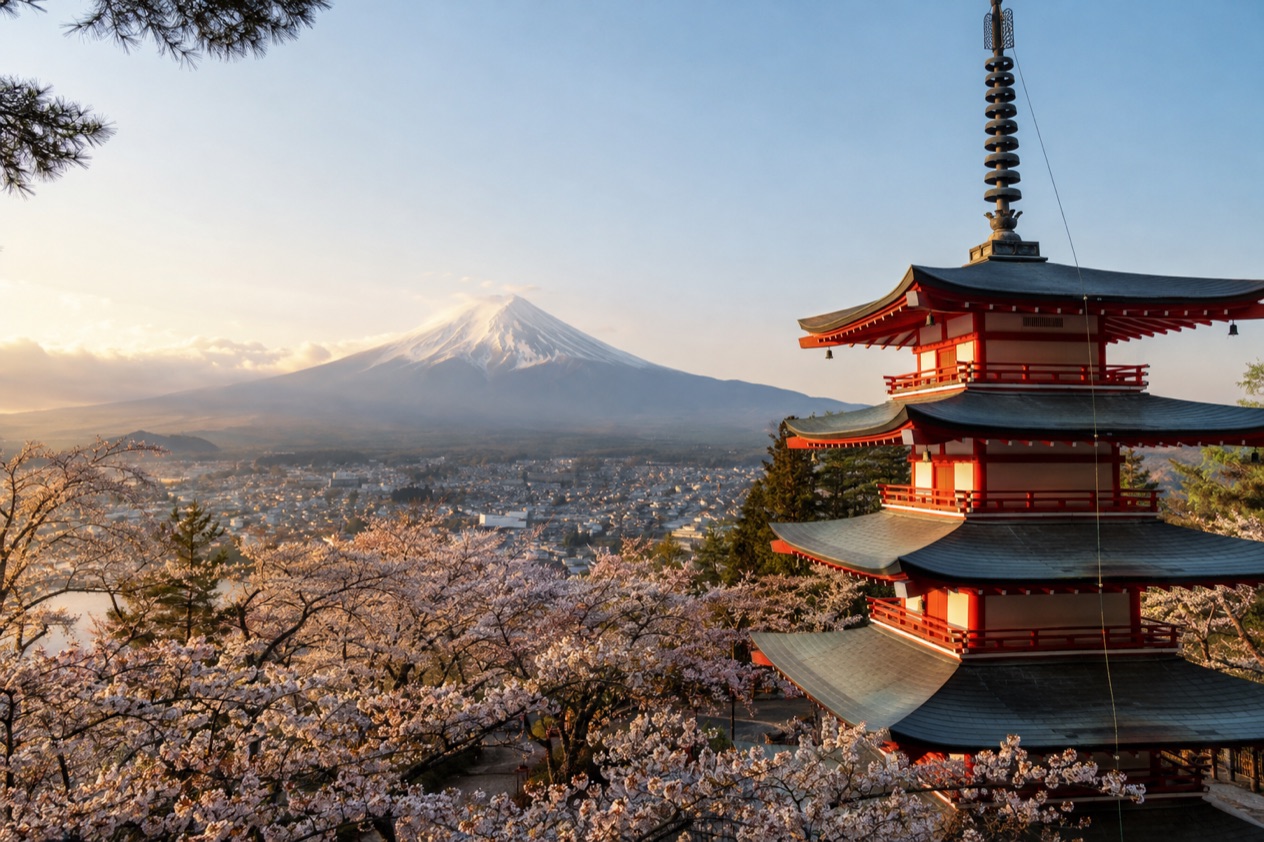
Is 10 Days enough for Japan?
Ten days is enough to see the central stretch of Honshu well, as long as you accept that you are sampling and not covering the country. The route suits a first visit, and anyone who likes to change beds every couple of nights and spend the days on foot, on trains and in temple gardens. It leaves out Hokkaido, Okinawa, Kyushu, Shikoku and most of the countryside, and all of those are better saved for another trip.
What the route does cover is a clear arc. Tokyo comes first, a metropolis on Tokyo Bay in the Kanto region, with districts as different as upscale Ginza and nightlife-minded Roppongi. Then comes a night in the hot-spring hills of Hakone, a pair of days in Kyoto, a day with the deer in Nara, a day of eating in Osaka, and a final stretch in Hiroshima with a boat out to Miyajima Island.
Spring is a good fit for this loop because the cherry trees bloom on a rolling schedule. The Somei-Yoshino cherries usually reach the Kanto, Kinki and Chugoku regions in late March, so Tokyo, Kyoto, Nara, Osaka and Hiroshima all fall inside the same general window.
Any one tree flowers for a short time, and dates shift from one spring to the next. Plan for a chance of blossoms, not a promise, and enjoy the new green and the mild days if you arrive a little early or late.
The weather in Tokyo in April is a useful guide to the mood of the trip: comfortable for walking in a light jacket, with showers now and then. Pack for a few gray, damp days, and keep a museum, a department store or a ramen counter in mind as the plan B for each stop.
| Tokyo in April | Value |
|---|---|
| Average high | 66.9°F |
| Average low | 49.6°F |
| Precipitation | 5.26 inches |
| Days with rain (1 mm or more) | 9.5 |
| Hours of sunshine | 179 |
| Relative humidity | 62% |
Each stage below changes the pace. Tokyo is a place to wander without a plan, while Kyoto rewards a more deliberate day of temples and old streets. The last stretch is more reflective, built around the Peace Memorial Park and a shrine whose red torii gate stands in the sea.
The itinerary stage by stage
Days 1 to 3: Tokyo
Tokyo is the capital and the most populous metropolitan area in the world, and three days give you a taste, not a full portrait. Spend the first day in Ginza and Nihonbashi, where high-end restaurants and luxury shops line the streets and the old merchant district sits beside the polished one. Let jet lag set the pace, with a long lunch and an early night.
On the second day, head to Roppongi and Akasaka, which you can reach from Shibuya Station in about 10 minutes by train. Roppongi is where the city stays out late, and Akasaka is the quieter business and dining district beside it. The third day is for whatever caught your eye: a neighborhood you only glimpsed from the train, a park under blossoms, or another round of the city’s many rail lines, from JR to the Tokyo Metro and Toei Subway.
Sleep in a business-hotel district near a major station, so that you can move onward by rail without hauling bags through the city. The move to Hakone on day four is by rail.
Day 4: Hakone
Hakone sits in the western part of Kanagawa Prefecture, inside the Fuji-Hakone-Izu National Park, and it is known for natural hot springs and views of Mount Fuji. Whether the mountain shows itself depends on the weather, so treat any glimpse as a gift. Hakone-Yumoto, the gateway town, is lined with restaurants and gift shops, a good place to wander after the train.
The Hakone Freepass covers unlimited rides on eight kinds of transport in the area, including the Hakone Tozan Train, the Hakone Ropeway and the Hakone Sightseeing Cruise. That lets you stitch together a loop of mountain train, cable car and lake boat at your own pace. Finish the day in a ryokan with an onsen bath, where shoes come off at the entrance, slippers give way to bare feet or socks on the tatami, and dinner arrives in courses.
Days 5 and 6: Kyoto
Kyoto served as Japan’s capital and the emperor’s residence for over a thousand years, and its traditions still show in machiya townhouses, the Gion Matsuri festival and the hanamachi districts where geishas live and work. Arrive by rail, since Kyoto Station is served by the Tokaido Shinkansen line. The station building itself holds a full floor of ramen restaurants, an Isetan department store, a theater and a Granvia hotel, so a first meal is easy to find.
Spend one day in central Kyoto, where Nijo Castle, built in 1603 by Tokugawa Ieyasu, the first shogun of the Edo period, anchors a walk through the old capital. Linger afterward on streets of wooden townhouses and teahouses. The second day is for temples and shrines of your choosing, with spring petals along the paths in a good year.
Stay near Kyoto Station or in central Kyoto, in a hotel or a machiya-style inn. The next stage is a day trip, so there is no packing on day seven.
Day 7: Nara
Nara lies east of Osaka and south of Kyoto, and trains from both cities reach it. The city has two main stations, JR Nara and Kintetsu Nara, and either one puts you on the way to Nara Park, where tame deer wander at the foot of Mount Wakakusa. Visitors can approach them and feed them with crackers sold along the roadside.
Take the day slowly, with a loop through the park, a stop at whatever temple or shrine you pass, and a meal in town. Keep crackers out of pockets until you want the deer’s attention, since they tend to notice. You can return to Kyoto for the night, or carry on to Osaka, which suits the next day.
Day 8: Osaka
Osaka is a relaxed city known for food, entertainment and nightlife, with some history and culture to discover. Dotonbori and Shinsaibashi are the districts for eating and strolling, reached from Osaka or Umeda Station on the Midosuji Line to Shinsaibashi Station. Eat your way through the evening, from street snacks to a sit-down dinner.
For a change of scene, Osaka Bay is a port area of the city, reached from Osaka or Umeda stations by the JR Loop Line and the Chuo subway line. Osaka also uses several railways at once, among them JR, Hankyu, Hanshin and Keihan, so the map looks busier than the trip feels once you have an IC card in hand.
Days 9 and 10: Hiroshima and Miyajima
Hiroshima is reached by rail from Osaka. The Peace Memorial Park and the Atomic Bomb Dome are the heart of the visit, and the dome can only be viewed from the outside because visitors cannot enter it. Give the park and the museums time and silence, then ease the mood with okonomiyaki, the local version of the savory pancake.
Spend the second day on Miyajima Island, in Hiroshima Prefecture, where Itsukushima Shrine has a red torii gate standing in the sea. The shrine was registered as a World Heritage Site in 1996, and the island is also known for its deer. Hiroshima Prefecture adds the Seto Inland Sea, wooded mountains and clear waters, for anyone who wants more scenery than the city offers. The trip ends here, and the way home is by rail or by air depending on where your flight leaves.
Getting between stops
| Leg | How | Time |
|---|---|---|
| Tokyo to Osaka (Shin-Osaka Station) | Tokaido-Sanyo shinkansen | About two and a half hours |
| Tokyo to Kanazawa (alternative stop) | Hokuriku Shinkansen | Around 2 1/2 hours |
| Shibuya to Roppongi and Akasaka | By train | About 10 minutes |
| Osaka Itami or Kansai airport to Nara | By bus and train | About one hour fifteen minutes |
Rail does most of the work on this route, and Japanese trains have a reputation for being on time, so a plan can be built to the minute. Rapid trains skip smaller stations and need no supplement, while express trains make fewer stops and a supplement may apply.
An IC card keeps small journeys simple. Although most regions have their own cards with different names and characters, they can be used throughout Japan, on trains, buses and boats. Hakone has its own pass for the mountain train, ropeway and boat, which suits the loop you will make there.
The links from Hakone to Kyoto and from Osaka to Hiroshima are by rail, and the same goes for Nara. For flights, Nara’s nearest airports are Osaka Itami and Kansai International, both in Osaka Prefecture.
Driving is a different proposition: traffic moves on the left, highway tolls can be very high, city traffic is often congested, and road signs are hard to read without Japanese. For this route, the train is what the page is built around.
What to book before your 10 Days in Japan
Settle the lodging for each stage first, since the route changes beds often: a hotel in Tokyo, a ryokan in Hakone, a base in Kyoto, and the final nights in Hiroshima. The ryokan is the one stay with its own rhythm, and it comes with habits such as removing shoes at the entrance and slippers on the tatami.
Next, think about passes. The Hakone Freepass gives unlimited rides on eight kinds of transport in Hakone, and its Hako Ticket Plus version adds art museums, hot springs and activity facilities. That version is valid for 2 days or 3 days. For the rest of the trip, an IC card works on trains, buses and boats, and also in vending machines and convenience stores. Most require a 500 yen deposit at purchase.
Kenrokuen Garden in Kanazawa offers free admission, if you swap that city into the plan. Beyond that, leave the days loose enough to follow the bloom and the weather.
Adapting the route
For a shorter trip, drop Hakone and Nara and keep Tokyo, Kyoto, Osaka and Hiroshima, which still gives you the big contrasts. For a longer one, add a night in each of Kyoto and Hiroshima, or stretch Tokyo so that no day feels packed. If you want a slower pace, choose fewer bases and use day trips, since moving beds is the tiring part.
Kanazawa is an alternative to Hakone and Hiroshima. The Hokuriku Shinkansen from Tokyo takes around 2 1/2 hours, and the city on the Sea of Japan was one of the most important cultural and artistic centers in Japan in the Edo period.
Kanazawa Castle Park and Kenrokuen Garden are illuminated at night, which suits an evening stroll. The Somei-Yoshino cherries reach the Hokuriku region around April 10, later than in Tokyo, so it also extends your blossom window.
If you travel in another season, the Tokyo figures change the mood. In July the city is hot and humid, with highs in the mid-80s and a heavy feel to the air, so museums and department stores become retreats.
October is damp, with the most rain of the months compared here and fewer hours of sun. January is cold and dry, with highs near 50 degrees, and snow or sleet can appear on a few days.
With children, spread the heavy days out. Nara’s deer and Miyajima’s torii gate make good anchors, and you can keep Tokyo to two days. In rain, the Kyoto Station building, with its ramen floor and department store, gives you somewhere warm.
Good to know before you go
Smoking while walking on the street is prohibited and can bring a fine, so smokers look for designated outdoor areas. In a ryokan or a home, shoes come off at the door and slippers come off again on tatami.
Yen is the currency, and an IC card covers small purchases at vending machines and convenience stores. Public transport is extremely punctual, so a tight connection is workable, and a late start costs more than it would elsewhere.
Sources
- U.S. Department of State, Japan travel information, travel and transportation (https://travel.state.gov/content/travel/en/international-travel/International-Travel-Country-Information-Pages/Japan.html), checked October 11, 2026
- Japan National Tourism Organization, trains and buses (https://www.japan.travel/en/guide/how-to-travel-by-train-and-bus-in-japan/), checked October 11, 2026
- Japan National Tourism Organization, traveling by rail (https://www.japan.travel/en/guide/traveling-by-rail/), checked October 11, 2026
- Japan National Tourism Organization, manners, etiquette, shoes, bowing, chopsticks, public behavior (https://www.japan.travel/en/guide/understanding-and-mastering-japanese-manners-and-etiquette/), checked October 11, 2026
- Japan National Tourism Organization, getting around Japan: trains, subways, buses, taxis (https://www.japan.travel/en/plan/getting-around/), checked October 11, 2026
- Japan National Tourism Organization, IC cards, Suica, Pasmo, ICOCA, how to use (https://www.japan.travel/en/plan/ic-card/), checked October 11, 2026
- Japan National Tourism Organization, Tokyo (https://www.japan.travel/en/destinations/kanto/tokyo/), checked October 11, 2026
- Japan National Tourism Organization, Kyoto (https://www.japan.travel/en/destinations/kansai/kyoto/), checked October 11, 2026
- Japan National Tourism Organization, Osaka (https://www.japan.travel/en/destinations/kansai/osaka/), checked October 11, 2026
- Japan National Tourism Organization, Hiroshima (https://www.japan.travel/en/destinations/chugoku/hiroshima/), checked October 11, 2026
- Visit Hiroshima, the official guide (https://visithiroshima.net/), checked October 11, 2026
- Japan National Tourism Organization, Nara (https://www.japan.travel/en/destinations/kansai/nara/), checked October 11, 2026
- Japan National Tourism Organization, Hakone (https://www.japan.travel/en/destinations/kanto/kanagawa/hakone-and-around/), checked October 11, 2026
- Hakone Tourist Information (https://www.hakonenavi.jp/international/en/), checked October 11, 2026
- Japan National Tourism Organization, Kanazawa (https://www.japan.travel/en/destinations/hokuriku-shinetsu/ishikawa/kanazawa-and-around/), checked October 11, 2026
- Kanazawa Tourist Information Guide (https://www.kanazawa-tourism.com/), checked October 11, 2026
- Wikipedia, Kanazawa, Ishikawa (https://en.wikipedia.org/wiki/Kanazawa,_Ishikawa), checked October 11, 2026
- Japan Meteorological Agency, cherry blossom first-bloom dates 2021-2026 and 1991-2020 normal (https://www.data.jma.go.jp/sakura/data/sakura003_07.html), checked October 11, 2026
- Japan Meteorological Agency, cherry blossom full-bloom dates 2021-2026 and 1991-2020 normal (https://www.data.jma.go.jp/sakura/data/sakura004_07.html), checked October 11, 2026
- Japan Meteorological Agency, sakura2020.pdf (https://www.data.jma.go.jp/sakura/data/sakura2020.pdf), checked October 11, 2026
- Japan Meteorological Agency (JMA), Normal values 1991-2020, monthly (https://www.data.jma.go.jp/stats/etrn/view/nml_sfc_ym.php?prec_no=44&block_no=47662), station Tokyo, elevation 25 m, checked October 11, 2026
- Plan de the (duree choisie by the redaction)
To plan your stay
- Best Time to Visit Japan: Cherry Blossoms, Autumn Colors, Weather and Festivals
- Where to Stay in Japan: Ryokan, Temple Stays, Capsule Hotels and the Best Cities to Base In
- Sending Luggage from the Airport in Japan: Hands-Free Travel, Hotel Delivery and Coin Lockers
- Know Before You Go to Japan: Entry, Money, Etiquette and Getting Around