
Along Bay Street the cruise crowds drift between straw markets, conch shacks and duty-free shops, while police in crisp uniforms stand at the corners and music spills out of bars once the ships’ horns have sounded. Nassau is a busy capital where visitors and residents share the same streets, and the pleasant surface is real. So is the honest question of how careful to be, and the answer depends on where you go, when, and how you get there.
Is Nassau safe to visit?
Millions of visitors come each year and most go home with nothing worse than a sunburn, but Nassau is a place for normal city habits, not for letting your guard down. Most of the crime in the Bahamas happens in Nassau, on New Providence, and in Freeport on Grand Bahama, so a capital full of tourists is also where the country’s crime is concentrated. That is simply the setting you are walking into.
The part of town most visitors see is the one that is watched most closely. In downtown Nassau and the other tourist areas, a large number of police officers are visible and vigilant, and closed circuit cameras are stationed downtown.
The Royal Bahamas Police Force has a Tourism Policing Unit of 147 officers, and it works constantly with the Ministry of Tourism on visitor safety. Bay Street, with its shopping, restaurants and nightlife, is the stage for all of this.
Two risks deserve a plain mention. Sexual assaults have occurred on and near the beaches of downtown Nassau, and sexual assaults by jet ski operators have been reported. U.S. citizens who are victims of sexual assault are encouraged to contact the U.S. Embassy for help. In an emergency, local police answer at 919 or 911, and the embassy can be reached at +(242) 322-1181.
The law is the other side of staying out of trouble. Marijuana and all products with its derivatives, including CBD and THC, are not legal, and a medical card does not change that. Drug violators are regularly arrested even for small quantities, and an arrest means at least one night in custody.
Firearms and ammunition are illegal too, even a stray bullet forgotten in a carry-on, and police enforce this at the airport on the way out. Anyone 16 or older is tried as an adult, and lower courts offer no public defender, so a lawyer would be at the visitor’s expense.
Safety by area in Nassau
Downtown and Bay Street
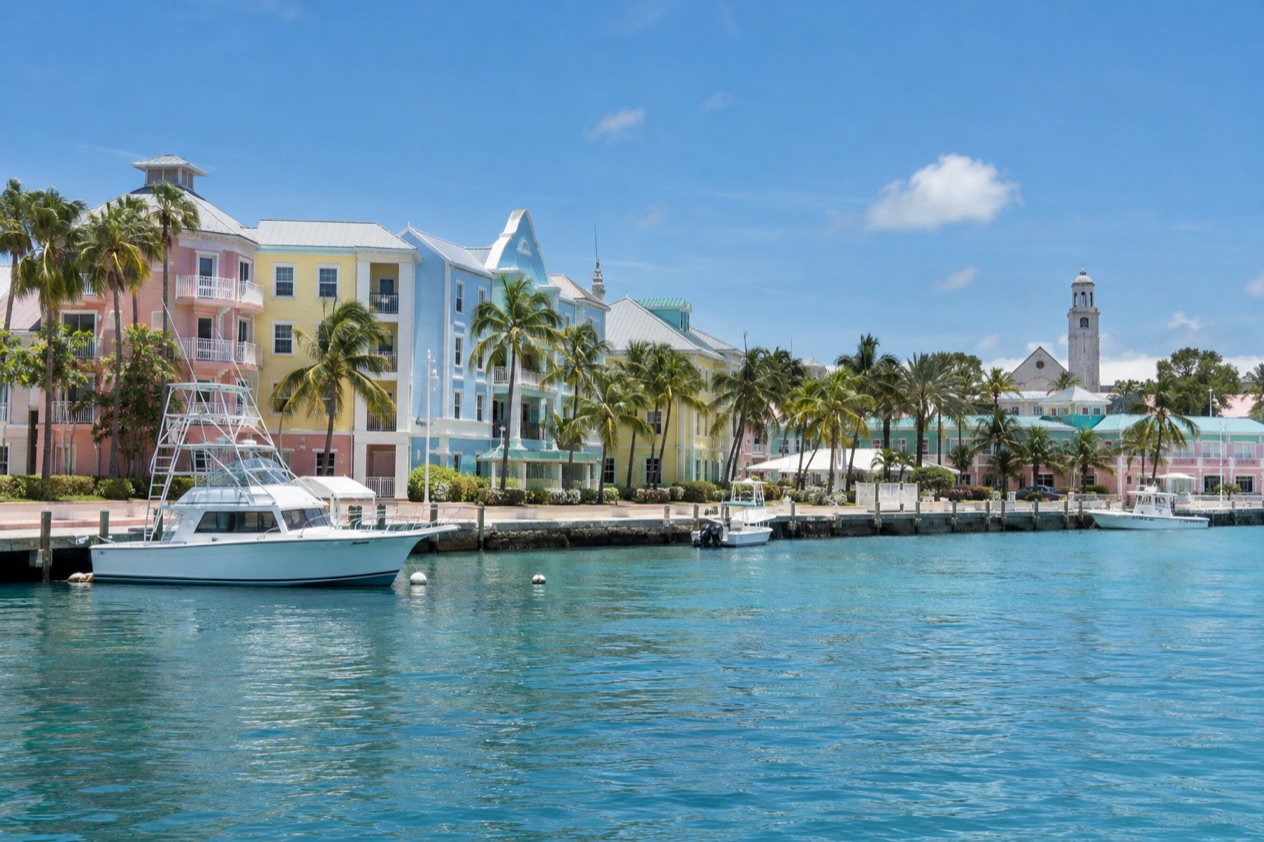
This is the Nassau of postcards: the cruise port, the straw market, the pastel government buildings and the restaurants and bars along Bay Street. Because it is where the ships dock, it is the most heavily policed part of the city, with officers on foot and cameras overhead. By day it is crowded and lively, and the nightlife gives it a second life after dark.
Visible policing is not a guarantee, so the usual habits apply: keep phones and wallets out of easy reach and stay with the busier streets. The beaches on and near downtown are where the advisory reports sexual assaults, so a late walk along the sand alone is the thing to skip.
Over the Hill
South of Shirley Street lies the area known as Over the Hill. It is a residential part of Nassau, and it has gang killings of residents. It is not where the sights are and not where visitors need to be, so treat it as part of the city you pass on a map rather than a place to wander through.
Residents bear the weight of that violence, which is a reminder that the calm of the tourist strip is not the whole of Nassau. If a plan seems to lead south of Shirley Street, it is worth asking whether the destination really requires it.
Paradise Island and vacation rentals
Paradise Island is a separate island from New Providence, home to the Atlantis resort, and people staying in resorts there spend most of their time within the property.
Rental properties are a different matter. Travelers staying in vacation rentals are told to stay alert, especially where private security is not present. When you choose a place to stay, whether it has a security presence is a reasonable thing to weigh, along with the neighborhood around it.
Common scams and how to avoid them
The strongest warning is not about a classic street scam but about the people who sell you things on the water. Commercial recreational watercraft, including water tours, are not consistently regulated in the Bahamas, and many companies lack safety certifications.
The tourism industry as a whole is unevenly regulated, and safety inspections of equipment and facilities do not commonly occur. The simple way around it is to treat a bargain jet ski or boat outing as a risk you are choosing, not a service you can assume is checked.
Jet skis deserve their own caution. U.S. government employees are not allowed to use or rent jet skis and personal watercraft from independent operators on New Providence and Paradise Island, and sexual assaults by jet ski operators have been reported. Skipping independent operators is the easy fix, and it is a fair signal of how seriously the advisory takes the subject.
Chartering a fishing boat or other vessel has its own legal edge. Operating a fishing boat or charter in Bahamian waters without a license from the Bahamas Port Department can bring a fine of up to $100,000 and three years in prison. If you hire a captain, a license is the thing that matters, because the penalty falls on the person running the boat.
Around the shops and the straw market, the ordinary city rules do the work: carry only the cash and cards you need, keep valuables out of sight, and decide what you are willing to pay before a conversation starts. The Bahamian dollar and the U.S. dollar are used side by side, so look at your change before you walk away. Drugs offered on the street are never a harmless shortcut, since arrests happen even for small quantities.
Getting around safely
Traffic is the daily hazard. Congestion in Nassau is severe, and drivers frequently show aggressive or careless tendencies. Accidents involving pedestrians on New Providence are common, so crossing a busy road deserves real attention, and cars drive on the left, which catches many Americans looking the wrong way.
After dark, that leaves you planning your way back before the evening starts. Seatbelts are required for drivers and passengers, and in a country that drives on the left, buckling up is the first habit to keep.
Rain changes the roads. Road flooding occurs frequently in many areas, including Nassau, during and after rainstorms, so a downpour can slow a drive or close off a low street. Ambulances operate on the major islands, but traffic congestion on New Providence can cause delays, which is one more reason the roads are worth respecting.
If you drive, give yourself time, keep to the left, and treat pedestrians as unpredictable. If you do not, the choice comes down to staying within the area where you are comfortable and making sure of your return before the evening, since the buses have gone home by early evening.
Beach, water and weather safety
The beaches near downtown Nassau are where the advisory records sexual assaults, so a beach day is best spent in company and in daylight. Water sports need the same thought: water tours and rented craft are not consistently regulated, and many companies lack safety certifications, so a polished brochure does not mean the equipment was inspected.
The sun is strong on these islands, and the air quality forecast from NASA covers the Bahamas with a three-day outlook if you have a sensitive chest. Serious injuries are a worry on any beach day, because serious illnesses or injuries might not be treatable locally. Medical care exists on New Providence, and the outer islands have only small clinics.
The Atlantic hurricane season runs from June 1 to November 30, and the Bahamas regularly experiences hurricanes, though they can occur outside that period. October sits inside the season, so a trip then means keeping an eye on the forecast. Airports and seaports cease operations well before a predicted hurricane arrives, which means leaving can become impossible long before the wind rises.
Because of that, supplemental medical evacuation insurance is strongly recommended by the U.S. State Department. Serious hospitalization or evacuation to the United States can cost tens of thousands of dollars up front, and a storm week is the moment you would most want a plan in place.
Good to know before you go
The U.S. State Department rates the Bahamas Level 2, “Exercise increased caution”, and says most crime occurs in Nassau on New Providence and in Freeport on Grand Bahama.
Money is the practical side of safety here. Most care providers overseas accept only cash, most hospitals and doctors do not take U.S. health insurance, and Medicare and Medicaid do not apply abroad.
Appropriate treatment is typically available only in or near major cities, and first responders generally cannot reach areas outside them, so carry prescription medication in its original packaging with the doctor’s prescription, and be up to date on recommended vaccinations. Keep the police and embassy numbers saved in your phone.
Sources
- U.S. Department of State, The Bahamas Travel Information, Travel Advisory (Level 2) (https://travel.state.gov/), checked October 10, 2026
- U.S. Department of State, The Bahamas Travel Information, Safety and security (https://travel.state.gov/), checked October 10, 2026
- U.S. Department of State, The Bahamas Travel Information, Local laws and special circumstances (https://travel.state.gov/), checked October 10, 2026
- U.S. Department of State, The Bahamas Travel Information, Health (https://travel.state.gov/), checked October 10, 2026
- U.S. Department of State, The Bahamas Travel Information, Traveling and transportation (https://travel.state.gov/), checked October 10, 2026
- Bahamas Ministry of Tourism, Investments & Aviation (bahamas.com), travel blog, safety downtown Nassau (https://www.bahamas.com/blog/downtown-nassau-safe-for-tourists), checked October 10, 2026
- U.S. Department of State, The Bahamas Travel Advisory, Level 2 (https://travel.state.gov/), checked October 10, 2026
- Bahamas Ministry of Tourism, Investments & Aviation (bahamas.com), Nassau and Paradise Island (New Providence) (https://www.bahamas.com/islands/nassau-paradise-island), checked October 10, 2026
- Wikipedia, Nassau, Bahamas (https://en.wikipedia.org/wiki/Nassau,_Bahamas), checked October 10, 2026
- Wikivoyage, Nassau travel guide (https://en.wikivoyage.org/wiki/Nassau), checked October 10, 2026
- NOAA National Hurricane Center, Climatology (https://www.nhc.noaa.gov/climo/), checked October 10, 2026
To plan your stay
- Best Time to Visit Nassau: Weather by Month, Hurricane Season, Beaches and Junkanoo
- Things to Do in Nassau: Forts, the Fish Fry, Beaches and Blue Lagoon Island
- Where to Stay in Nassau: Cable Beach, Paradise Island, Downtown and How to Choose
- Nassau from the United States: Flights, Cruises, Airport Transfers and Getting Around