
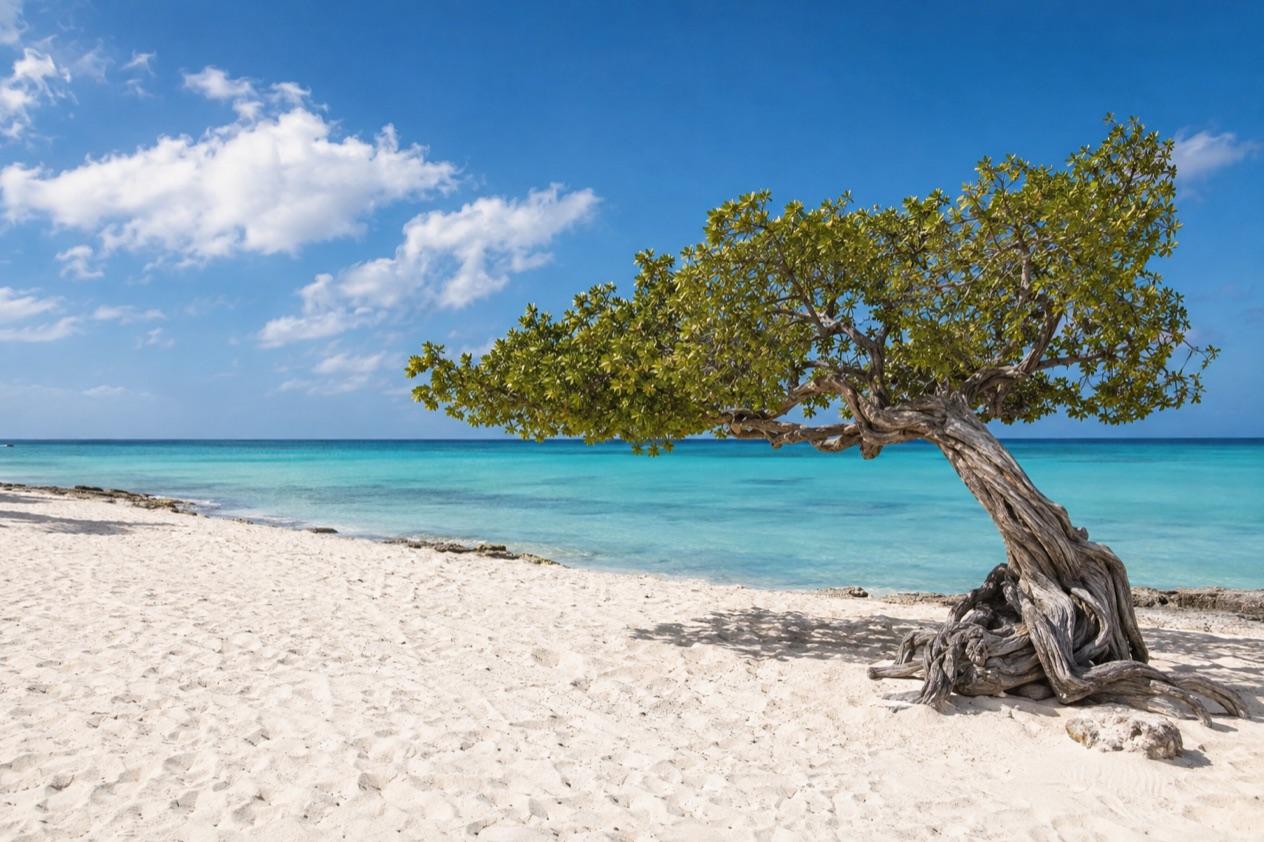
In August the trade wind keeps combing the leaning fofoti trees of Eagle Beach, and by mid-morning the pastechi, the little fried pastries stuffed with cheese or meat, are disappearing from the bakery counters of Oranjestad. The sun is high, the sea is as warm as a bath, and evenings run long over grilled fish and a cold Balashi, the local beer. August on Aruba is a month for snorkeling, for the resort beaches of the leeward coast and for the wilder shore facing the wind, all in steady, dry heat.
What is the weather like in Aruba in August?
August is hot, sunny and mostly dry on Aruba, with a warm sea and an east wind that blows across the whole island, softening the heat on the sheltered western coast and roughening the water on the eastern one.
| Place | Region | Average high (°F) | Average low (°F) | Rain (in) | Rain days | Sea (°F) |
|---|---|---|---|---|---|---|
| Oranjestad | Leeward (west) coast | 91.8 | 81.0 | 0.77 | 3.1 | 83.7 |
Afternoons are properly hot, and nights bring little relief, so you eat outside after dark without a thought for a jacket. Rain is a passing affair. A shower may cross the island on a few days of the month, and the real rainy season is still a couple of months away, in the fall. Daylight lasts just over twelve and a half hours in mid-August, which leaves a long evening for the waterfront.
The wind is the other half of the weather. It blows from the east all year and averages 18 mph this month, enough to keep the sun bearable on the leeward beaches and to make the windward coast, on the north and east sides, rough and wild.
The sea off Palm Beach on the northwest side and off San Nicolas in the south reads 83.9°F, a touch above the figure for Oranjestad. Either way it feels warm from the first step in.
Where to go in Aruba in August
The leeward coast: Palm Beach, Eagle Beach and Oranjestad
The west and southwest coast is where the island’s resort beaches lie, and August suits them well. Palm Beach, the strip of resorts in the Noord district, is the place for long days between sand and water and for dinners at tables a few steps from the surf. Eagle Beach, a little farther south, is wider and quieter in mood, with the fofoti trees bent by decades of wind.
Oranjestad, the capital, is the town to wander when the sun is too much for the beach. Its Dutch colonial facades in candy colors make good shade-hunting walks, and the harbor-side cafés are the place for a pastechi breakfast. This coast is the one to choose if you want the sheltered side of the island and the widest choice of restaurants after dark.
The northwest tip and the snorkeling coves
At the northwest end, the California Lighthouse stands over a landscape of scrub and boulders, and near it lies Malmok Beach, one of the spots named among the best for snorkeling on the island. Boca Catalina sits on the same stretch of coast. With the sea this warm in August, masks and fins are the natural kit for the month.
The clear water lets snorkelers and divers see reefs and wrecks, and snorkel tours stop at the Antilla, the World War II shipwreck. Plan these outings for the morning, when the light is soft, and keep the afternoons for shade and a cold drink.
The south and the windward coast: San Nicolas, Baby Beach and Arikok
San Nicolas, in the south, is the town of the mural tour, where the walls of the old refinery town are covered in large painted works. Baby Beach, in the south near San Nicolas, and Mangel Halto are both counted among the island’s best snorkeling beaches. Savaneta, between the capital and San Nicolas, is a fishing village where the catch of the day is the draw.
On the north and east side, the sea hits black rock and the wind is at its strongest. Bushiribana, the ruin of an old gold smelter, stands on the north coast, and Arikok National Park fills much of the east with desert hills and cactus.
In the middle of the island, Hooiberg rises as a lone cone over the flat landscape. These are places for looking and walking, in the early hours before the heat settles.
What to do in Aruba in August
August has no great national festival to organize a trip around, and that is part of its charm: the month belongs to the sea, the table and slow days in a warm wind. The days fall into a rhythm of a morning in the water, a long lunch, an hour in the shade and an evening by the shore.
In and under the water
The ocean is warm all year, and in August it is at the warm end of its range, which is what makes snorkeling and diving the natural headline. Malmok Beach, Boca Catalina, Mangel Halto and Baby Beach are the names to know for masks and fins.
Every beach and cove on the island is public, and there are more than twenty of them, so you can move from one to the next through the day without a plan. Eagle Beach and Palm Beach hold the wide sand, while the coves have a different feel, rockier and more tucked away.
Eating the island
Aruban cooking reflects Amerindian, European, African and Asian influences, and August is a fine month to taste it at a table outside. Keshi yena, a hollowed round of cheese baked with a spiced filling, is the dish that tells the story of the island’s mixing. The first inhabitants, the Caquetio, lived on fresh fish and conch, and both still turn up on menus today.
Start the day with pastechi, then look for the catch of the day in the fishing village of Savaneta. In the evening, Papiamento, the local language blending Portuguese, Spanish, Dutch and more, drifts across the tables, and a bon bini, or welcome, is part of every greeting.
On land, early in the day
Heat and wind shape the land activities. Arikok National Park, Hooiberg in the middle of the island, the gold smelter ruin at Bushiribana and the California Lighthouse are the places to head for in the morning light. The mural tour in San Nicolas gives you a walk past the painted walls of the old refinery town.
When the afternoon gets heavy, retreat to the water or to the shaded terraces of Oranjestad. If one of the few showers of the month sweeps in, it passes fast, and the wind dries the streets quickly.
Is Aruba busy in August?
August sits in the middle of the island’s calendar: it is not the peak season, which runs from December to April, and it comes just before the off-season of September to November. For Americans it is also the last stretch of summer vacation, so the resort strip keeps its holiday mood.
Palm Beach and Eagle Beach carry the most movement, with beach clubs, sunset bars and restaurant terraces all in use after dark. Oranjestad has a busy side on its waterfront and in its shopping streets, while the coves and the windward coast have a quieter, more solitary feel.
The other half of the island is calmer by nature. San Nicolas and Savaneta in the south work at a village pace, with fishermen at the dock and neighbors at the snack bars. Arikok National Park and the north coast, with the ruin at Bushiribana, feel empty by comparison, and only the wind makes noise.
A good way to read the month is by time of day. Mornings are gentle at the snorkeling coves, midday belongs to shade and long lunches, and the shoreline picks up again at sunset, when the leeward beaches turn gold and diners fill the tables nearest the water. A traveler who shifts plans around those rhythms finds August comfortable.
What to pack for Aruba in August
Packing for August is mostly the same across the island: hot days, warm nights and a steady wind. The leeward beaches call for swimwear and light clothes, while the windward coast and the park ask for a hat and closed shoes for rough ground, and for something you do not mind getting sandy.
- Light, breathable clothes in cotton or linen for the hot afternoons and warm evenings.
- Two swimsuits, so one can dry in the wind while you wear the other.
- A snorkel mask and fins if you have your own, since the clear water and the coves invite it.
- A hat, sunglasses and plenty of sunscreen for the high sun.
- Sturdy shoes or sandals with a grip for the rocky north coast and Arikok National Park.
- A light wrap or shirt for the breeze on a terrace after dark.
Good to know before you go
The U.S. State Department rates Aruba Level 1, ‘Exercise normal precautions,’ and says Aruba is generally a safe destination for travelers, with petty crime the main concern in popular tourist areas.
The hurricane season runs from the first of June to the end of November, so August falls inside it. Aruba sits on the southern fringes of the hurricane belt, where damaging storms are rare, but a system passing elsewhere in the Caribbean can still bring more rain, gusty winds, a day with no wind at all or a heavier feel to the heat.
For entry, U.S. citizens do not need a visa, but they do need a passport valid for the whole stay. They must complete the Aruba ED Card (Embarkation and Disembarkation Card) within 7 days before travel, hold proof of return or onward travel, and have enough money to cover the stay.
Is August a good time to visit Aruba?
August is a good time to visit for travelers who love the water, the heat and an unhurried pace, and the leeward coast around Palm Beach, Eagle Beach and Oranjestad is the place to base yourself. The month closes the stretch from February to August that is considered the best time overall, and it brings a sea at its warmest and a dry spell before the fall rains.
Compared with July, August is a little drier, with fewer showers and a slightly warmer feel to the air. The sea is a shade warmer as well. July is already good, but August has the more settled weather of the two, and the sea has had longer to heat up.
September is hotter still in the water, but it brings more rain, and it falls into the off-season, when the island slows down further. If the warmest sea is your priority, September has it. If you want the driest, most reliable run of days with the island still in a holiday mood, August is the safer choice.
What makes August special on Aruba is the combination: a warm clear sea over reefs and the Antilla wreck, a wind that never stops, and fofoti trees leaning over Eagle Beach as the light turns gold. Finish the day with a plate of fresh fish in Savaneta as the last light fades behind the water.
Sources
- Meteorological Department Aruba (meteo.aw), Summary Climatological Normals 1991-2020, Queen Beatrix Airport station (http://www.meteo.aw/files/Download/climatnormals19912020.pdf), checked October 9, 2026
- Open-Meteo Marine API, average 2015-2024, checked October 9, 2026
- sunrise-sunset.org, sunrise and sunset calculated for the 15th of the month, checked October 9, 2026
- Aruba Tourism Authority, Weather and climate (https://www.aruba.com/us/our-island/island-facts/weather-and-climate), checked October 9, 2026
- Aruba Tourism Authority, Best time to visit (https://www.aruba.com/us/our-island/one-happy-island/when-is-the-best-time-to-visit-aruba), checked October 9, 2026
- Aruba Tourism Authority, Where is Aruba (https://www.aruba.com/us/our-island/island-facts/where-is-aruba), checked October 9, 2026
- NOAA National Hurricane Center, Climatology (https://www.nhc.noaa.gov/climo/), checked October 9, 2026
- Aruba Tourism Authority, Aruba hurricane season (https://www.aruba.com/us/blog/aruba-hurricane-season), checked October 9, 2026
- Aruba Tourism Authority, Passports and visas (https://www.aruba.com/us/plan-your-visit/getting-to-aruba/passports-and-visas), checked October 9, 2026
- Aruba Tourism Authority, Sustainability (https://www.aruba.com/us/our-island/island-facts/sustainability), checked October 9, 2026
- Aruba Tourism Authority, Beaches and coves (https://www.aruba.com/us/things-to-do/beaches-and-coves), checked October 9, 2026
- Aruba Tourism Authority, On the water (https://www.aruba.com/us/things-to-do/on-the-water), checked October 9, 2026
- Aruba Tourism Authority, Scuba and snorkel (https://www.aruba.com/us/things-to-do/on-the-water/scuba-snorkel), checked October 9, 2026
- Aruba Tourism Authority, Local Aruba cuisine (https://www.aruba.com/us/things-to-do/dining/local-aruba-cuisine), checked October 9, 2026
- U.S. Department of State, Aruba Travel Advisory, Level 1, issued August 19, 2026 (https://travel.state.gov/content/tsg_aem/us/en/home/international-travel/travel-advisories/destination.abw.html), checked October 9, 2026
To plan your stay
- Things to Do in Aruba: Beaches, Arikok National Park, Island Tours and Food
- Where to Stay in Aruba: Palm Beach, Eagle Beach, Oranjestad and All-Inclusives
- Aruba Airport (AUA): Arrival, Getting to Your Hotel, U.S. Preclearance and Departure
- Know Before You Go to Aruba: Entry Forms, Money, Water and Local Customs