
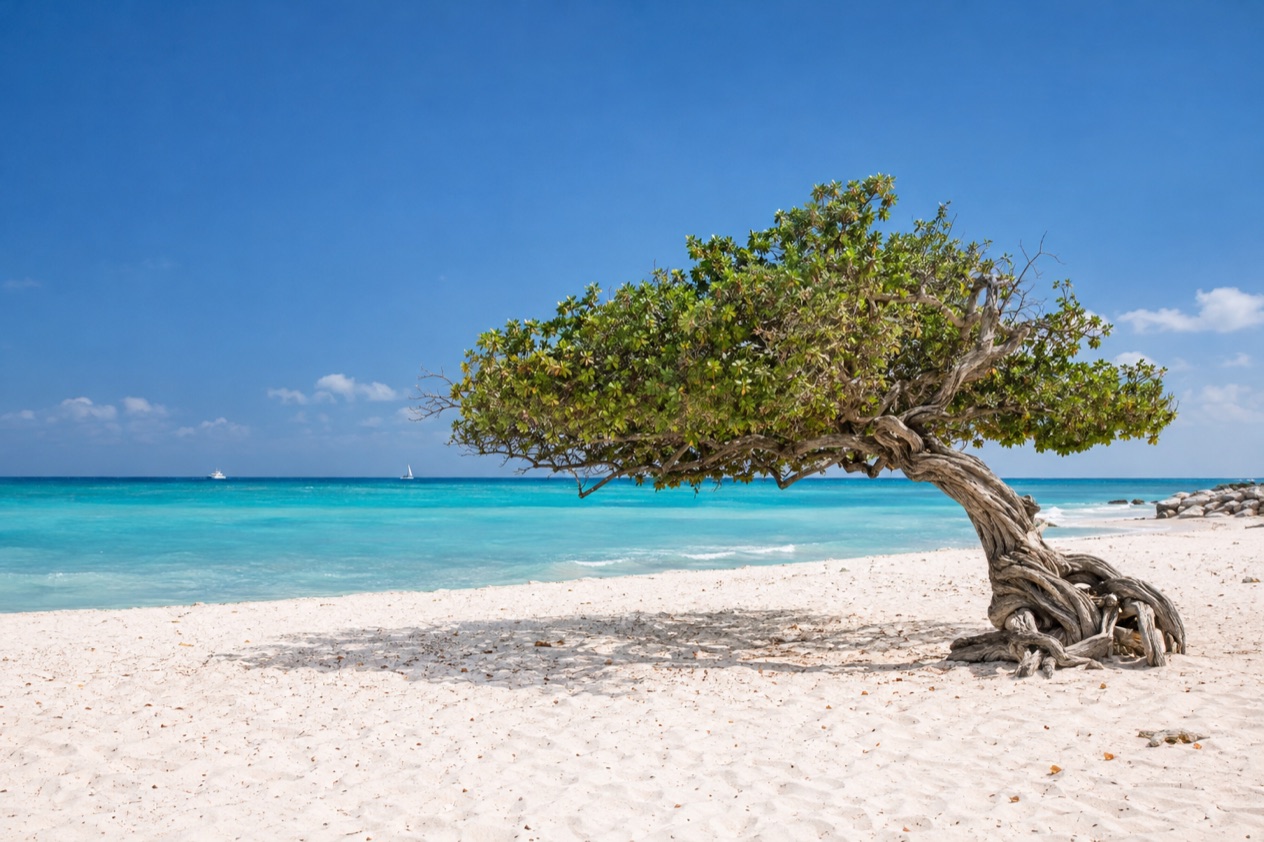
In April the trade wind keeps the divi-style silhouettes of the fofoti trees on Eagle Beach leaning toward the west, kites cross the bay off the north-west tip, and the dry hills around Hooiberg look scorched and golden against a hard blue sky. Pastechi (fried pastries filled with cheese or meat) come out of the kitchens at breakfast and fresh fish gets grilled by evening. This is Aruba at the tail end of its busiest stretch, hot, bright and breezy, for beach lovers, snorkelers and wind sports fans.
What is the weather like in Aruba in April?
April in Aruba is hot, sunny and windy, with very little rain, and the sea is warm enough that getting in is never a shock. Showers are rare and short, the kind that pass over the island before you have finished your coffee. Days run a little longer than twelve hours, so there is plenty of daylight for a late start at the beach and an unhurried dinner afterward.
| Place | Region | Average high (°F) | Average low (°F) | Rain (in) | Rain days | Sea (°F) |
|---|---|---|---|---|---|---|
| Oranjestad | Leeward (west) coast | 89.4 | 78.8 | 0.34 | 1.5 | 80.8 |
The heat is steady rather than dramatic. Afternoons are strong sun, nights stay warm enough for dinner outside in a T-shirt, and the east wind, which blows all year and averages about 18 mph this month, takes the edge off the midday hours. It also dries swimsuits in minutes and blows napkins off tables, so restaurants right on the sand often serve with a glass on top of everything.
The wind is also what separates the two sides of the island. The leeward coast, west and south-west, is where the resort beaches sit and is sheltered from it. The windward coast, north and east, takes the wind and the waves head on and is rough and wild. The sea off Palm Beach and off San Nicolas, at opposite ends of the leeward and southern shores, is within a fraction of a degree of the temperature off Oranjestad, so water warmth does not decide where you stay.
Where to go in Aruba in April
Aruba is small, flat and dry, so April is less about choosing a climate than choosing a coast and a mood. The dry season runs through this month, which means sunny skies on every side of the island, and the wind decides how each coast feels.
The leeward coast: Palm Beach, Eagle Beach and Oranjestad
This is the stretch most people picture: Palm Beach, the strip of resorts in the Noord district, then Eagle Beach with its leaning fofoti trees, then the pastel Dutch-colonial facades of Oranjestad, the capital. Mornings here are the time for a long beach walk, when the sand is empty and the light is soft. Afternoons belong to a lounge chair and a cold drink.
Snorkelers have a few names to know on this side. Malmok Beach, Boca Catalina and Mangel Halto are among the best beaches for snorkeling in Aruba, and the clear water lets you see reefs and wrecks. Snorkel boat tours often stop at the Antilla, the World War II shipwreck. In town, Oranjestad rewards an evening stroll, when the heat eases and the waterfront and the shops open to the breeze.
The south: Baby Beach, San Nicolas and Savaneta
The south end of the island feels like a different Aruba, less polished and more local. San Nicolas is the town known for its murals, and a walk through its streets turns up painted walls on corner after corner. Baby Beach, near the southern tip, is another name on the list of the island’s best snorkeling beaches.
Savaneta, up the coast from San Nicolas, is a quieter fishing district where a seafood lunch is the main event. This part of the island suits travelers who prefer a day of neighborhoods, murals and a long meal to a resort pool, and it fits well as a half-day between beach sessions.
The windward coast and the interior
On the north and east side, the sea arrives with force, and the landscape turns to rock, cactus and wide empty views. The ruins of the Bushiribana gold smelter stand on the north coast, and Arikok National Park covers a large part of the island’s wild side. Hooiberg, the hill standing alone in the middle of the island, is a landmark you will keep spotting from the road.
At the north-west tip, the California Lighthouse watches over the point where the leeward and windward sides meet. In April this part of the island is dry, bright and exposed, with the wind at its constant work. It suits travelers who like open landscapes more than sheltered sand.
What to do in Aruba in April
April has two rhythms in Aruba: the Easter season, with its family gatherings and church services, and the everyday rhythm of sea, wind and food that never really changes. Holy Week and Easter move every year, so when they fall in April the island has a more festive and local feel, with families out at the beaches and parks over the long weekend.
King’s Day and the Easter season
As a constituent country of the Kingdom of the Netherlands, Aruba marks King’s Day on April 27, known in Dutch as Koningsdag. Expect orange clothing, music and family outings, a reminder of the island’s Dutch ties alongside its Papiamento-speaking identity (Papiamento is the local language, a blend with Portuguese, Spanish, Dutch and African roots).
Easter, when it lands in April, brings its own atmosphere. It is a time for big family lunches, and the kitchens turn out island dishes. Keshi yena, a baked ball of cheese stuffed with spiced meat, is a classic of the home table, and local menus are shaped by Amerindian, European, African and Asian influences. Fresh fish and conch, which the first Caquetio inhabitants already ate, are still on menus today.
Wind, water and reefs
With steady trade winds of about 15 knots, Aruba is one of the most popular spots on earth for windsurfers and kitesurfers, and April, in the middle of the dry season, is a fine month to watch or try it. The sails on the water off the north-west tip make a lively scene even if you stay on the sand.
For quieter water, head to a snorkeling beach on the leeward side. Warm sea and clear visibility make a morning at Mangel Halto or Boca Catalina a natural plan, and a boat trip to the Antilla wreck gives you a look at one of the island’s best-known dive and snorkel sites. Afternoons can go to Oranjestad, to the Arikok landscape, or simply to a shaded seat with a view.
Is Aruba busy in April?
April is still part of the island’s peak season, which runs from December to April, but it sits at the end of that run, so the pace is a notch gentler than in midwinter. Travelers come for the dry weather, the warm sea and the Easter break, and the resort strips on the leeward coast see the most visitors.
The busiest moment is around Holy Week and Easter, whenever they fall in the month. Families on school vacation fill the beaches, and restaurants feel livelier at dinner. Before and after that stretch, April days feel more relaxed, especially in the morning, when the sand is quiet and the wind has not yet picked up.
For a calmer outing, the south around San Nicolas and Savaneta, and the open, rocky windward side, give you room to wander. Those places feel less like resort territory and more like the island’s everyday life. The off-season runs from September to November, so April is a different mood altogether: sunny, lively and just before the island eases into its quieter months.
What to pack for Aruba in April
Packing in April is simple because the island is hot, dry and windy everywhere, so the question is mostly sun and wind. The leeward beaches call for swimwear, while the windward side and the open interior ask for something that will not fly off in the breeze.
- Light, breathable clothes for hot afternoons and warm evenings.
- Several swimsuits, since the sea is warm and they dry quickly in the wind.
- A hat that ties on or fits snugly, because the east wind is constant.
- Sunscreen and sunglasses for the bright, open days.
- Snorkel gear, if you like your own, for the reefs and the Antilla wreck.
- Sturdy shoes for the rocky windward coast and the Arikok landscape.
Good to know before you go
The U.S. State Department rates Aruba Level 1, ‘Exercise normal precautions,’ and says Aruba is generally a safe destination for travelers, with petty crime the main concern in popular tourist areas.
The Atlantic hurricane season runs from June 1 to November 30, so April falls before it begins. Aruba sits on the southern fringes of the hurricane belt, where damaging storms are rare. The State Department also advises checking its levels again before you travel.
U.S. citizens do not need a visa. They do need a passport valid for the whole stay, the Aruba ED Card completed within 7 days before travel, proof that they can return to their country of departure or transit onward, and enough money to cover the stay.
Is April a good time to visit Aruba?
Yes, April is a very good month for beach travelers, snorkelers and wind sports fans, and the leeward coast with Palm Beach, Eagle Beach and Oranjestad is the natural base. It is hot and bright, almost rainless, and the sea is warm, which is the combination most people come for. It also suits travelers who like the south and the wild windward coast, since the dry weather makes every side of the island easy to explore.
Compared with March, April is a touch warmer, with nights a little softer and the sea creeping up a shade, while rain stays just as scarce. March feels slightly cooler in the afternoon and is a bit more reliably breezy for kitesurfers, but the difference is small enough that you would hardly notice it on a beach towel.
May is warmer again, with noticeably balmier nights and a sea that feels a few degrees friendlier, along with a little more rain, though still modest. April sits right before that shift, and it is the last month of the dry season, which gives it a crisp, bright quality. The trade for that is that it also falls at the end of the peak season, so the Easter weeks can feel busy.
What is special about April in Aruba is the mix: the last of the dry-season sun, the east wind at work over the kite beaches, King’s Day in orange on the 27th, and Easter tables with keshi yena and fresh fish. It is a month when the island feels both lively and settled, with warm water, sunny mornings and long, golden evenings.
Sources
- Meteorological Department Aruba (meteo.aw), Summary Climatological Normals 1991-2020, Queen Beatrix Airport station (http://www.meteo.aw/files/Download/climatnormals19912020.pdf), checked October 9, 2026
- Open-Meteo Marine API, average 2015-2024, checked October 9, 2026
- sunrise-sunset.org, sunrise and sunset calculated for the 15th of the month, checked October 9, 2026
- Aruba Tourism Authority, Weather and climate (https://www.aruba.com/us/our-island/island-facts/weather-and-climate), checked October 9, 2026
- Aruba Tourism Authority, Best time to visit (https://www.aruba.com/us/our-island/one-happy-island/when-is-the-best-time-to-visit-aruba), checked October 9, 2026
- Aruba Tourism Authority, Where is Aruba (https://www.aruba.com/us/our-island/island-facts/where-is-aruba), checked October 9, 2026
- Aruba Tourism Authority, Passports and visas (https://www.aruba.com/us/plan-your-visit/getting-to-aruba/passports-and-visas), checked October 9, 2026
- Aruba Tourism Authority, Sustainability (https://www.aruba.com/us/our-island/island-facts/sustainability), checked October 9, 2026
- Aruba Tourism Authority, Beaches and coves (https://www.aruba.com/us/things-to-do/beaches-and-coves), checked October 9, 2026
- Aruba Tourism Authority, On the water (https://www.aruba.com/us/things-to-do/on-the-water), checked October 9, 2026
- Aruba Tourism Authority, Scuba and snorkel (https://www.aruba.com/us/things-to-do/on-the-water/scuba-snorkel), checked October 9, 2026
- Aruba Tourism Authority, Local Aruba cuisine (https://www.aruba.com/us/things-to-do/dining/local-aruba-cuisine), checked October 9, 2026
- Aruba Tourism Authority, Kite and windsurfing (https://www.aruba.com/us/things-to-do/on-the-water/kite-windsurfing), checked October 9, 2026
- U.S. Department of State, Aruba Travel Advisory, Level 1, issued August 19, 2026 (https://travel.state.gov/content/tsg_aem/us/en/home/international-travel/travel-advisories/destination.abw.html), checked October 9, 2026
To plan your stay
- Things to Do in Aruba: Beaches, Arikok National Park, Island Tours and Food
- Where to Stay in Aruba: Palm Beach, Eagle Beach, Oranjestad and All-Inclusives
- Aruba Airport (AUA): Arrival, Getting to Your Hotel, U.S. Preclearance and Departure
- Know Before You Go to Aruba: Entry Forms, Money, Water and Local Customs