
PUNTA CANA · FEBRUARY · 18.58° N
An average February day in Punta Cana tops out at 79.0°F and bottoms out at 74.2°F, and the whole month collects 1.42 inches of rain. Offshore, the sea averages 80.0°F. Those four numbers decide most of what a week here looks like: swimming from the first morning, dinner outdoors after dark, and a suitcase that never once needs a sweater.
What February costs is harder to answer. We could not read an occupancy series or a monthly room rate for Punta Cana, so no month gets crowned cheap or expensive here. What the data does support is the comparison with the months on either side, and January and March sit closer than most travelers assume. Pick your week from the normals below, then book a flight and a room you can cancel.
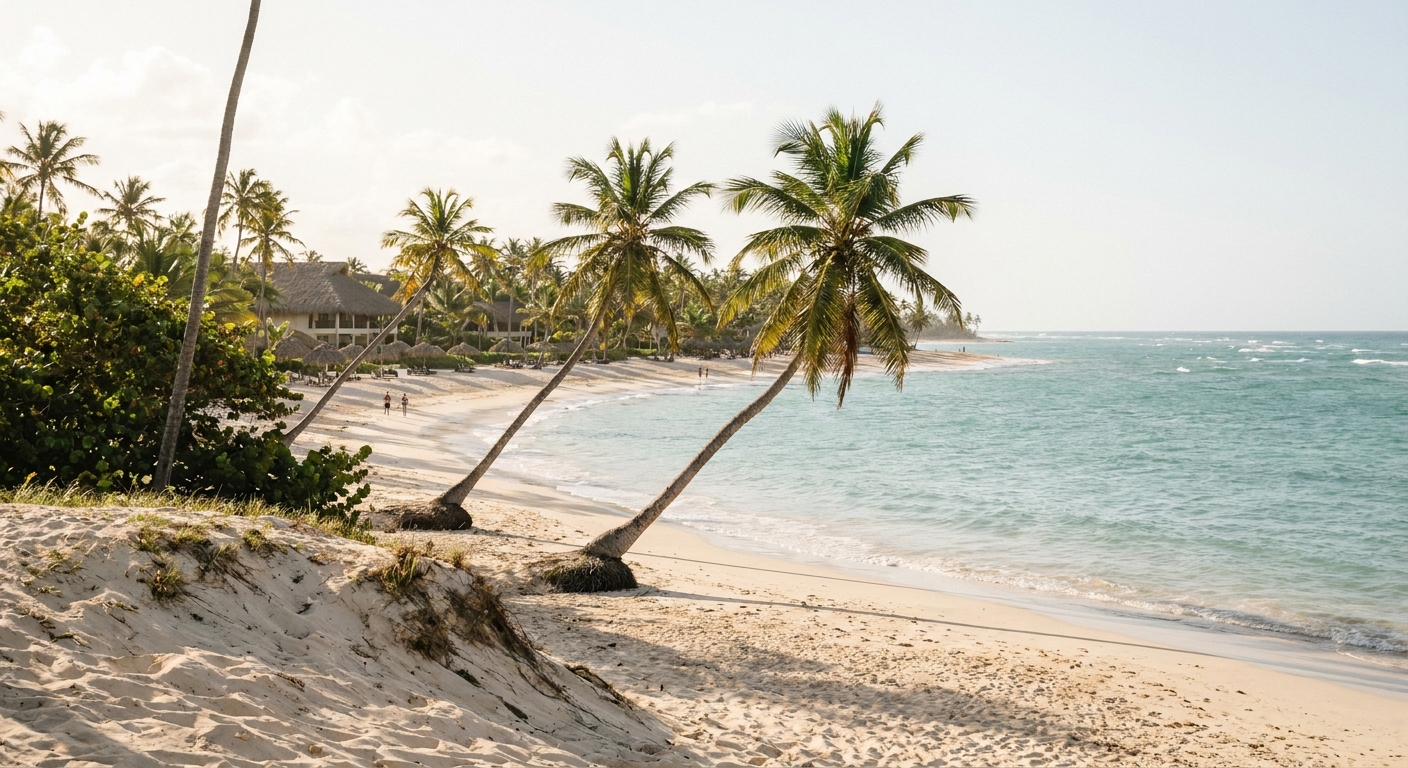
THE MONTH AT A GLANCE · PUNTA CANA · FEBRUARY
February gives you an 80.0°F sea, an average high of 79.0°F and rain on roughly one day in eight, which is as reliable a beach week as these three winter months offer.
ERA5 REANALYSIS 1991-2020 · SEA FROM DAILY MAXIMA 2015-2024 · NO PRICE DATA VERIFIED
Go for: water warm enough to swim at 7 a.m., 1.42 inches of rain across the whole month, and no day in an average February collecting an inch or more.
Think twice before: treating these figures as an airport reading: they come from a model grid cell on the island’s windward eastern tip, not from a station thermometer.
Air: Open-Meteo / ECMWF ERA5 · Sea: Open-Meteo Marine API · Light: sunrise-sunset.org · full sources at the end
On this page
- Average highs, lows and rain daysFebruary weather, figure by figure
- Can you swim in February?An 80.0°F sea, and the caveat behind it
- Crowds, prices and the lodging taxWhat we can and cannot price
- Things to do with 11 hours 35 minutes of daylightBeaches, the cenote and the south-coast boat day
- A two-day plan keyed to sunrise and sunsetTwo days, hour by hour
- Punta Cana in February vs January and MarchHow the three months compare
- Is February a good time to visit?The verdict, and who should shift
Punta Cana sits on the island’s eastern tip, and every figure here describes that corner. The grid cell used for the normals below takes the trade winds full on, while the sheltered south coast around Bayahíbe runs calmer and drier than these averages suggest.
Punta Cana weather in February: average highs, lows and rain days
| February in numbers | Value | Where it comes from |
|---|---|---|
| Average high | 79.0°F | ERA5 reanalysis, 1991-2020 |
| Average low | 74.2°F | ERA5 reanalysis, 1991-2020 |
| Precipitation | 1.42 in | ERA5 reanalysis, 1991-2020 |
| Days with 0.10 in or more | 3.7 | ERA5 reanalysis, 1991-2020 |
| Days with 1 in or more | 0.0 | ERA5 reanalysis, 1991-2020 |
| Sea surface (mean of daily maxima) | 80.0°F | Marine API, 2015-2024 |
| Daylight on Feb 15 | 11h 35m | sunrise-sunset.org |
The 79.0°F high and 74.2°F low come from the ECMWF ERA5 reanalysis served by Open-Meteo, averaged over 1991-2020 for the grid cell at 18.5818° N, 68.4043° W. That matters more than it sounds: a reanalysis reconstructs the weather over a square of map, it does not read an airport thermometer, and station normals for the same spot can land a degree or two apart on the overnight minimum.
Rain works out to 1.42 inches for the month across 3.7 days that record 0.10 inch or more, which is measurable rain on roughly one day in eight. In an average February, no single day collects an inch or more. In practice that reads as a shower that moves through while you order a second coffee, not a vacation day written off.
Day to night, the normals move 4.8°F, from 79.0°F down to 74.2°F. Nothing in that spread asks for warm clothes. A long-sleeve shirt for the breeze on an open beach at night, one pair of closed shoes if you plan to walk a park trail, and the rest of the bag goes to swimwear and sun cover.
February 15 brings 11 hours 35 minutes of daylight, with the sun up at 7:00 a.m. and down at 6:35 p.m. local time. Dinner happens after dark, every night, whatever hour you sit down. Anything you want to photograph on the water belongs before 5:30 p.m.
Can you swim in Punta Cana in February? Sea temperature and what it feels like
Yes, and the figure is 80.0°F. It comes from the Open-Meteo Marine API, averaged over 2015-2024, and it is the mean of daily maxima: the warmest point of each day, not a 24-hour mean. Read it as a shade warmer than the water you will meet at 7 a.m., and as the number other sea-temperature tables will sit slightly below.
For anyone walking in, 80.0°F is a full degree above February’s average daytime air temperature of 79.0°F and nearly six above the 74.2°F overnight low. The sea is the warm part of a February morning here. No shortie wetsuit, no counting to three on the first step, and no shivering hour after a long snorkel.
On wind and swell we have no monthly series to quote, and we are not going to invent one. What the climate source does state is where its numbers sit: the eastern tip, exposed to the trade winds, with the south coast calmer. If a windy morning turns the beach choppy, the boat trips run from that sheltered side.
How busy is Punta Cana in February? Crowds, prices and the demand peak
February falls in the middle of the northern winter stretch, which is a fact of the calendar rather than a measurement. Our research turned up no occupancy series and no monthly room rates for Punta Cana, so you will not read here that February is the year’s cheapest or priciest month. Anyone who tells you so with a straight face is reading a booking site, not a dataset.
That gap changes how you book rather than whether you go. Without a demand curve to lean on, the safe move is a refundable rate and a flight with a change option, then a second look at the price two or three weeks out. US winter school breaks land in this month, so the weeks around them are the ones where holding a cancellable reservation pays for itself.
On the lodging tax, we came up empty: no verified figure for the Dominican Republic available, and no amount is invented here. Check the tax line on your booking confirmation before you pay, and ask at check-in whether anything is collected on site.
The one upgrade that genuinely changes a February week is the boat day to the sheltered south coast, because it is the lever that moves you out of the windward corner these normals describe. Prices and departure times vary by operator and we could not verify current ones, so confirm both when you book rather than on the morning.
Things to do in Punta Cana in February
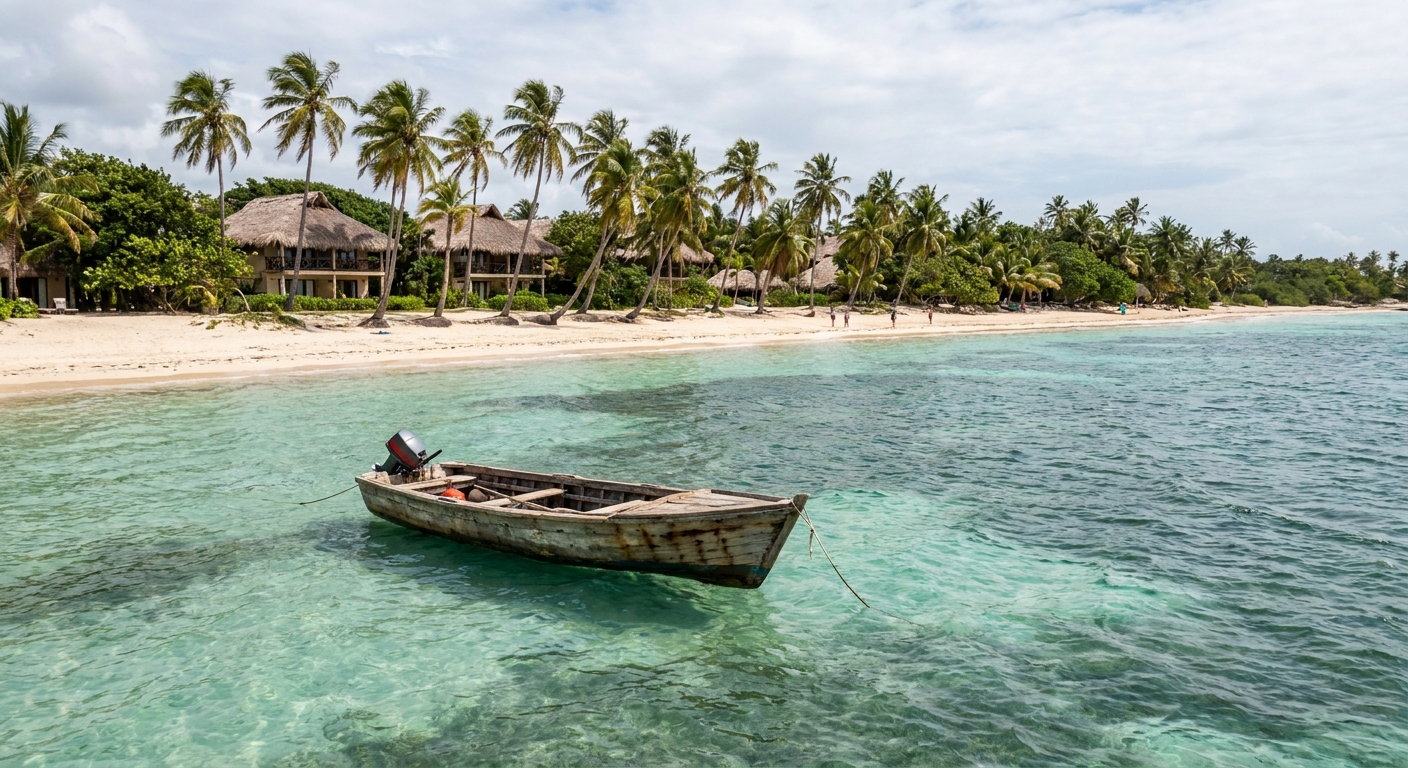
What February hands you that a wetter month does not is a water calendar you can plan against: 3.7 days with measurable rain, down from January’s 4.3, and not one day in the average month that collects an inch. Book the snorkel trip, the catamaran, the long beach afternoon, and expect the weather to hold the appointment.
The named targets: the Bávaro strand for the long flat walk, Macao for the surf-facing stretch, Hoyo Azul at Scape Park for the freshwater cenote, the Indigenous Eyes Ecological Park for lagoons and shade, and Isla Saona reached from the calmer south coast. We could not verify current admission prices or opening hours for any of them, so treat operator sites as the authority on both.
February changes the air around these places far more than the water inside them. A cenote swim feels the same in any month; what shifts is walking to it under a 79.0°F sky instead of a summer one, and coming out into a breeze rather than a thunderhead. The ocean, meanwhile, is at its winter setting of 80.0°F, one degree above the average day.
Free this month, with no ticket involved: the beach at 7:00 a.m., when the sea is warmer than the overnight air, and the stretch between 5:00 p.m. and the 6:35 p.m. sunset. No free-admission days were confirmed for any site named above, so assume a ticket unless the operator says otherwise.
Punta Cana in February: a two-day itinerary
Day one. In the water by 7:00 a.m., when the sun clears the horizon and the sea’s 80.0°F beats the 74.2°F the air has been sitting at all night. Breakfast at 8:30, then a boat or snorkel departure mid-morning while the wind is still finding its footing. Lunch and shade from 1 to 3, back on the sand at 4, and the light gone by 6:35, which puts dinner comfortably after dark.
Day two goes inland: the cenote and park trails in the morning, beach in the afternoon, reversing day one so the walking happens before the 79.0°F peak. If a shower arrives, swap the order rather than cancel anything. With 1.42 inches spread over the whole month and no day averaging an inch, February rain buys you a long lunch, not a lost day.
Punta Cana in February vs January and March
| Measure | January | February | March |
|---|---|---|---|
| Average high | 78.9°F | 79.0°F | 79.6°F |
| Average low | 74.5°F | 74.2°F | 74.2°F |
| Precipitation | 1.72 in | 1.42 in | 1.48 in |
| Days with 0.10 in or more | 4.3 | 3.7 | 3.4 |
| Sea surface (mean of daily maxima) | 81.0°F | 80.0°F | 80.0°F |
Across the three months the air barely moves: 78.9°F in January, 79.0°F in February, 79.6°F in March, a spread of 0.7°F from end to end. Rain does more work. January carries 1.72 inches over 4.3 wet days, February 1.42 inches over 3.7, March 1.48 inches over 3.4. The sea is the odd one out: 81.0°F in January, a degree warmer than either month that follows.
Shift four weeks back to January and you gain that extra degree of sea and lose 0.6 of a wet day and a third of an inch of rain. Shift forward to March and you gain 0.6°F on the daytime high and 0.3 fewer wet days, with the same 80.0°F water. Neither move is dramatic, which is the point: these three months are one season, and the deciding factor is your flight, not the thermometer.
Is February a good time to visit Punta Cana?
For a beach week with swimming as the main event, yes. An 80.0°F sea, an average high of 79.0°F and measurable rain on about one day in eight is a week that does what the brochure promised. It is a weaker case for anyone chasing a bargain, because nobody, ourselves included, can show you a verified price curve for these months.
If you would rather duck the school-break weeks, March is the shift to make: 3.4 wet days against February’s 3.7, the highest daytime average of the three at 79.6°F, and the sea holding at 80.0°F. If warm water outranks everything else on your list, January’s 81.0°F is the only figure in the table where the earlier month wins.
What February alone offers is the lowest rainfall total of the three, 1.42 inches, while the sea still sits at 80.0°F.
The last word
Book the cancellable rate, then stop optimizing: on the normals, February and March share the identical average low of 74.2°F, and the gap between the best and worst of these three winter months is under a degree of daytime air. The decision that actually improves the week is smaller and free. Set an alarm for 6:45 and be in an 80.0°F sea when the sun comes up at 7:00. Plan the rest of the year with the month-by-month view.
Sources & data for this guide
- February normals: high 79.0°F, low 74.2°F, 1.42 in, 3.7 days at 0.10 in or more, 0.0 day at 1 in or more · Open-Meteo / ECMWF ERA5, 1991-2020, grid cell 18.5818° N, 68.4043° W · model reanalysis, not an airport station reading · checked Sep 15, 2026
- Scope caveat: the cell sits on the island’s windward eastern tip; the sheltered south coast runs calmer and drier · same ERA5 source · checked Sep 15, 2026
- January and March normals used in the comparison table · same ERA5 source and period · checked Sep 15, 2026
- Sea surface 80.0°F (February), 81.0°F (January), 80.0°F (March), taken as the mean of daily maxima · Open-Meteo Marine API, 2015-2024 · checked Sep 15, 2026
- Daylight 11h 35m on February 15, sunrise 11:00 UTC and sunset 22:35 UTC, converted to local time (UTC-4) · sunrise-sunset.org · checked Sep 15, 2026
- Our admission: no occupancy series, no monthly room rates, no lodging tax figure and no site admission prices or hours were verified for this guide. Nothing of the kind is quoted above · confirm rates, taxes and opening times with operators when you book.