
HONOLULU · MARCH · OAHU’S SOUTH SHORE
March in Honolulu averages a high of 81.2°F, a low of 68.1°F and 2.36 inches of rain, with the sea surface off the south shore sitting at 76.0°F. Those four numbers settle most of the trip before you pack. The water is swimmable from the first morning, the evenings ask for one light layer at most, and the rain still belongs to the wetter half of Oahu’s year, arriving in short bursts rather than in all-day gray.
The question in front of you is not where to fly, since the island is chosen, but whether to hold these dates. Three nights or ten, the weather argument lives in a 1.59-inch rainfall gap with April, and the crowd argument lives in whichever weeks your school district takes off. The rest of the year is laid out in our best time to visit Honolulu guide.
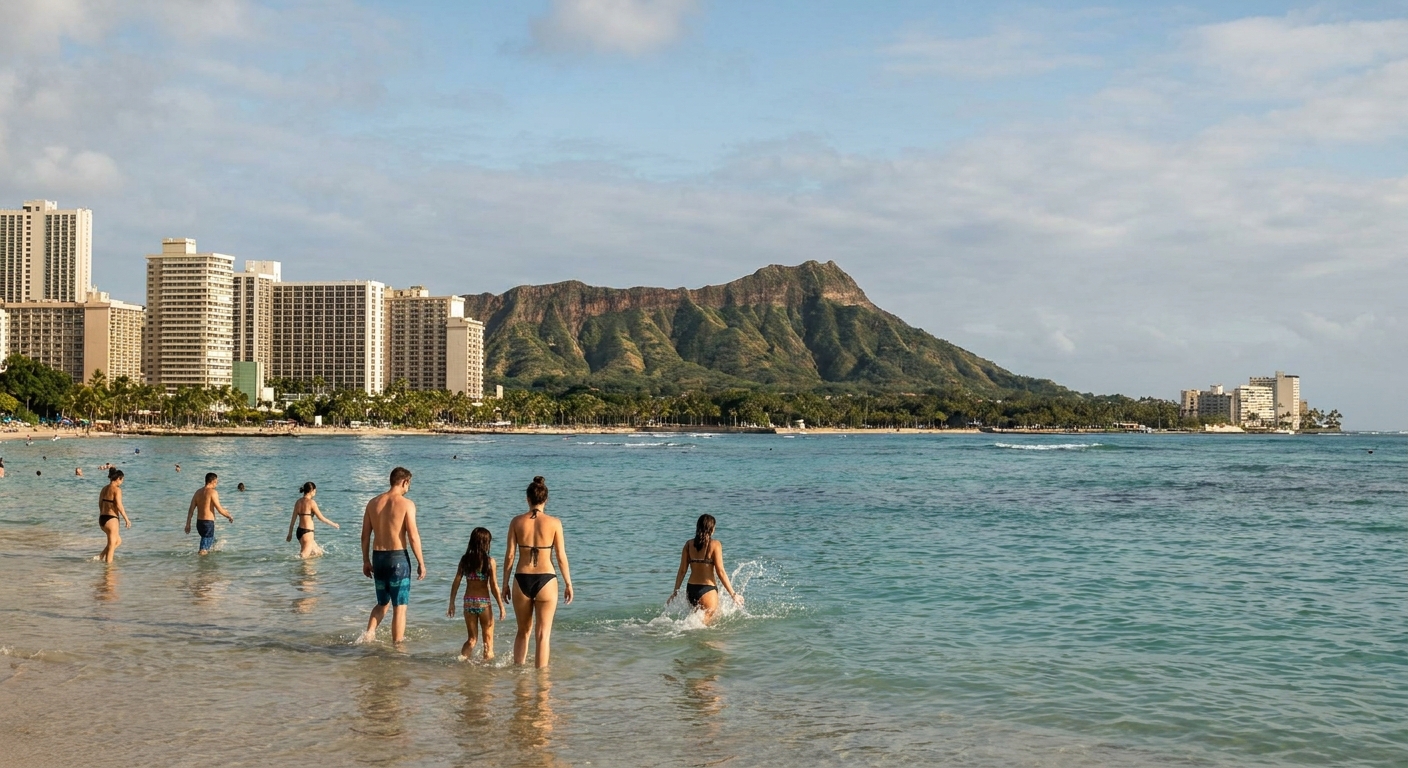
THE MONTH AT A GLANCE · HONOLULU IN MARCH
March gives you warm, swimmable water and the break weeks most American families actually get, in exchange for the wettest of the three surrounding months.
AVG HIGH 81.2°F · SEA 76.0°F · 2.36 IN OF RAIN · 3.1 WET DAYS · 12H 04M OF DAYLIGHT
Go for: water at 76.0°F, afternoons at 81.2°F, and twelve hours of daylight to spend on a beach that never closes.
Think twice before: booking March for dry weather. April averages 0.77 inch against March’s 2.36, on the same beaches and the same flights.
Air: NOAA NCEI 1991-2020, Honolulu International Airport · Sea: Open-Meteo Marine API 2015-2024 · full sources at the end
On this page
- Honolulu weather in March81.2°F days, 68.1°F nights, 2.36 inches of rain
- Sea temperature for swimming76.0°F at the surface, and what that feels like
- Spring break crowds and how early to bookBreak weeks, booking lead times and lodging taxes
- Things to do in Honolulu in MarchWaikīkī, Ala Moana, Hanauma Bay, Diamond Head, Pearl Harbor
- A two-day plan for MarchTwo swims and one climb inside 12 hours of daylight
- March against February and April1.94, 2.36 and 0.77 inches of rain
- Is March a good time to visit Honolulu?Yes if the dates are fixed, April if they float
- The other eleven monthsHonolulu month by month
Practical shape of the trip first: five to seven nights is the usual Oahu week, flights land at Honolulu International, and the itinerary further down assumes a bed within walking distance of the water. Every figure here carries its source in the paragraph that uses it, because a station normal and a grid reanalysis do not measure the same thing. Nothing is estimated except where it says.
Honolulu weather in March: average highs, lows and rain days
| Measure | March normal |
|---|---|
| Average high | 81.2°F |
| Average low | 68.1°F |
| Precipitation | 2.36 in |
| Days with 0.10 in or more | 3.1 |
| Days with 1.00 in or more | 0.7 |
| Sea surface (mean of daily maxima) | 76.0°F |
| Daylight, March 15 | 12h 04m |
All of the air figures here come from one real thermometer: NOAA NCEI’s 1991-2020 monthly normals for station USW00022521, at Honolulu International Airport on the leeward south shore. March there averages 81.2°F by day, 68.1°F at night and 2.36 inches of rain. The gauge sits on the island’s dry side. The windward coast and the ridges behind town take several times that rainfall and no instrument in this dataset records them, so 2.36 inches is a south-shore number, not an Oahu number.
Rain arrives in countable episodes rather than in weather systems. An average March logs 3.1 days with at least 0.10 inch, which works out to measurable rain about one day in ten, and 0.7 of a day reaching an inch or more. Translated into a week on the ground: most mornings run dry, one afternoon produces a shower worth stepping under an awning for, and a full soaking is the exception. Umbrellas in March are a convenience, not equipment.
Between the 81.2°F afternoon and the 68.1°F night sit 13.1 degrees, a one-layer gap. The March bag: swimwear that dries overnight, a long-sleeve layer for evenings outdoors and for over-air-conditioned restaurants, a rain shell thin enough to fold into a day bag, and shoes you can rinse in a hotel sink. Heavier rain gear stays home, and so does the sweater.
On March 15 the city gets 12 hours and 4 minutes of daylight, with the sun down at 6:42 p.m. local time. That sunset is the hinge of the day. Usable beach light holds until around six, dinner happens after dark, and any excursion with a view at the far end of it needs to leave by mid-afternoon. Build the outdoor block before six and let the evening be food.
Can you swim in Honolulu in March? Sea temperature and what 76°F feels like
The sea surface off Honolulu averages 76.0°F in March, from the Open-Meteo Marine API across 2015-2024. One qualifier changes how you read it: that average is built from daily maxima, the warmest reading of each day, so it runs a shade above a true 24-hour mean. The water at seven in the morning is a little cooler than 76.0°F, the water at three in the afternoon a little warmer.
A 5.2-degree gap separates that water from the average afternoon air, which is enough for the first ten seconds to register and nothing after that. For a fifteen-minute swim off Waikīkī, skin is fine. For an hour face down and barely moving over a reef, a rash guard or a thin shorty keeps the session going, and children lose heat faster than adults at this temperature.
Wind and swell are the part we cannot put a figure on. Our March dataset for Oahu carries air normals, rain days, daylight and sea surface temperature, and no wind speed or wave height at all, so none is quoted here. Surf also differs by coast on the same morning, which is a question of place rather than of date. Read the National Weather Service surf forecast on the morning you plan to be in the water.
How busy is Honolulu in March? Spring break weeks and how far ahead to book
March is the month American school spring breaks cluster in, and Honolulu absorbs a large share of the West Coast’s. Where March sits in the annual price cycle is something we will not rank, because this page’s data is climate data: no occupancy series, no monthly room rates, no airfare curve. Treat the crowd question as a calendar question instead, starting with the two or three weeks your own district takes off.
Booking follows that calendar rather than the forecast. For dates landing inside the main break weeks, we would hold flights and the room about three months out (est.). For the last week of March, which falls outside the break in many districts, four to six weeks (est.) is usually enough. Those are editorial rules of thumb, not measured lead times. A refundable first night costs little and covers the arrival day when a trans-Pacific flight slips.
Hawaii lodging bills carry state and county taxes on top of the nightly rate, and the percentages are not in our dataset, so no figure appears here. Read the total on the confirmation screen rather than the headline rate, and budget parking separately if the property charges for it. That last line is the one most mainland visitors leave out of the nightly math.
If one line of the budget deserves the upgrade in March, it is the walk to the water. With sunset at 6:42 p.m. and showers arriving in short bursts, a room you can leave for a swim in ten minutes turns three or four small weather windows a week into actual sea time. A room that needs a car and a parking lot turns none of them into anything.
Things to do in Honolulu in March: Waikīkī, Ala Moana, Hanauma Bay and Diamond Head
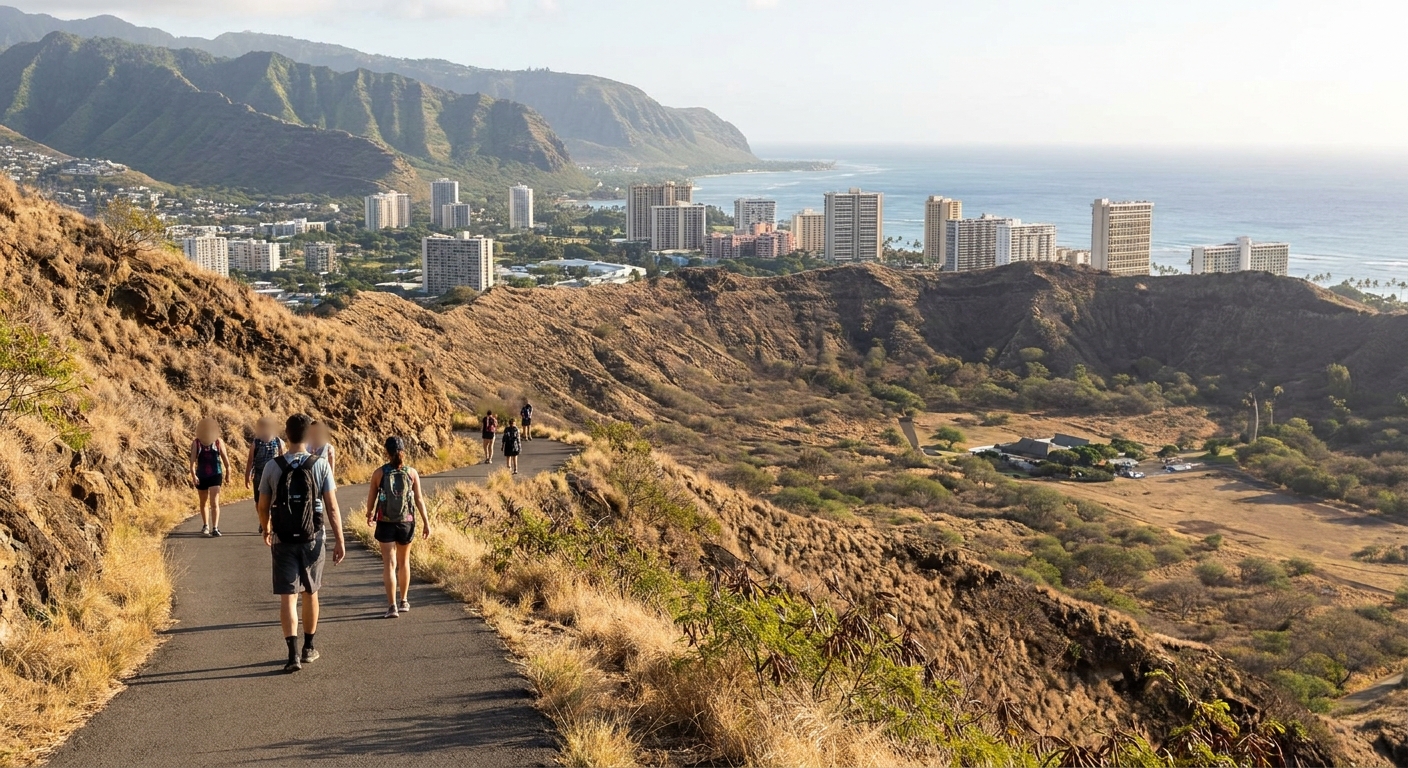
What March offers is the overlap: water already at 76.0°F while the island is still inside its wetter half. February’s sea is 76.1°F under cooler air at 80.5°F, and April is drier and warmer but sits after most school breaks have ended. March is the month where warm ocean and available dates meet, and that pairing, not the sky, is the reason to book it.
The south-shore shortlist names itself: Waikīkī Beach for the easy swim off the sand, Ala Moana Regional Park for calmer water and shade, Hanauma Bay Nature Preserve for snorkeling, Diamond Head State Monument for the crater walk, and Pearl Harbor for the historic sites. Admission prices, opening hours and reservation rules for those five are outside this month’s dataset and none are invented here. Check the official state and city sites for fees and reservations before you go.
March changes the air at those places far more than the water. Across February, March and April the sea moves 0.7 degrees in total, from 76.1°F to 76.7°F, while the afternoon high climbs 2.6 degrees, from 80.5°F to 83.1°F, and rainfall drops from 2.36 inches to 0.77. So the swim is the same swim in any of the three, and the uphill walk is not. Take the climbs in the morning block, while the 68.1°F night air is still hanging around.
The free part of March is daylight and sand: 12 hours and 4 minutes of it on the 15th, and public access along the south shore, Waikīkī’s stretch included. Fee-free days, waivers and event admissions are not in our data for this month, and we hold no verified March event dates for Honolulu, so none are listed here.
Honolulu in March: a two-day itinerary
Day one runs on the morning. Swim before breakfast, while the water is quietest and the night air has not lifted, then take the Diamond Head walk between seven and nine and be off exposed ground by late morning. Lunch indoors. Give the early afternoon to Pearl Harbor or a museum, which is also the slot that absorbs the day’s most likely shower. Back in the water around four, dinner after the 6:42 p.m. sunset. Two swims and one climb out of a single 12-hour day.
Day two goes east for snorkeling at Hanauma Bay, reserved ahead, with the afternoon on Ala Moana’s calmer side. If the sky turns, remember the shape of March rain: 3.1 days in the month reach 0.10 inch and 0.7 of a day reaches an inch, so waiting forty minutes usually beats rebuilding the plan. Keep one indoor block loose. Pearl Harbor, the museums and a long lunch are the wet version of the same two days, with the swim sliding to the next morning.
Honolulu in March vs February and April
| Measure | February | March | April |
|---|---|---|---|
| Average high | 80.5°F | 81.2°F | 83.1°F |
| Average low | 67.1°F | 68.1°F | 70.1°F |
| Precipitation | 1.94 in | 2.36 in | 0.77 in |
| Days with 0.10 in or more | 3.0 | 3.1 | 1.9 |
| Sea surface (daily maxima) | 76.1°F | 76.0°F | 76.7°F |
Line the three up and the ocean barely registers the calendar: 76.1°F in February, 76.0 in March, 76.7 in April, a spread of 0.7 degrees across two months, all of it from the same marine dataset. The air works harder, climbing from 80.5°F to 83.1°F. Rain is where the months genuinely separate. February takes 1.94 inches, March 2.36, April 0.77, with wet days falling from 3.1 in March to 1.9 in April.
Move four weeks forward and you drop 1.59 inches of rain, add 1.9 degrees to the afternoon high and 0.7 to the water, for identical beaches. Move four weeks back and February is 0.42 inch drier than March with air 0.7 degrees cooler and the same sea. What March returns in exchange is calendar fit, plus a wet-season month that swims anyway. On the columns above, April wins the weather argument outright.
Is March a good time to visit Honolulu?
Yes for swimmers, for families tied to a school break, and for anyone who would rather have warm water than dry air. Water at 76.0°F, afternoons at 81.2°F and twelve hours of daylight make a complete beach vacation by any mainland standard. No for the traveler with a free calendar who is chasing guaranteed sun, since 2.36 inches makes March the wettest of these three months even though the rain comes in short pieces.
If the dates float, take April. It cuts rainfall to 0.77 inch, drops wet days from 3.1 to 1.9, adds 1.9 degrees to the afternoon high and 0.7 to the sea, and asks for nothing in return. February runs the other way, 0.42 inch drier than March and 0.7 degrees cooler by day, with the water at 76.1°F, and it has its own page in our February guide.
What March alone lines up is a school-break week against water at 76.0°F and afternoons at 81.2°F, on dates that April, for most districts, simply does not offer.
The last word
Book March for the dates rather than for the sky, then defend the mornings. The sun clears the horizon at 6:37 a.m. on the 15th, which puts a swim, a coffee and the Diamond Head walk inside the first four hours, ahead of the day’s most likely shower and while the crater trail still holds cool air. The museums, the historic sites and the long lunch all survive rain. Set the alarm for six and keep the afternoon loose.
Sources & data for this guide
- March air normals (81.2°F / 68.1°F / 2.36 in) and rain-day counts (3.1 days at 0.10 in, 0.7 day at 1.00 in) · NOAA NCEI monthly normals 1991-2020, station USW00022521, Honolulu International Airport · checked Sep 15, 2026
- February and April normals used in the comparison table · same NOAA NCEI 1991-2020 series, same station · checked Sep 15, 2026
- Sea surface 76.0°F (February 76.1, April 76.7), taken as the mean of daily maxima · Open-Meteo Marine API, 2015-2024 average · checked Sep 15, 2026
- Daylight of 12h 04m on March 15, sunrise 6:37 a.m. and sunset 6:42 p.m. local · sunrise-sunset.org · checked Sep 15, 2026
- Editorial admission: this dataset holds no hotel occupancy or rate series, no lodging-tax percentage, no admission prices or opening hours for Waikīkī, Ala Moana, Hanauma Bay, Diamond Head or Pearl Harbor, and no verified March event dates. None of those are quoted above. Booking lead times are marked (est.) and are our judgment, not measurements.
- Scope caveat: the station sits on the leeward south shore. Windward Oahu and the mountains take several times this rainfall and are not represented in these normals.