
LAS VEGAS · THE 12-MONTH VERDICT · 36.1° N
Las Vegas is sold as a city without weather, which works right up to the moment you cross a parking lot in July. The airport’s average high that month is 104.5°F. In December it is 56.9°F. That 47.6°F swing decides more about a trip here than the hotel you book: whether you walk the Strip or taxi four blocks, whether the pool is the plan or the consolation, whether a morning at Red Rock Canyon is a pleasure or a medical event.
Rain is almost a non-issue: 4.18 inches across the whole year, on eleven days that manage 0.10 inch. So the calendar here is a heat calendar, and it has two soft landings, one in spring and one in fall. Below are the twelve months with their numbers, then the verdict, month named.
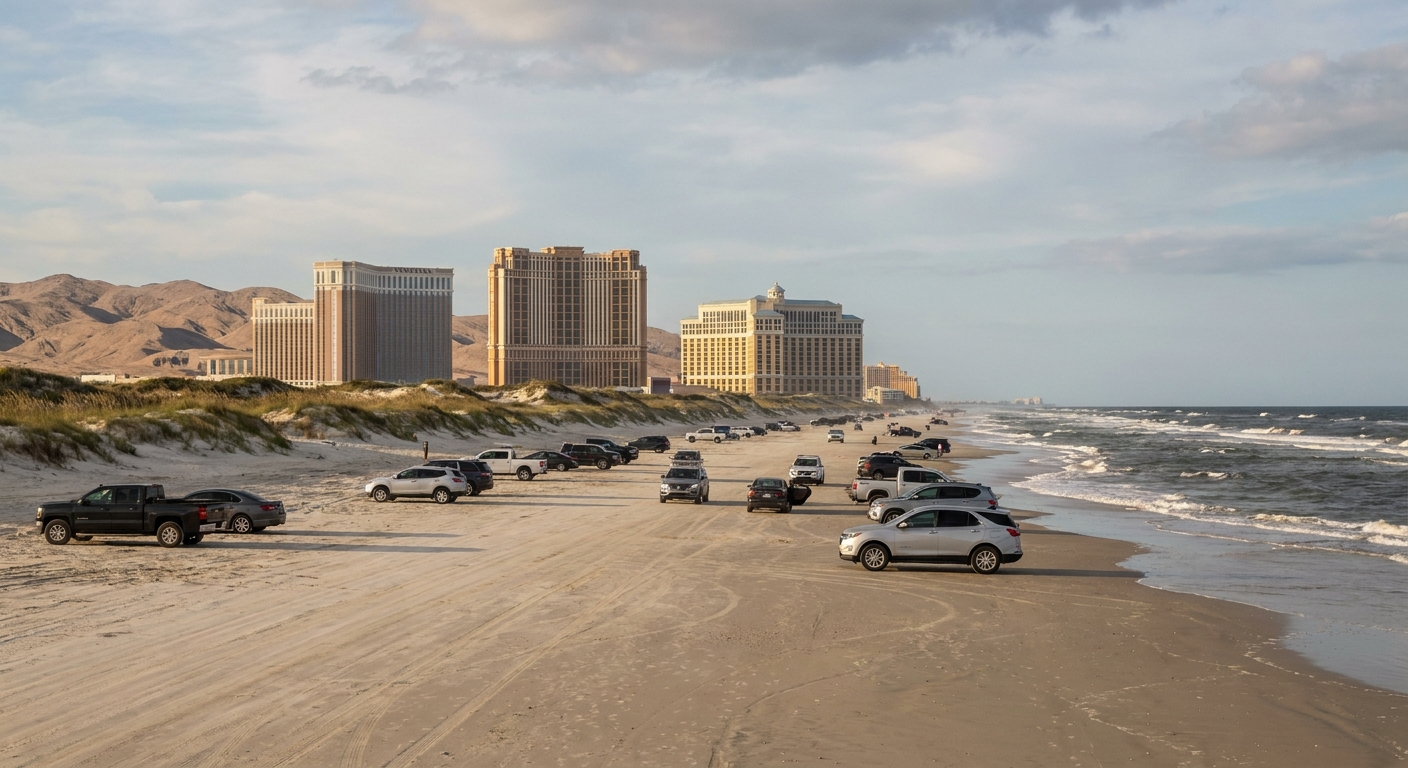
THE YEAR AT A GLANCE · LAS VEGAS
Go in October: 81.2°F days, 59.6°F nights, one rain day, and a Strip you can walk end to end at noon.
BEST: OCTOBER, THEN APRIL · HARDEST: JULY · NORMALS FROM LAS VEGAS MCCARRAN AIRPORT
Go for: October or April, when the walk between hotels, a canyon trail in the morning and a rooftop table at nine all fit into one day.
Think twice before: booking an outdoor-heavy July trip with children. The average low is 82.0°F, so the heat never fully lets go overnight.
Normals: NOAA NCEI 1991-2020, Las Vegas McCarran Airport · Daylight: sunrise-sunset.org · full sources at the end
On this page
- Las Vegas weather month by monthHighs, lows and rain days for all twelve
- The single best month to bookOctober, at 81.2°F and 59.6°F
- July and August temperatures104.5°F days and 82.0°F nights
- The quietest weeks of the yearEarly December and mid-January
- Which month to avoid in Las VegasJuly, at a 104.5°F average high
- Spring and fall trade-offsApril and October against high summer
The short answer is October: 81.2°F by day, 59.6°F by night, one rain day in an average month. A trip built around a pool wants a different month than one built around a canyon trail, and the numbers sort both.
Las Vegas weather month by month: highs, lows and rainfall
| Month | Avg high | Avg low | Rain | Days 0.10 in+ | Daylight (15th) |
|---|---|---|---|---|---|
| January | 58.5°F | 40.5°F | 0.56 in | 1.6 | 10h01 |
| February | 62.9°F | 44.1°F | 0.80 in | 2.1 | 10h56 |
| March | 71.1°F | 50.5°F | 0.42 in | 1.3 | 12h01 |
| April | 78.5°F | 56.9°F | 0.20 in | 0.5 | 13h11 |
| May | 88.5°F | 66.1°F | 0.07 in | 0.2 | 14h09 |
| June | 99.4°F | 75.8°F | 0.04 in | 0.1 | 14h40 |
| July | 104.5°F | 82.0°F | 0.38 in | 1.0 | 14h25 |
| August | 102.8°F | 80.6°F | 0.32 in | 0.7 | 13h34 |
| September | 94.9°F | 72.4°F | 0.32 in | 0.7 | 12h26 |
| October | 81.2°F | 59.6°F | 0.32 in | 1.0 | 11h18 |
| November | 67.1°F | 47.3°F | 0.30 in | 0.7 | 10h17 |
| December | 56.9°F | 39.6°F | 0.45 in | 1.1 | 9h46 |
The year climbs fast and falls fast. Average highs gain 28.3°F between March (71.1°F) and June (99.4°F), then give back 38.0°F between September (94.9°F) and December (56.9°F). Rain hardly interrupts anything: 4.18 inches over twelve months, on 11.0 days that reach 0.10 inch, and roughly one day every five years across February and December combined that reaches a full inch.
Two months do the real switching. May, at 88.5°F, is still a walkable city; June, at 99.4°F, is not, and that is a 10.9°F step in a single calendar page. On the way down the reverse happens between September (94.9°F) and October (81.2°F), a 13.7°F drop that turns an indoor trip back into an outdoor one. April and October are the months that behave, 78.5°F and 81.2°F, both under a single rain day.
For anyone whose plans put them outside between 10 a.m. and 6 p.m., July is the hardest of the twelve months, 104.5°F of it by day. It does not release after dark either: the average July low is 82.0°F, which is 0.8°F above the average October high of 81.2°F. Put plainly, a normal July night in Las Vegas is warmer than a normal October afternoon.
Every figure here comes from the 1991-2020 official normals recorded at Las Vegas McCarran Airport, down on the valley floor. The desert around the city and the Spring Mountains above it both run cooler than the Strip at night, so these are runway numbers, not canyon numbers. A normal is a thirty-year average: July afternoons climb well past 104.5°F, and the rain-day counts use the American thresholds of 0.10 inch and 1 inch.
When is the best time to visit Las Vegas?
October, and it is not close. Average high 81.2°F, average low 59.6°F, 0.32 inch of rain spread over 1.0 day, and 11 hours 18 minutes of daylight on the 15th, sunrise at 6:46 a.m. and sunset at 6:05 p.m. That combination lets you cross from one resort to the next on foot at midday, hike in the morning without a headlamp start, and sit outside at nine at night in a shirt.
September looks similar on a brochure and is not: 94.9°F by day, 13.7°F hotter than October, with nights at 72.4°F rather than 59.6°F. November goes the other way, down to 67.1°F, and takes 61 minutes of daylight with it (10h17 against October’s 11h18), which is an hour of terrace time gone. October sits in between, and only 1.0 day of the month reaches 0.10 inch of rain.
If October is booked out or your dates are fixed, April is the spring version of the same deal: 2.7°F cooler by day (78.5°F) and 2.7°F cooler by night (56.9°F), with 13 hours 11 minutes of daylight and just 0.5 of a rain day. For readers weighing Las Vegas against other trips in the same window, our month-by-month view of where to go and the wider destination index line the options up.
How hot does Las Vegas get in summer?
June averages 99.4°F, July 104.5°F, August 102.8°F. The nights are the part visitors underestimate: average lows of 75.8°F, 82.0°F and 80.6°F, so the 11 p.m. walk back from dinner is still warm work, and pool water stops cooling anyone off. Daylight runs long with the heat, 14 hours 25 minutes on July 15, sunrise 5:34 a.m. and sunset 7:59 p.m., which means sun on the sidewalk until nearly eight.
One thing we cannot tell you: how dry the heat feels. Our source set carries temperature, precipitation and daylight, and no humidity or dew point series, so we make no claim there. What the precipitation record does carry is a late-summer bump. July collects 0.38 inch, more than April, May and June put together (0.31 inch), on 1.0 day that reaches 0.10 inch. Those are thunderstorms, brief and loud, not a rainy week.
When is Las Vegas quietest?
The calendar strands two stretches. The first three weeks of December sit after Thanksgiving and before the holiday surge, and mid-January into early February lands once the New Year crowd has flown home. Weekday nights inside those windows are the emptiest the Strip gets. We read no visitor-volume or hotel-rate series, so treat that as a calendar reading rather than a count, and check your own dates against the convention schedule before booking.
What you gain is a walkable city. Mid-January days average 58.5°F with only 1.6 rain days in the month, which is jacket weather rather than air-conditioning weather, and the same numbers make Red Rock Canyon and the Hoover Dam approach comfortable at noon instead of at dawn. December averages 56.9°F by day. Restaurant tables and show seats come easier on a Tuesday in these weeks than on any Saturday in October.
What you lose is the evening and the pool. December records 4.6 nights at or below 32°F and January 3.3, so rooftop bars and cabanas are decorative. Daylight is the other cost: December 15 gives 9 hours 46 minutes, sunrise 6:43 a.m., sunset 4:28 p.m., which is 4 hours 54 minutes less than June 15. An average December also logs 0.1 day with measurable snow.
Which month should you avoid in Las Vegas?
July, for the traveler whose trip happens outdoors. Families walking children between hotels, hikers heading for Red Rock, anyone queuing outside for a show or a dam tour: 104.5°F by day and 82.0°F at night is the wall, and the sun holds until 7:59 p.m. on the 15th, so the cool hour never arrives before dinner. For a conference delegate moving between air-conditioned rooms, or a poolside weekend, the same month barely registers as a problem.
July does give something back. Sunrise at 5:34 a.m. opens a genuinely pleasant three-hour window for a canyon trail, and 14 hours 25 minutes of daylight means the drive back from Lake Mead still happens in the light. Water that sits at air temperature all night is the one summer luxury the shoulder months cannot match: April nights average 56.9°F, 25.1°F colder than July’s.
Is the shoulder season worth it in Las Vegas?
April and October are the shoulders, and the gap to high summer is large. April, at 78.5°F, runs 26.0°F below July by day and 25.1°F below it by night. October, at 81.2°F, sits 23.3°F under July and 13.7°F under September. March (71.1°F) and November (67.1°F) are the outer edges of the same stretch, still dry, still walkable, noticeably cooler after dark.
What those months hand you is the midday. You can cross the Strip on foot at one in the afternoon, eat outside, and put a morning hike and an evening show in the same day without rearranging either around the heat. April is the third-driest month of the twelve, with 0.20 inch of rain on half a rain day, and it carries 13 hours 11 minutes of daylight, sunrise 6:04 a.m., sunset 7:16 p.m.
The cost is the night. April lows average 56.9°F, 18.9°F colder than June’s 75.8°F, and pool water follows the air with a lag, so an April cabana is a sunbathing proposition rather than a swimming one. October pays in light instead: a 6:05 p.m. sunset ends the outdoor day 1 hour 56 minutes earlier than June’s 8:01 p.m.
Take October if you want one date to cover everything, since 81.2°F by day and 59.6°F by night is the only combination in the year that serves walking, hiking and late tables at once. Take April if the trip includes children who will be in the water anyway, and accept the cooler evenings. Skip the shoulder only if the pool is the whole point of the weekend.
The last word
Book October, pack one layer for the 59.6°F evenings, and put the outdoor half of the trip before noon anyway, because a normal is an average and the desert ignores averages. The month nobody argues for is November, and it deserves a mention: 67.1°F days, 47.3°F nights, 0.7 of a rain day and 0.7 of a freezing night, the quietest stretch of good walking weather in the Las Vegas year.
Sources & data for this guide
- Monthly highs, lows, precipitation, rain-day and freeze-night counts · NOAA NCEI 1991-2020 monthly normals, station USW00023169, Las Vegas McCarran Airport · checked Sep 15, 2026
- Daylight length, sunrise and sunset for the 15th of each month, converted to local time · sunrise-sunset.org · checked Sep 15, 2026
- Annual totals (4.18 inches of rain, 11.0 days at 0.10 inch or more) are our own sums of the twelve monthly normals above · checked Sep 15, 2026
- Humidity and dew point: no series was read for this page, and we make no claim about how the summer heat feels
- Quiet weeks, crowd patterns and event timing are editorial: no visitor-volume, hotel-rate or convention series was consulted · convention calendars and show schedules change, check them for your own dates