
PUNTA CANA · JULY · 18.58° N
July in Punta Cana runs hot and level: an average high of 83.6°F, an average low of 78.7°F, and sea surface water at 85.2°F. The heat is not what decides the month. Rain does, at 3.74 inches spread over 9.3 days that record at least a tenth of an inch, and so does the calendar, since the northern school break lands on the same weeks every year.
Every figure here comes from an ERA5 reanalysis cell centered at 18.5818N, -68.4043E, over the eastern tip of the island, where the trade winds arrive first. It is a model grid square, not a thermometer on the airport apron, and the sheltered south coast of the Dominican Republic runs calmer and drier than these numbers suggest. For the twelve-month view, see our best time to visit Punta Cana guide.
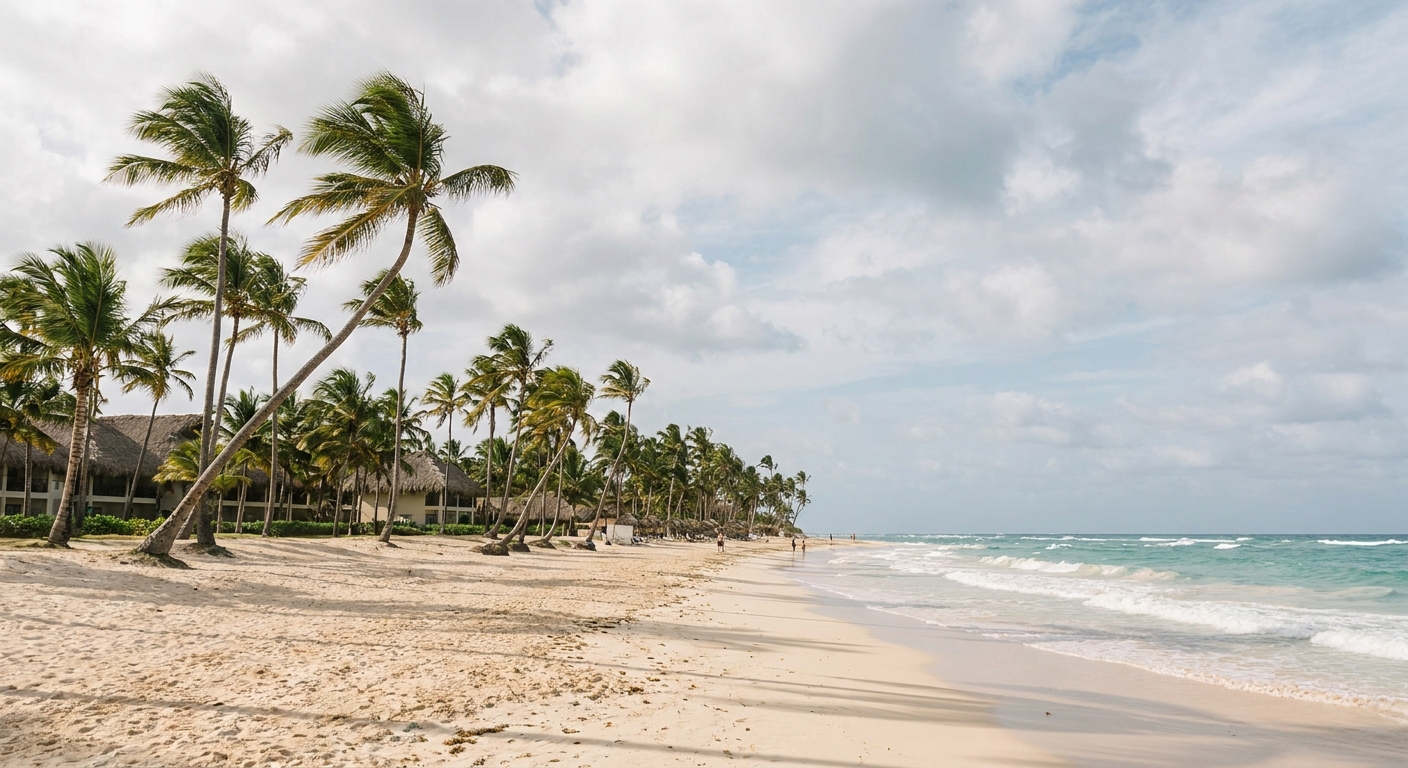
THE MONTH AT A GLANCE · PUNTA CANA · JULY
July gives you 85.2°F water and 13 hours 10 minutes of daylight on the 15th, with 9.3 wet days and the northern school break as the price you pay for it.
AVG HIGH 83.6°F · AVG LOW 78.7°F · SEA 85.2°F · 9.3 WET DAYS · 13H 10M OF DAYLIGHT ON JULY 15
Go for: swimming and snorkeling in 85.2°F water, long evenings with sunset at 7:14 pm, and boat mornings that start in full light before seven.
Think twice before: booking a short, rigid July trip: 9.3 days record measurable rain and the school holidays of three continents overlap the month.
Climate: Open-Meteo / ECMWF ERA5, 1991-2020 grid cell · Sea: Open-Meteo Marine API, 2015-2024 · Sun: sunrise-sunset.org · full sources at the end
On this page
- Average highs, lows and rain days in July83.6°F, 78.7°F and 9.3 wet days
- Sea temperature for swimming85.2°F off the beach
- Crowds and how far ahead to bookThe summer school-break window
- Things to do in JulyBávaro, Macao, Hoyo Azul and the Saona boats
- A two-day plan built around the heatSunrise 6:04 am, sunset 7:14 pm
- July against June and AugustHow the three months compare, line by line
- Is July a good month to go?Who July suits, and who should shift four weeks
One caveat before the numbers start: our source set for this month covers climate, sea and sun. It carries no occupancy series, no monthly room rates and no verified lodging tax, so nothing below ranks July against the other eleven months on price.
Punta Cana weather in July: average highs, lows and rain days
| Measure | July, 1991-2020 |
|---|---|
| Average high | 83.6°F |
| Average low | 78.7°F |
| Precipitation | 3.74 in |
| Days with 0.10 in or more | 9.3 |
| Days with 1 in or more | 0.3 |
| Daylight, July 15 | 13h 10m |
| Sunrise / sunset, July 15 | 6:04 am / 7:14 pm local |
| Sea surface, daily maxima | 85.2°F |
These normals come from ERA5, the European reanalysis served through Open-Meteo, averaged over 1991-2020 for the grid cell at 18.5818N, -68.4043E. A reanalysis blends model physics with observations across a square of land and ocean. It is not the same instrument as a national weather station record, and the gap between the two methods can run a degree or two on the overnight low. That cell sits on the exposed eastern tip, so read the figures as Punta Cana and Bávaro, not as the Dominican Republic.
9.3 days in an average July record at least 0.10 inch of rain, close to one day in three. Spread evenly, the month’s 3.74 inches would put about 0.4 inch on each of those days, the kind of total that soaks a towel and dries off the road within the hour. Our data set does not break precipitation down by hour, so no promise about a dependable late-afternoon shower appears here.
The gap between the average high and the average low is 4.9°F, smaller than what most American cities see between noon and dawn in the same month. Nothing in the suitcase needs to be warm. What it needs is a second swimsuit, because the first one will still be damp, quick-drying shirts instead of cotton, more sunscreen than you think, and one light layer for restaurants and transfer vans running the air conditioning hard.
July 15 delivers 13 hours 10 minutes of daylight, sun up at 6:04 am and down at 7:14 pm local time (the calculation runs 10:04 and 23:14 UTC, converted at UTC-4). Tropical dusk is short, so the sand goes dark soon after that. The useful consequence is the morning: by 8 am you have already had two hours of light, and the excursion boats that leave early are working while the air is still near its 78.7°F floor.
Can you swim in Punta Cana in July? Sea temperature and what it feels like
Sea surface off Punta Cana averages 85.2°F in July, taken as the mean of daily maxima over 2015-2024 from the Open-Meteo Marine API. The method matters: it averages the warmest reading of each day, so it sits a shade above a 24-hour mean and a shade above what the water gives you at seven in the morning. On the same series June comes in at 84.9°F and August at 85.5°F, six tenths of a degree across the whole summer.
At that temperature there is no entry shock and no reason to count minutes. Children stay in until they are hungry, a snorkel session ends when the light or the interest ends, and no one needs a rash guard for warmth. The trade-off is that the sea returns nothing in the way of cooling when the air is at 83.6°F: a midday swim leaves you as warm as you went in, which puts the shade break and the water bottle in the plan rather than in the hotel room.
Our sources carry no wave height and no wind series for July, so nothing here ranks the surf. What the climate source does state is where its numbers sit: the cell over the eastern tip takes the trade winds full on, while the sheltered south coast lies out of them. East-facing sand at Bávaro and Macao therefore sees more chop than a south-coast bay. The sargassum question varies year to year and belongs to your hotel the week before you fly, not to a table of normals.
How busy is Punta Cana in July? Crowds, prices and how far ahead to book
July sits inside the northern summer school break. That is a calendar fact rather than a measurement, and it is the only demand signal our sources for this month carry. No occupancy figures and no monthly rate series appear in that set, so no claim about the year’s cheapest or dearest weeks belongs on the page. The part that can be stated plainly: families in the United States, Canada and Europe are free in the same four or five weeks, every year.
Treat the timing advice that follows as editorial, since no booking-window data sits behind it. If a July trip depends on a particular property, a swim-up room or two connecting rooms, reserve it at the moment you book the flight instead of after the flight is settled. And keep the rate refundable where you can: our sources carry no storm-risk figure for Punta Cana in July, and a summer Caribbean booking is not one to lock down on climate normals alone.
On the tourist tax, no amount goes in this paragraph. Our source set for Punta Cana, read on September 8, 2026, holds climate, sea and sun data and no verified figure for a per-night lodging tax or how it is collected. That is a gap in what we were able to check, not a statement that no such charge exists. Ask for the full tax line on the reservation confirmation before you pay, then read it again at check-in.
The one upgrade that changes July specifically is covered outdoor space. With 9.3 days recording measurable rain and nights that stay near 78.7°F, the difference between a room with a deep shaded balcony and a room without one decides where you spend the wet hour and the flat middle of the afternoon. The other things extra money buys, a better view or a quieter wing, work exactly the same in February.
Things to do in Punta Cana in July: Bávaro, Macao, Hoyo Azul and the Saona boats
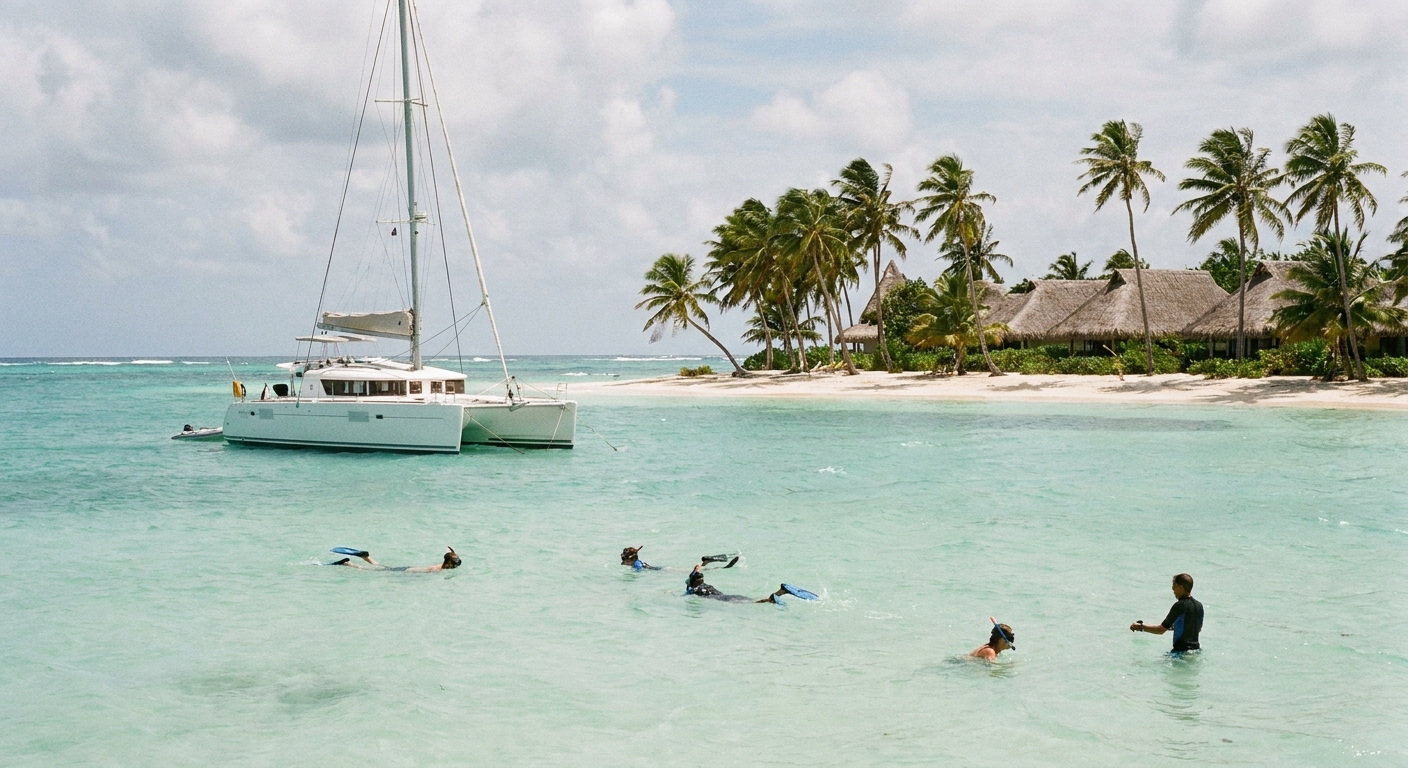
Of the three high-summer months, July is the last one before wet days reach double figures: 9.3 here against 11.1 in August. Put that beside 85.2°F water and the month’s particular use becomes the boat day. Catamarans, reef snorkeling and the Saona crossings all want a full daylight window, and July hands over 13 hours 10 minutes of it on the 15th.
Playa Bávaro and Playa Macao are the two east-facing stretches under that grid cell, and they meet the wind first. Hoyo Azul, the cenote pool at the foot of a cliff inside Scape Park, sits inland and in shade. Indigenous Eyes Ecological Park keeps a chain of freshwater lagoons within the resort strip. Isla Saona boats leave from Bayahibe on the south coast, the sheltered side our climate cell does not describe. Admission prices and opening hours are not in our source set, so none is printed here: check each operator before you go.
Spring-fed, cliff-shaded water changes very little across a year, while the air around it swings. In July that air averages 83.6°F and never settles below 78.7°F at night, so the inland pools read cold on the first step in, in a way they never do in a cooler month, and the shade along the cenote path is worth nearly as much as the swim. On the sand the arithmetic runs the other way: at 85.2°F the sea is the warm option.
No free-admission day and no municipal program for July shows up in our sources, so nothing here promises one. What costs nothing is the light. With sunset at 7:14 pm, the hour on the beach between six and seven is the easiest walking hour of the day, and the same 13-hour window covers a full morning of swimming before a single ticket gets bought.
Punta Cana in July: a two-day itinerary
Day one runs on the light. Sunrise at 6:04 am makes the beach usable by half past six and genuinely pleasant until about ten, so swim first and eat breakfast second. Give eleven to three to shade, a lagoon at Indigenous Eyes or a long lunch, because that block is what the 83.6°F average high actually describes. Back in the water at four, then dinner timed so the walk home falls after the 7:14 pm sunset, with the air finally heading down toward its 78.7°F floor.
Day two takes the boat: a Saona crossing from Bayahibe or a reef snorkel, booked for a morning departure so the return lands well inside the 13-hour window. If the sky turns, the plan shuffles instead of collapsing. Move the boat to day three where the operator allows it, spend the wet hour at Hoyo Azul, where you were getting wet anyway, and keep the beach for the clearing. With 3.74 inches across the whole month, a July wet day is more often an interruption than a lost day.
Punta Cana in July vs June and August
| Measure | June | July | August |
|---|---|---|---|
| Average high | 83.4°F | 83.6°F | 84.1°F |
| Average low | 78.3°F | 78.7°F | 78.9°F |
| Precipitation | 2.94 in | 3.74 in | 4.33 in |
| Days with 0.10 in or more | 8.2 | 9.3 | 11.1 |
| Sea surface, daily maxima | 84.9°F | 85.2°F | 85.5°F |
Air temperature barely separates the three: 0.7°F between June’s 83.4°F high and August’s 84.1°F, and 0.6°F on the lows. Rain does all the separating. June averages 2.94 inches over 8.2 wet days, July 3.74 inches over 9.3, August 4.33 inches over 11.1, so the walk from early summer to late summer adds nearly three wet days to a month. The sea moves least of anything, 84.9°F to 85.5°F across ten weeks.
Shift four weeks earlier and you gain 1.1 dry days and give up three tenths of a degree of sea warmth, a trade nobody feels in the water and most people notice on the beach: Punta Cana in June has that month in full. Shift four weeks later and you take on 1.8 extra wet days for a sea that is 0.3°F warmer, the poorest exchange in this table. The air normals in all three columns come from the same ERA5 series and the same 1991-2020 period, and the sea figures from the marine API.
Is July a good time to visit Punta Cana?
Yes for anyone whose main verb is swimming. Water at 85.2°F, nights that hold near 78.7°F and 13 hours of light make a strong package for families and for anyone who wants sea time rather than trail time. It works badly for a short, rigid trip: three nights inside a month of 9.3 wet days is a real chance of losing the one boat morning you flew for, with no slack to move it.
If that risk decides it, take June: 8.2 wet days against 9.3, 2.94 inches against 3.74, and water only 0.3°F cooler, for weeks that fall before most school calendars open. The winter and spring months sit outside the data set we assembled, and the full year is laid out in our best time to visit Punta Cana guide.
What July holds that neither neighbor does is August’s water within three tenths of a degree, on June’s side of the rain line.
The last word
Book the room with covered outdoor space, put the boat on a morning, and stop budgeting worry for the rain: an average July records 0.3 of a day with an inch or more, roughly one July in three producing a single downpour worth rearranging around. The rest arrives in tenths and leaves. Spend the attention on the 6:04 am sunrise instead, because the two hours after it are the only stretch of a July day when the sand, the 85.2°F water and the shade all cooperate at once.
Sources & data for this guide
- July normals: high 83.6°F, low 78.7°F, 3.74 in, 9.3 days at 0.10 in or more, 0.3 day at 1 in or more · Open-Meteo / ECMWF ERA5, 1991-2020 normals for the grid cell at 18.5818N, -68.4043E · model reanalysis, not an airport station record · checked Sep 15, 2026
- June and August normals (83.4/78.3°F, 2.94 in, 8.2 days · 84.1/78.9°F, 4.33 in, 11.1 days) · same ERA5 series and period · checked Sep 15, 2026
- Sea surface 85.2°F in July, 84.9°F in June, 85.5°F in August, as the mean of daily maxima 2015-2024 · Open-Meteo Marine API · checked Sep 15, 2026
- Daylight and sun times for July 15 (13h 10m; 10:04 and 23:14 UTC, converted at UTC-4) · sunrise-sunset.org · checked Sep 15, 2026
- Editorial admission: this source set holds no occupancy data, no monthly room rates, no verified lodging tax and no storm-risk figure for Punta Cana, so none is quoted above. Attraction hours and prices change · check operators when you book.